


Key Insights
The UV Picosecond Pulse Laser market is poised for significant expansion, driven by its precision and unique capabilities across diverse high-tech sectors. With a projected market size of $2.83 billion in 2025, the industry is set to experience a robust CAGR of 15.2% during the forecast period of 2025-2033. This substantial growth is fueled by the increasing adoption of UV picosecond pulse lasers in advanced manufacturing, particularly in microelectronics, where their ability to perform delicate material processing with minimal thermal damage is invaluable. The demand for miniaturization and enhanced precision in electronic components, displays, and semiconductors directly translates into a stronger market for these specialized lasers. Furthermore, advancements in medical treatments, such as ophthalmic surgery and dermatological procedures requiring extreme accuracy and minimal collateral tissue disruption, are also playing a crucial role in driving market momentum. Scientific research, including spectroscopy and materials science, continues to be a key adopter, leveraging the laser's ability to probe and manipulate matter at a femtosecond level. The trend towards higher power outputs and shorter pulse durations within the picosecond range is enabling new applications and pushing the boundaries of what is achievable in these fields.
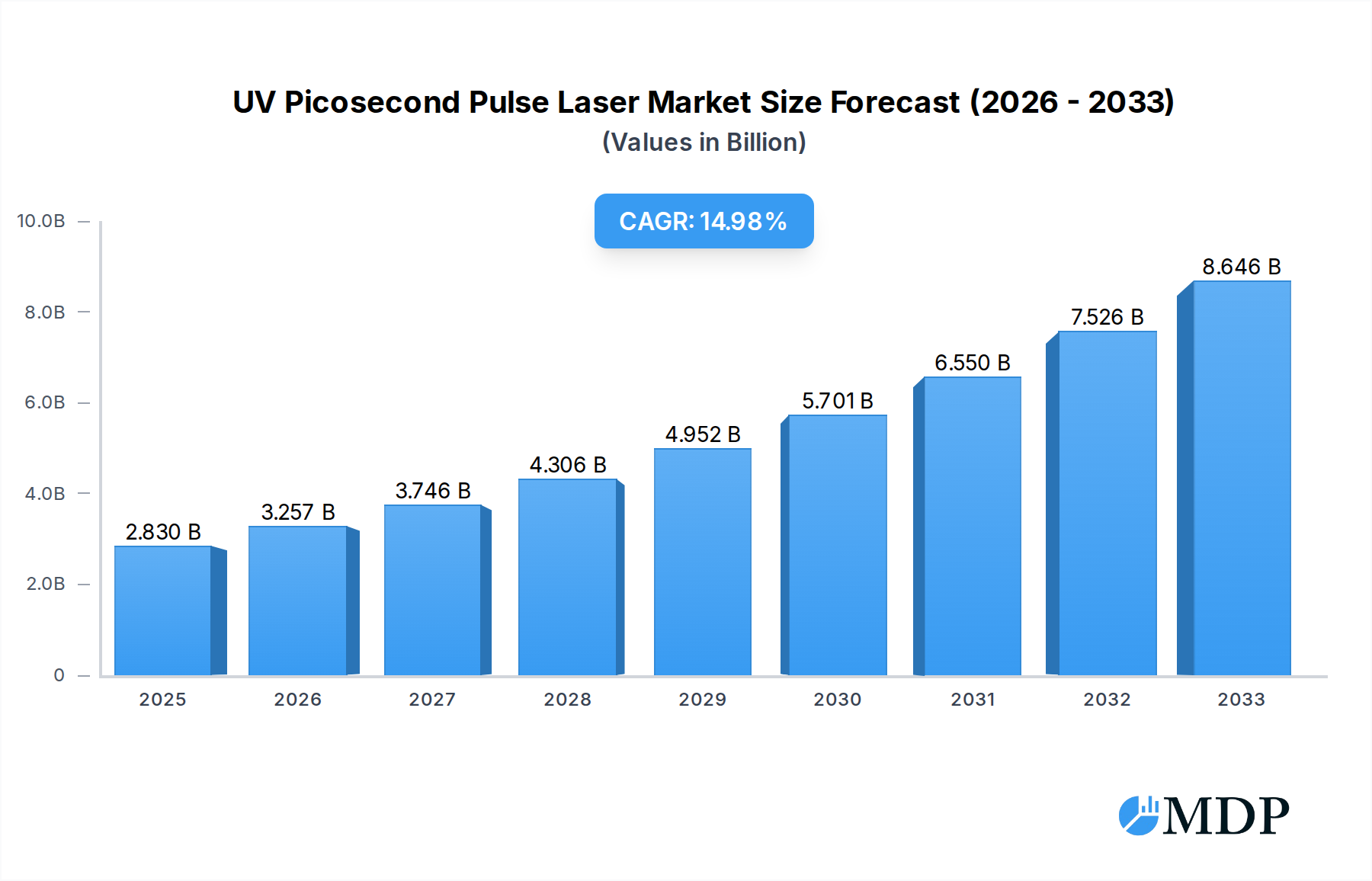
UV Picosecond Pulse Laser Market Size (In Billion)

While the market demonstrates strong upward trajectory, certain factors warrant attention. The high cost of these sophisticated laser systems can present a barrier to entry for smaller enterprises, although declining manufacturing costs and increasing economies of scale are gradually mitigating this. Supply chain complexities for specialized components and the need for highly skilled personnel for operation and maintenance also represent potential constraints. However, the inherent advantages of UV picosecond pulse lasers in achieving unprecedented precision, speed, and material quality in applications where conventional lasers fall short are expected to outweigh these challenges. The continuous innovation in laser design, including improvements in beam quality, pulse stability, and wavelength flexibility, alongside the expansion of applications into emerging areas like advanced material synthesis and quantum computing, are strong indicators of sustained market vitality and growth potential. The trend towards compact and more energy-efficient systems will further broaden their accessibility and adoption across a wider spectrum of industries.
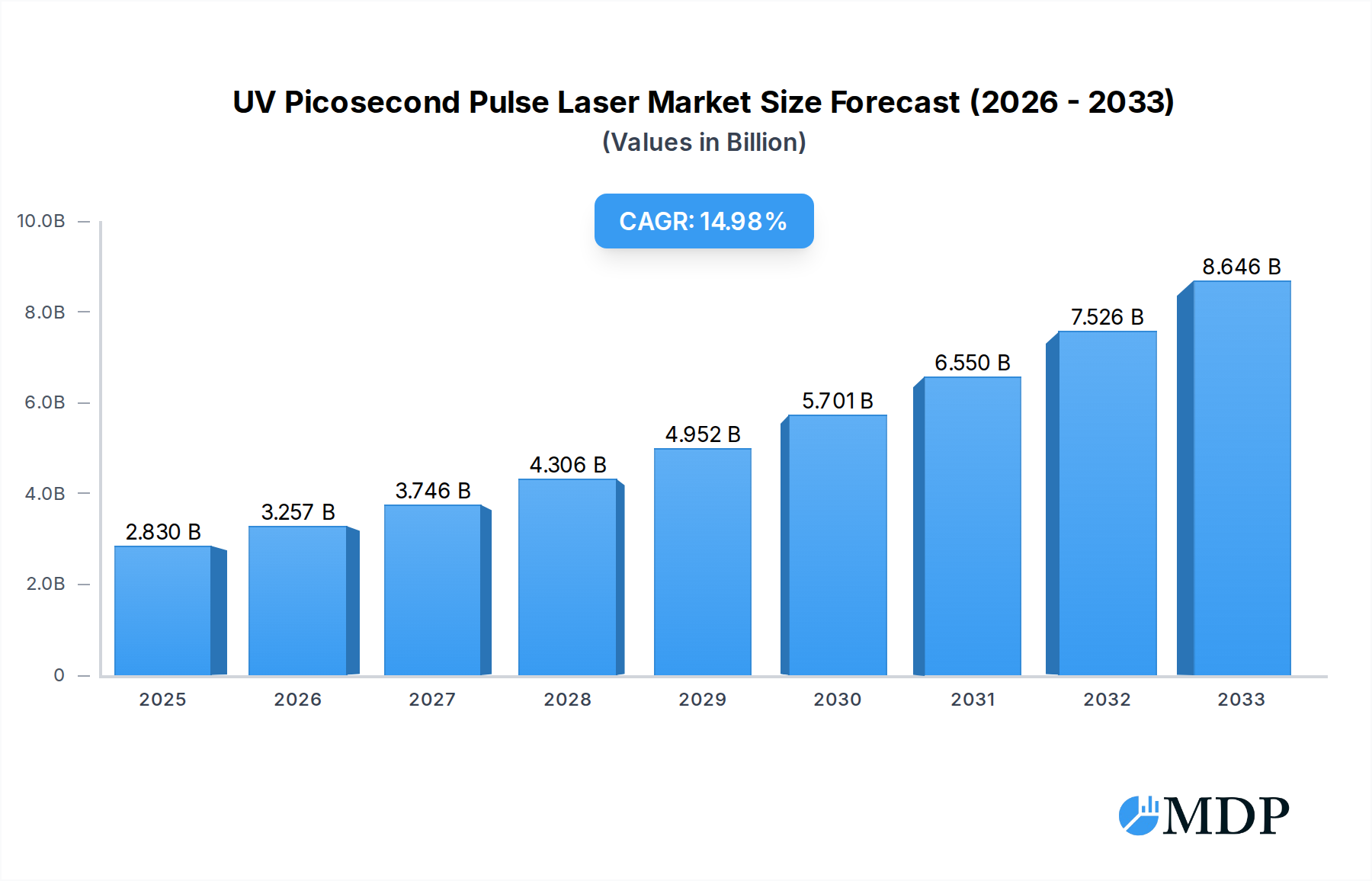
UV Picosecond Pulse Laser Company Market Share
This in-depth report offers a definitive analysis of the global UV Picosecond Pulse Laser market, providing critical insights for stakeholders looking to navigate its dynamic landscape. Covering a comprehensive study period from 2019 to 2033, with a base year of 2025, this report delves into market segmentation, technological advancements, competitive strategies, and future growth trajectories. Understand the core drivers, emerging opportunities, and challenges shaping this multi-billion dollar industry.
UV Picosecond Pulse Laser Market Dynamics & Concentration
The UV Picosecond Pulse Laser market is characterized by a moderate to high concentration, driven by specialized technological expertise and significant R&D investments. Key innovation drivers include the pursuit of higher pulse energies, shorter pulse durations, and enhanced beam quality, pushing the boundaries in precision material processing and scientific exploration. Regulatory frameworks, while generally supportive of technological advancement, primarily focus on safety standards and laser emission regulations, influencing product design and adoption rates. Product substitutes, such as nanosecond lasers and other laser wavelengths, present a competitive challenge, but the unique advantages of UV picosecond pulses, like minimal thermal damage and precise ablation, solidify their market position. End-user trends indicate a growing demand for these lasers in microelectronics manufacturing, advanced medical procedures, and cutting-edge scientific research, with an increasing preference for integrated solutions and user-friendly systems. Mergers and acquisitions (M&A) activities are moderate, signaling consolidation among key players seeking to expand their product portfolios, geographical reach, or technological capabilities. Estimated M&A deal counts are in the low hundreds over the forecast period. Market share is fragmented among a few dominant players and a significant number of niche manufacturers.
UV Picosecond Pulse Laser Industry Trends & Analysis
The UV Picosecond Pulse Laser industry is experiencing robust growth, propelled by a confluence of technological advancements and expanding application horizons. The compound annual growth rate (CAGR) is projected to be in the double digits, reflecting the increasing adoption of these high-precision lasers across various sectors. Market penetration is steadily rising, particularly in segments demanding ultra-fine processing and minimal collateral damage. A primary growth driver is the insatiable demand for miniaturization and precision in microelectronics manufacturing, where UV picosecond lasers are indispensable for intricate circuit board etching, semiconductor dicing, and display panel fabrication. In scientific research, these lasers are revolutionizing fields such as femtochemistry, high-harmonic generation, and advanced spectroscopy, enabling unprecedented insights into molecular dynamics and material properties. The medical sector is witnessing increased utilization for minimally invasive surgeries, precise tissue ablation, and advanced diagnostics. Technological disruptions, including advancements in laser architecture, pump sources, and nonlinear optical materials, are continuously pushing the limits of pulse energy and repetition rate, leading to more versatile and cost-effective solutions. Consumer preferences are shifting towards lasers offering higher reliability, longer operational lifetimes, and seamless integration with automated manufacturing and research platforms. Competitive dynamics are characterized by intense innovation, with leading companies investing heavily in R&D to develop next-generation products and maintain their market leadership. The competitive landscape features both established giants and agile startups vying for market share through technological superiority and strategic market positioning. The market size is estimated to reach hundreds of billions of dollars by the end of the forecast period.
Leading Markets & Segments in UV Picosecond Pulse Laser
The Optical Instrument segment is a dominant force within the UV Picosecond Pulse Laser market, driven by its critical role in advanced metrology, optical component manufacturing, and high-resolution imaging systems. Within this segment, key drivers include the escalating demand for ultra-precise optical coatings, lens fabrication, and the development of sophisticated optical sensors. Economic policies supporting advanced manufacturing and technological innovation further bolster its growth. The Scientific Research application is another significant segment, fueled by groundbreaking discoveries across physics, chemistry, and biology. Government funding for basic research, coupled with the inherent need for highly controlled and precise excitation sources, makes this segment a consistent growth engine. The development of new experimental techniques and the exploration of novel materials heavily rely on the capabilities offered by UV picosecond lasers.
In terms of laser types, the Below 250µj category exhibits substantial market penetration due to its widespread use in high-throughput manufacturing processes and delicate medical applications where precise energy delivery is paramount. The 250-600µj range is gaining traction in applications requiring higher ablation rates or deeper penetration, such as advanced material structuring and certain industrial cutting tasks. The Above 600µj segment, while currently a smaller portion of the market, holds immense potential for high-power industrial applications and cutting-edge scientific endeavors demanding extreme energy densities.
Geographically, North America and Europe currently lead the market, owing to their strong academic research infrastructure, advanced manufacturing capabilities, and substantial government investment in scientific and technological development. Countries like the United States and Germany are at the forefront, supported by robust economic policies and a highly skilled workforce. However, Asia-Pacific, particularly China, is emerging as a rapidly growing market, driven by its expanding manufacturing base, increasing investments in R&D, and a burgeoning demand for precision industrial equipment and advanced medical technologies. Government initiatives promoting technological self-sufficiency and innovation further accelerate growth in this region.
UV Picosecond Pulse Laser Product Developments
Recent product developments in the UV Picosecond Pulse Laser market are centered on enhancing pulse energy, improving beam quality, and achieving higher repetition rates, enabling more efficient and precise material processing. Innovations include the development of compact, all-solid-state laser systems, offering increased reliability and reduced operational costs. New applications are emerging in advanced semiconductor lithography, ultra-fine medical surgery, and the rapid prototyping of novel materials. Competitive advantages are being gained through superior laser stability, ease of integration into existing industrial automation, and tailored wavelength options for specific material interactions. These advancements are crucial for meeting the ever-increasing demands for precision and efficiency in high-tech industries.
Key Drivers of UV Picosecond Pulse Laser Growth
The growth of the UV Picosecond Pulse Laser market is propelled by several key drivers. Technologically, advancements in diode-pumped solid-state (DPSS) lasers and fiber laser technologies are enabling higher pulse energies and more precise control over pulse duration. Economically, the increasing demand for precision manufacturing in industries like electronics and medical devices, where micro-scale accuracy is critical, creates a substantial market pull. Regulatory factors, such as stricter quality control standards in healthcare and manufacturing, indirectly encourage the adoption of high-precision laser solutions. The continuous drive for miniaturization across consumer electronics and the need for advanced research tools further fuel this expansion.
Challenges in the UV Picosecond Pulse Laser Market
Despite its growth, the UV Picosecond Pulse Laser market faces several challenges. High initial capital investment for these advanced systems can be a barrier for smaller enterprises. Stringent regulatory compliance and safety standards, while necessary, can add to development and approval timelines. Supply chain complexities for specialized components and the need for skilled technicians for operation and maintenance also pose hurdles. Furthermore, intense competition from alternative laser technologies and ongoing R&D costs necessitate continuous innovation to maintain market share, impacting profitability for some players.
Emerging Opportunities in UV Picosecond Pulse Laser
Emerging opportunities in the UV Picosecond Pulse Laser market are significant and multifaceted. Technological breakthroughs in ultrafast laser science, such as the development of novel nonlinear optical crystals and advanced pulse shaping techniques, promise even greater precision and efficiency. Strategic partnerships between laser manufacturers and end-users in critical sectors like quantum computing and advanced materials discovery are creating new application frontiers. Market expansion strategies targeting underdeveloped geographical regions with growing industrial bases and increased investment in R&D represent further growth catalysts. The increasing application in biotech and pharmaceuticals for precise drug delivery and imaging also presents a burgeoning opportunity.
Leading Players in the UV Picosecond Pulse Laser Sector
- Coherent
- Trumpf
- IPG Photonics
- Lumentum
- Newport
- Laser Quantum
- Thorlabs
- MKS Instruments
- Photonics Industries International
- Passat
- PicoQuant
- Han's Laser
- Wuhan HGTECH
- Shenzhen JPT Opto-Electronics
- Wuhan Huaray Laser
- Shanghai Eachwave
- Suzhou Bellin Laser
- BWT Beijing
- Anhui Huachuang
Key Milestones in UV Picosecond Pulse Laser Industry
- 2019: Introduction of new generation UV picosecond lasers with significantly enhanced pulse energy for industrial applications.
- 2020: Key players announce strategic partnerships to develop integrated laser processing solutions for the microelectronics sector.
- 2021: Advancements in compact UV picosecond laser systems designed for medical imaging and diagnostics.
- 2022: Significant increase in M&A activity as larger companies acquire specialized UV picosecond laser startups.
- 2023: Breakthroughs in achieving ultra-short pulse durations and higher repetition rates, opening new research avenues.
- 2024: Launch of novel laser architectures enabling lower cost of ownership for industrial users.
Strategic Outlook for UV Picosecond Pulse Laser Market
The strategic outlook for the UV Picosecond Pulse Laser market remains exceptionally positive, driven by sustained innovation and expanding applications. Growth accelerators include the relentless pursuit of miniaturization in electronics, the increasing complexity of medical treatments, and the ever-present need for fundamental scientific discovery. Companies that focus on developing cost-effective, high-performance, and user-friendly UV picosecond laser systems, while also exploring novel applications in emerging fields, are poised for significant success. Strategic investments in R&D, coupled with agile market penetration strategies, will be crucial for capitalizing on the immense future potential of this rapidly evolving sector.
UV Picosecond Pulse Laser Segmentation
-
1. Application
- 1.1. Optical Instrument
- 1.2. Scientific Research
- 1.3. Medical Treatment
- 1.4. Other
-
2. Types
- 2.1. Below 250µj
- 2.2. 250-600µj
- 2.3. Above 600µj
UV Picosecond Pulse Laser Segmentation By Geography
-
1. North America
- 1.1. United States
- 1.2. Canada
- 1.3. Mexico
-
2. South America
- 2.1. Brazil
- 2.2. Argentina
- 2.3. Rest of South America
-
3. Europe
- 3.1. United Kingdom
- 3.2. Germany
- 3.3. France
- 3.4. Italy
- 3.5. Spain
- 3.6. Russia
- 3.7. Benelux
- 3.8. Nordics
- 3.9. Rest of Europe
-
4. Middle East & Africa
- 4.1. Turkey
- 4.2. Israel
- 4.3. GCC
- 4.4. North Africa
- 4.5. South Africa
- 4.6. Rest of Middle East & Africa
-
5. Asia Pacific
- 5.1. China
- 5.2. India
- 5.3. Japan
- 5.4. South Korea
- 5.5. ASEAN
- 5.6. Oceania
- 5.7. Rest of Asia Pacific
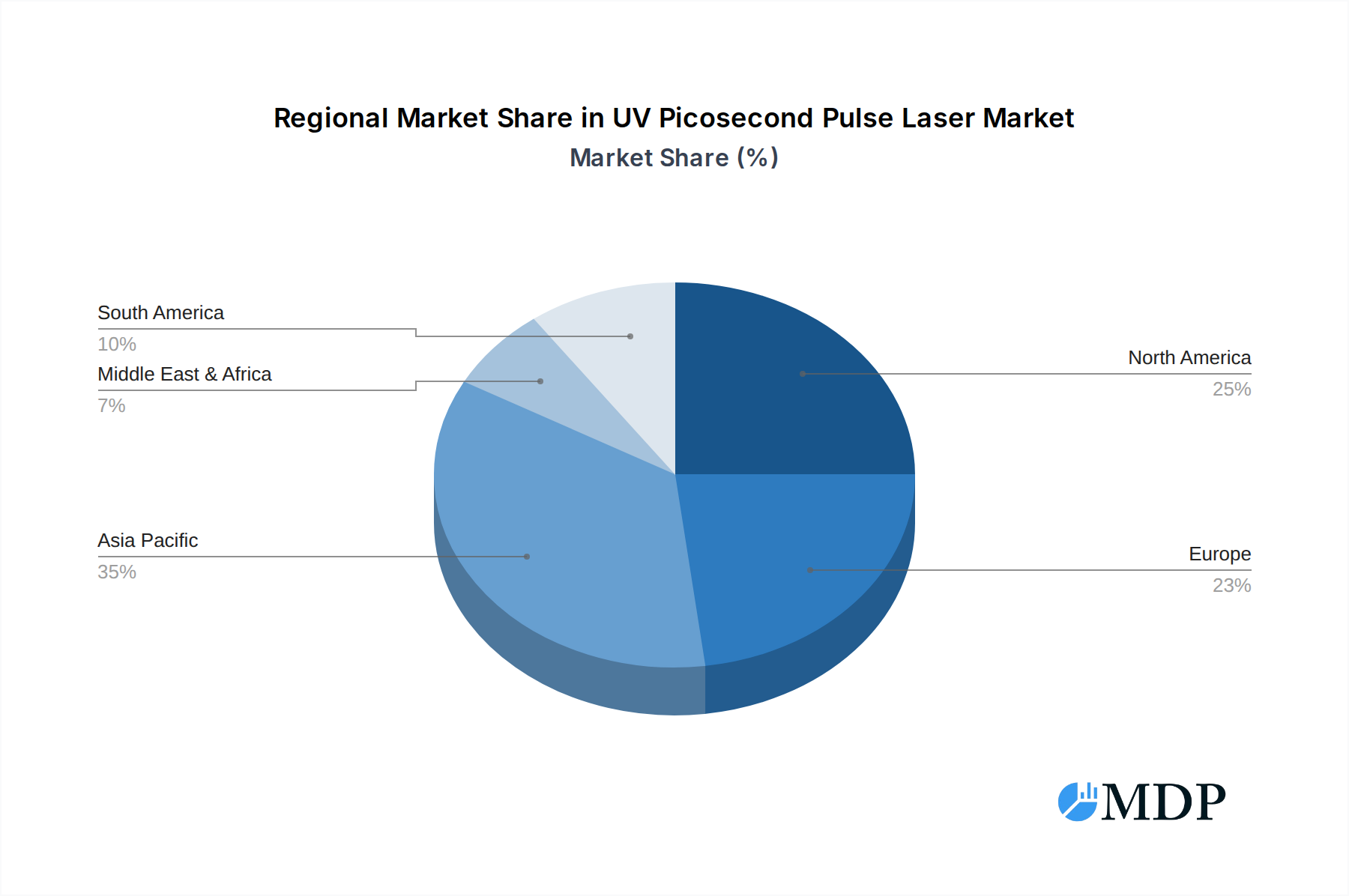
UV Picosecond Pulse Laser Regional Market Share
Geographic Coverage of UV Picosecond Pulse Laser
UV Picosecond Pulse Laser REPORT HIGHLIGHTS
| Aspects | Details |
|---|---|
| Study Period | 2020-2034 |
| Base Year | 2025 |
| Estimated Year | 2026 |
| Forecast Period | 2026-2034 |
| Historical Period | 2020-2025 |
| Growth Rate | CAGR of 15.2% from 2020-2034 |
| Segmentation |
|
Table of Contents
- 1. Introduction
- 1.1. Research Scope
- 1.2. Market Segmentation
- 1.3. Research Methodology
- 1.4. Definitions and Assumptions
- 2. Executive Summary
- 2.1. Introduction
- 3. Market Dynamics
- 3.1. Introduction
- 3.2. Market Drivers
- 3.3. Market Restrains
- 3.4. Market Trends
- 4. Market Factor Analysis
- 4.1. Porters Five Forces
- 4.2. Supply/Value Chain
- 4.3. PESTEL analysis
- 4.4. Market Entropy
- 4.5. Patent/Trademark Analysis
- 5. Global UV Picosecond Pulse Laser Analysis, Insights and Forecast, 2020-2032
- 5.1. Market Analysis, Insights and Forecast - by Application
- 5.1.1. Optical Instrument
- 5.1.2. Scientific Research
- 5.1.3. Medical Treatment
- 5.1.4. Other
- 5.2. Market Analysis, Insights and Forecast - by Types
- 5.2.1. Below 250µj
- 5.2.2. 250-600µj
- 5.2.3. Above 600µj
- 5.3. Market Analysis, Insights and Forecast - by Region
- 5.3.1. North America
- 5.3.2. South America
- 5.3.3. Europe
- 5.3.4. Middle East & Africa
- 5.3.5. Asia Pacific
- 5.1. Market Analysis, Insights and Forecast - by Application
- 6. North America UV Picosecond Pulse Laser Analysis, Insights and Forecast, 2020-2032
- 6.1. Market Analysis, Insights and Forecast - by Application
- 6.1.1. Optical Instrument
- 6.1.2. Scientific Research
- 6.1.3. Medical Treatment
- 6.1.4. Other
- 6.2. Market Analysis, Insights and Forecast - by Types
- 6.2.1. Below 250µj
- 6.2.2. 250-600µj
- 6.2.3. Above 600µj
- 6.1. Market Analysis, Insights and Forecast - by Application
- 7. South America UV Picosecond Pulse Laser Analysis, Insights and Forecast, 2020-2032
- 7.1. Market Analysis, Insights and Forecast - by Application
- 7.1.1. Optical Instrument
- 7.1.2. Scientific Research
- 7.1.3. Medical Treatment
- 7.1.4. Other
- 7.2. Market Analysis, Insights and Forecast - by Types
- 7.2.1. Below 250µj
- 7.2.2. 250-600µj
- 7.2.3. Above 600µj
- 7.1. Market Analysis, Insights and Forecast - by Application
- 8. Europe UV Picosecond Pulse Laser Analysis, Insights and Forecast, 2020-2032
- 8.1. Market Analysis, Insights and Forecast - by Application
- 8.1.1. Optical Instrument
- 8.1.2. Scientific Research
- 8.1.3. Medical Treatment
- 8.1.4. Other
- 8.2. Market Analysis, Insights and Forecast - by Types
- 8.2.1. Below 250µj
- 8.2.2. 250-600µj
- 8.2.3. Above 600µj
- 8.1. Market Analysis, Insights and Forecast - by Application
- 9. Middle East & Africa UV Picosecond Pulse Laser Analysis, Insights and Forecast, 2020-2032
- 9.1. Market Analysis, Insights and Forecast - by Application
- 9.1.1. Optical Instrument
- 9.1.2. Scientific Research
- 9.1.3. Medical Treatment
- 9.1.4. Other
- 9.2. Market Analysis, Insights and Forecast - by Types
- 9.2.1. Below 250µj
- 9.2.2. 250-600µj
- 9.2.3. Above 600µj
- 9.1. Market Analysis, Insights and Forecast - by Application
- 10. Asia Pacific UV Picosecond Pulse Laser Analysis, Insights and Forecast, 2020-2032
- 10.1. Market Analysis, Insights and Forecast - by Application
- 10.1.1. Optical Instrument
- 10.1.2. Scientific Research
- 10.1.3. Medical Treatment
- 10.1.4. Other
- 10.2. Market Analysis, Insights and Forecast - by Types
- 10.2.1. Below 250µj
- 10.2.2. 250-600µj
- 10.2.3. Above 600µj
- 10.1. Market Analysis, Insights and Forecast - by Application
- 11. Competitive Analysis
- 11.1. Global Market Share Analysis 2025
- 11.2. Company Profiles
- 11.2.1 Coherent
- 11.2.1.1. Overview
- 11.2.1.2. Products
- 11.2.1.3. SWOT Analysis
- 11.2.1.4. Recent Developments
- 11.2.1.5. Financials (Based on Availability)
- 11.2.2 Trumpf
- 11.2.2.1. Overview
- 11.2.2.2. Products
- 11.2.2.3. SWOT Analysis
- 11.2.2.4. Recent Developments
- 11.2.2.5. Financials (Based on Availability)
- 11.2.3 IPG Photonics
- 11.2.3.1. Overview
- 11.2.3.2. Products
- 11.2.3.3. SWOT Analysis
- 11.2.3.4. Recent Developments
- 11.2.3.5. Financials (Based on Availability)
- 11.2.4 Lumentum
- 11.2.4.1. Overview
- 11.2.4.2. Products
- 11.2.4.3. SWOT Analysis
- 11.2.4.4. Recent Developments
- 11.2.4.5. Financials (Based on Availability)
- 11.2.5 Newport
- 11.2.5.1. Overview
- 11.2.5.2. Products
- 11.2.5.3. SWOT Analysis
- 11.2.5.4. Recent Developments
- 11.2.5.5. Financials (Based on Availability)
- 11.2.6 Laser Quantum
- 11.2.6.1. Overview
- 11.2.6.2. Products
- 11.2.6.3. SWOT Analysis
- 11.2.6.4. Recent Developments
- 11.2.6.5. Financials (Based on Availability)
- 11.2.7 Thorlabs
- 11.2.7.1. Overview
- 11.2.7.2. Products
- 11.2.7.3. SWOT Analysis
- 11.2.7.4. Recent Developments
- 11.2.7.5. Financials (Based on Availability)
- 11.2.8 MKS Instruments
- 11.2.8.1. Overview
- 11.2.8.2. Products
- 11.2.8.3. SWOT Analysis
- 11.2.8.4. Recent Developments
- 11.2.8.5. Financials (Based on Availability)
- 11.2.9 Photonics Industries International
- 11.2.9.1. Overview
- 11.2.9.2. Products
- 11.2.9.3. SWOT Analysis
- 11.2.9.4. Recent Developments
- 11.2.9.5. Financials (Based on Availability)
- 11.2.10 Passat
- 11.2.10.1. Overview
- 11.2.10.2. Products
- 11.2.10.3. SWOT Analysis
- 11.2.10.4. Recent Developments
- 11.2.10.5. Financials (Based on Availability)
- 11.2.11 PicoQuant
- 11.2.11.1. Overview
- 11.2.11.2. Products
- 11.2.11.3. SWOT Analysis
- 11.2.11.4. Recent Developments
- 11.2.11.5. Financials (Based on Availability)
- 11.2.12 Han's Laser
- 11.2.12.1. Overview
- 11.2.12.2. Products
- 11.2.12.3. SWOT Analysis
- 11.2.12.4. Recent Developments
- 11.2.12.5. Financials (Based on Availability)
- 11.2.13 Wuhan HGTECH
- 11.2.13.1. Overview
- 11.2.13.2. Products
- 11.2.13.3. SWOT Analysis
- 11.2.13.4. Recent Developments
- 11.2.13.5. Financials (Based on Availability)
- 11.2.14 Shenzhen JPT Opto-Electronics
- 11.2.14.1. Overview
- 11.2.14.2. Products
- 11.2.14.3. SWOT Analysis
- 11.2.14.4. Recent Developments
- 11.2.14.5. Financials (Based on Availability)
- 11.2.15 Wuhan Huaray Laser
- 11.2.15.1. Overview
- 11.2.15.2. Products
- 11.2.15.3. SWOT Analysis
- 11.2.15.4. Recent Developments
- 11.2.15.5. Financials (Based on Availability)
- 11.2.16 Shanghai Eachwave
- 11.2.16.1. Overview
- 11.2.16.2. Products
- 11.2.16.3. SWOT Analysis
- 11.2.16.4. Recent Developments
- 11.2.16.5. Financials (Based on Availability)
- 11.2.17 Suzhou Bellin Laser
- 11.2.17.1. Overview
- 11.2.17.2. Products
- 11.2.17.3. SWOT Analysis
- 11.2.17.4. Recent Developments
- 11.2.17.5. Financials (Based on Availability)
- 11.2.18 BWT Beijing
- 11.2.18.1. Overview
- 11.2.18.2. Products
- 11.2.18.3. SWOT Analysis
- 11.2.18.4. Recent Developments
- 11.2.18.5. Financials (Based on Availability)
- 11.2.19 Anhui Huachuang
- 11.2.19.1. Overview
- 11.2.19.2. Products
- 11.2.19.3. SWOT Analysis
- 11.2.19.4. Recent Developments
- 11.2.19.5. Financials (Based on Availability)
- 11.2.1 Coherent
List of Figures
- Figure 1: Global UV Picosecond Pulse Laser Revenue Breakdown (undefined, %) by Region 2025 & 2033
- Figure 2: Global UV Picosecond Pulse Laser Volume Breakdown (K, %) by Region 2025 & 2033
- Figure 3: North America UV Picosecond Pulse Laser Revenue (undefined), by Application 2025 & 2033
- Figure 4: North America UV Picosecond Pulse Laser Volume (K), by Application 2025 & 2033
- Figure 5: North America UV Picosecond Pulse Laser Revenue Share (%), by Application 2025 & 2033
- Figure 6: North America UV Picosecond Pulse Laser Volume Share (%), by Application 2025 & 2033
- Figure 7: North America UV Picosecond Pulse Laser Revenue (undefined), by Types 2025 & 2033
- Figure 8: North America UV Picosecond Pulse Laser Volume (K), by Types 2025 & 2033
- Figure 9: North America UV Picosecond Pulse Laser Revenue Share (%), by Types 2025 & 2033
- Figure 10: North America UV Picosecond Pulse Laser Volume Share (%), by Types 2025 & 2033
- Figure 11: North America UV Picosecond Pulse Laser Revenue (undefined), by Country 2025 & 2033
- Figure 12: North America UV Picosecond Pulse Laser Volume (K), by Country 2025 & 2033
- Figure 13: North America UV Picosecond Pulse Laser Revenue Share (%), by Country 2025 & 2033
- Figure 14: North America UV Picosecond Pulse Laser Volume Share (%), by Country 2025 & 2033
- Figure 15: South America UV Picosecond Pulse Laser Revenue (undefined), by Application 2025 & 2033
- Figure 16: South America UV Picosecond Pulse Laser Volume (K), by Application 2025 & 2033
- Figure 17: South America UV Picosecond Pulse Laser Revenue Share (%), by Application 2025 & 2033
- Figure 18: South America UV Picosecond Pulse Laser Volume Share (%), by Application 2025 & 2033
- Figure 19: South America UV Picosecond Pulse Laser Revenue (undefined), by Types 2025 & 2033
- Figure 20: South America UV Picosecond Pulse Laser Volume (K), by Types 2025 & 2033
- Figure 21: South America UV Picosecond Pulse Laser Revenue Share (%), by Types 2025 & 2033
- Figure 22: South America UV Picosecond Pulse Laser Volume Share (%), by Types 2025 & 2033
- Figure 23: South America UV Picosecond Pulse Laser Revenue (undefined), by Country 2025 & 2033
- Figure 24: South America UV Picosecond Pulse Laser Volume (K), by Country 2025 & 2033
- Figure 25: South America UV Picosecond Pulse Laser Revenue Share (%), by Country 2025 & 2033
- Figure 26: South America UV Picosecond Pulse Laser Volume Share (%), by Country 2025 & 2033
- Figure 27: Europe UV Picosecond Pulse Laser Revenue (undefined), by Application 2025 & 2033
- Figure 28: Europe UV Picosecond Pulse Laser Volume (K), by Application 2025 & 2033
- Figure 29: Europe UV Picosecond Pulse Laser Revenue Share (%), by Application 2025 & 2033
- Figure 30: Europe UV Picosecond Pulse Laser Volume Share (%), by Application 2025 & 2033
- Figure 31: Europe UV Picosecond Pulse Laser Revenue (undefined), by Types 2025 & 2033
- Figure 32: Europe UV Picosecond Pulse Laser Volume (K), by Types 2025 & 2033
- Figure 33: Europe UV Picosecond Pulse Laser Revenue Share (%), by Types 2025 & 2033
- Figure 34: Europe UV Picosecond Pulse Laser Volume Share (%), by Types 2025 & 2033
- Figure 35: Europe UV Picosecond Pulse Laser Revenue (undefined), by Country 2025 & 2033
- Figure 36: Europe UV Picosecond Pulse Laser Volume (K), by Country 2025 & 2033
- Figure 37: Europe UV Picosecond Pulse Laser Revenue Share (%), by Country 2025 & 2033
- Figure 38: Europe UV Picosecond Pulse Laser Volume Share (%), by Country 2025 & 2033
- Figure 39: Middle East & Africa UV Picosecond Pulse Laser Revenue (undefined), by Application 2025 & 2033
- Figure 40: Middle East & Africa UV Picosecond Pulse Laser Volume (K), by Application 2025 & 2033
- Figure 41: Middle East & Africa UV Picosecond Pulse Laser Revenue Share (%), by Application 2025 & 2033
- Figure 42: Middle East & Africa UV Picosecond Pulse Laser Volume Share (%), by Application 2025 & 2033
- Figure 43: Middle East & Africa UV Picosecond Pulse Laser Revenue (undefined), by Types 2025 & 2033
- Figure 44: Middle East & Africa UV Picosecond Pulse Laser Volume (K), by Types 2025 & 2033
- Figure 45: Middle East & Africa UV Picosecond Pulse Laser Revenue Share (%), by Types 2025 & 2033
- Figure 46: Middle East & Africa UV Picosecond Pulse Laser Volume Share (%), by Types 2025 & 2033
- Figure 47: Middle East & Africa UV Picosecond Pulse Laser Revenue (undefined), by Country 2025 & 2033
- Figure 48: Middle East & Africa UV Picosecond Pulse Laser Volume (K), by Country 2025 & 2033
- Figure 49: Middle East & Africa UV Picosecond Pulse Laser Revenue Share (%), by Country 2025 & 2033
- Figure 50: Middle East & Africa UV Picosecond Pulse Laser Volume Share (%), by Country 2025 & 2033
- Figure 51: Asia Pacific UV Picosecond Pulse Laser Revenue (undefined), by Application 2025 & 2033
- Figure 52: Asia Pacific UV Picosecond Pulse Laser Volume (K), by Application 2025 & 2033
- Figure 53: Asia Pacific UV Picosecond Pulse Laser Revenue Share (%), by Application 2025 & 2033
- Figure 54: Asia Pacific UV Picosecond Pulse Laser Volume Share (%), by Application 2025 & 2033
- Figure 55: Asia Pacific UV Picosecond Pulse Laser Revenue (undefined), by Types 2025 & 2033
- Figure 56: Asia Pacific UV Picosecond Pulse Laser Volume (K), by Types 2025 & 2033
- Figure 57: Asia Pacific UV Picosecond Pulse Laser Revenue Share (%), by Types 2025 & 2033
- Figure 58: Asia Pacific UV Picosecond Pulse Laser Volume Share (%), by Types 2025 & 2033
- Figure 59: Asia Pacific UV Picosecond Pulse Laser Revenue (undefined), by Country 2025 & 2033
- Figure 60: Asia Pacific UV Picosecond Pulse Laser Volume (K), by Country 2025 & 2033
- Figure 61: Asia Pacific UV Picosecond Pulse Laser Revenue Share (%), by Country 2025 & 2033
- Figure 62: Asia Pacific UV Picosecond Pulse Laser Volume Share (%), by Country 2025 & 2033
List of Tables
- Table 1: Global UV Picosecond Pulse Laser Revenue undefined Forecast, by Application 2020 & 2033
- Table 2: Global UV Picosecond Pulse Laser Volume K Forecast, by Application 2020 & 2033
- Table 3: Global UV Picosecond Pulse Laser Revenue undefined Forecast, by Types 2020 & 2033
- Table 4: Global UV Picosecond Pulse Laser Volume K Forecast, by Types 2020 & 2033
- Table 5: Global UV Picosecond Pulse Laser Revenue undefined Forecast, by Region 2020 & 2033
- Table 6: Global UV Picosecond Pulse Laser Volume K Forecast, by Region 2020 & 2033
- Table 7: Global UV Picosecond Pulse Laser Revenue undefined Forecast, by Application 2020 & 2033
- Table 8: Global UV Picosecond Pulse Laser Volume K Forecast, by Application 2020 & 2033
- Table 9: Global UV Picosecond Pulse Laser Revenue undefined Forecast, by Types 2020 & 2033
- Table 10: Global UV Picosecond Pulse Laser Volume K Forecast, by Types 2020 & 2033
- Table 11: Global UV Picosecond Pulse Laser Revenue undefined Forecast, by Country 2020 & 2033
- Table 12: Global UV Picosecond Pulse Laser Volume K Forecast, by Country 2020 & 2033
- Table 13: United States UV Picosecond Pulse Laser Revenue (undefined) Forecast, by Application 2020 & 2033
- Table 14: United States UV Picosecond Pulse Laser Volume (K) Forecast, by Application 2020 & 2033
- Table 15: Canada UV Picosecond Pulse Laser Revenue (undefined) Forecast, by Application 2020 & 2033
- Table 16: Canada UV Picosecond Pulse Laser Volume (K) Forecast, by Application 2020 & 2033
- Table 17: Mexico UV Picosecond Pulse Laser Revenue (undefined) Forecast, by Application 2020 & 2033
- Table 18: Mexico UV Picosecond Pulse Laser Volume (K) Forecast, by Application 2020 & 2033
- Table 19: Global UV Picosecond Pulse Laser Revenue undefined Forecast, by Application 2020 & 2033
- Table 20: Global UV Picosecond Pulse Laser Volume K Forecast, by Application 2020 & 2033
- Table 21: Global UV Picosecond Pulse Laser Revenue undefined Forecast, by Types 2020 & 2033
- Table 22: Global UV Picosecond Pulse Laser Volume K Forecast, by Types 2020 & 2033
- Table 23: Global UV Picosecond Pulse Laser Revenue undefined Forecast, by Country 2020 & 2033
- Table 24: Global UV Picosecond Pulse Laser Volume K Forecast, by Country 2020 & 2033
- Table 25: Brazil UV Picosecond Pulse Laser Revenue (undefined) Forecast, by Application 2020 & 2033
- Table 26: Brazil UV Picosecond Pulse Laser Volume (K) Forecast, by Application 2020 & 2033
- Table 27: Argentina UV Picosecond Pulse Laser Revenue (undefined) Forecast, by Application 2020 & 2033
- Table 28: Argentina UV Picosecond Pulse Laser Volume (K) Forecast, by Application 2020 & 2033
- Table 29: Rest of South America UV Picosecond Pulse Laser Revenue (undefined) Forecast, by Application 2020 & 2033
- Table 30: Rest of South America UV Picosecond Pulse Laser Volume (K) Forecast, by Application 2020 & 2033
- Table 31: Global UV Picosecond Pulse Laser Revenue undefined Forecast, by Application 2020 & 2033
- Table 32: Global UV Picosecond Pulse Laser Volume K Forecast, by Application 2020 & 2033
- Table 33: Global UV Picosecond Pulse Laser Revenue undefined Forecast, by Types 2020 & 2033
- Table 34: Global UV Picosecond Pulse Laser Volume K Forecast, by Types 2020 & 2033
- Table 35: Global UV Picosecond Pulse Laser Revenue undefined Forecast, by Country 2020 & 2033
- Table 36: Global UV Picosecond Pulse Laser Volume K Forecast, by Country 2020 & 2033
- Table 37: United Kingdom UV Picosecond Pulse Laser Revenue (undefined) Forecast, by Application 2020 & 2033
- Table 38: United Kingdom UV Picosecond Pulse Laser Volume (K) Forecast, by Application 2020 & 2033
- Table 39: Germany UV Picosecond Pulse Laser Revenue (undefined) Forecast, by Application 2020 & 2033
- Table 40: Germany UV Picosecond Pulse Laser Volume (K) Forecast, by Application 2020 & 2033
- Table 41: France UV Picosecond Pulse Laser Revenue (undefined) Forecast, by Application 2020 & 2033
- Table 42: France UV Picosecond Pulse Laser Volume (K) Forecast, by Application 2020 & 2033
- Table 43: Italy UV Picosecond Pulse Laser Revenue (undefined) Forecast, by Application 2020 & 2033
- Table 44: Italy UV Picosecond Pulse Laser Volume (K) Forecast, by Application 2020 & 2033
- Table 45: Spain UV Picosecond Pulse Laser Revenue (undefined) Forecast, by Application 2020 & 2033
- Table 46: Spain UV Picosecond Pulse Laser Volume (K) Forecast, by Application 2020 & 2033
- Table 47: Russia UV Picosecond Pulse Laser Revenue (undefined) Forecast, by Application 2020 & 2033
- Table 48: Russia UV Picosecond Pulse Laser Volume (K) Forecast, by Application 2020 & 2033
- Table 49: Benelux UV Picosecond Pulse Laser Revenue (undefined) Forecast, by Application 2020 & 2033
- Table 50: Benelux UV Picosecond Pulse Laser Volume (K) Forecast, by Application 2020 & 2033
- Table 51: Nordics UV Picosecond Pulse Laser Revenue (undefined) Forecast, by Application 2020 & 2033
- Table 52: Nordics UV Picosecond Pulse Laser Volume (K) Forecast, by Application 2020 & 2033
- Table 53: Rest of Europe UV Picosecond Pulse Laser Revenue (undefined) Forecast, by Application 2020 & 2033
- Table 54: Rest of Europe UV Picosecond Pulse Laser Volume (K) Forecast, by Application 2020 & 2033
- Table 55: Global UV Picosecond Pulse Laser Revenue undefined Forecast, by Application 2020 & 2033
- Table 56: Global UV Picosecond Pulse Laser Volume K Forecast, by Application 2020 & 2033
- Table 57: Global UV Picosecond Pulse Laser Revenue undefined Forecast, by Types 2020 & 2033
- Table 58: Global UV Picosecond Pulse Laser Volume K Forecast, by Types 2020 & 2033
- Table 59: Global UV Picosecond Pulse Laser Revenue undefined Forecast, by Country 2020 & 2033
- Table 60: Global UV Picosecond Pulse Laser Volume K Forecast, by Country 2020 & 2033
- Table 61: Turkey UV Picosecond Pulse Laser Revenue (undefined) Forecast, by Application 2020 & 2033
- Table 62: Turkey UV Picosecond Pulse Laser Volume (K) Forecast, by Application 2020 & 2033
- Table 63: Israel UV Picosecond Pulse Laser Revenue (undefined) Forecast, by Application 2020 & 2033
- Table 64: Israel UV Picosecond Pulse Laser Volume (K) Forecast, by Application 2020 & 2033
- Table 65: GCC UV Picosecond Pulse Laser Revenue (undefined) Forecast, by Application 2020 & 2033
- Table 66: GCC UV Picosecond Pulse Laser Volume (K) Forecast, by Application 2020 & 2033
- Table 67: North Africa UV Picosecond Pulse Laser Revenue (undefined) Forecast, by Application 2020 & 2033
- Table 68: North Africa UV Picosecond Pulse Laser Volume (K) Forecast, by Application 2020 & 2033
- Table 69: South Africa UV Picosecond Pulse Laser Revenue (undefined) Forecast, by Application 2020 & 2033
- Table 70: South Africa UV Picosecond Pulse Laser Volume (K) Forecast, by Application 2020 & 2033
- Table 71: Rest of Middle East & Africa UV Picosecond Pulse Laser Revenue (undefined) Forecast, by Application 2020 & 2033
- Table 72: Rest of Middle East & Africa UV Picosecond Pulse Laser Volume (K) Forecast, by Application 2020 & 2033
- Table 73: Global UV Picosecond Pulse Laser Revenue undefined Forecast, by Application 2020 & 2033
- Table 74: Global UV Picosecond Pulse Laser Volume K Forecast, by Application 2020 & 2033
- Table 75: Global UV Picosecond Pulse Laser Revenue undefined Forecast, by Types 2020 & 2033
- Table 76: Global UV Picosecond Pulse Laser Volume K Forecast, by Types 2020 & 2033
- Table 77: Global UV Picosecond Pulse Laser Revenue undefined Forecast, by Country 2020 & 2033
- Table 78: Global UV Picosecond Pulse Laser Volume K Forecast, by Country 2020 & 2033
- Table 79: China UV Picosecond Pulse Laser Revenue (undefined) Forecast, by Application 2020 & 2033
- Table 80: China UV Picosecond Pulse Laser Volume (K) Forecast, by Application 2020 & 2033
- Table 81: India UV Picosecond Pulse Laser Revenue (undefined) Forecast, by Application 2020 & 2033
- Table 82: India UV Picosecond Pulse Laser Volume (K) Forecast, by Application 2020 & 2033
- Table 83: Japan UV Picosecond Pulse Laser Revenue (undefined) Forecast, by Application 2020 & 2033
- Table 84: Japan UV Picosecond Pulse Laser Volume (K) Forecast, by Application 2020 & 2033
- Table 85: South Korea UV Picosecond Pulse Laser Revenue (undefined) Forecast, by Application 2020 & 2033
- Table 86: South Korea UV Picosecond Pulse Laser Volume (K) Forecast, by Application 2020 & 2033
- Table 87: ASEAN UV Picosecond Pulse Laser Revenue (undefined) Forecast, by Application 2020 & 2033
- Table 88: ASEAN UV Picosecond Pulse Laser Volume (K) Forecast, by Application 2020 & 2033
- Table 89: Oceania UV Picosecond Pulse Laser Revenue (undefined) Forecast, by Application 2020 & 2033
- Table 90: Oceania UV Picosecond Pulse Laser Volume (K) Forecast, by Application 2020 & 2033
- Table 91: Rest of Asia Pacific UV Picosecond Pulse Laser Revenue (undefined) Forecast, by Application 2020 & 2033
- Table 92: Rest of Asia Pacific UV Picosecond Pulse Laser Volume (K) Forecast, by Application 2020 & 2033
Frequently Asked Questions
1. What is the projected Compound Annual Growth Rate (CAGR) of the UV Picosecond Pulse Laser?
The projected CAGR is approximately 15.2%.
2. Which companies are prominent players in the UV Picosecond Pulse Laser?
Key companies in the market include Coherent, Trumpf, IPG Photonics, Lumentum, Newport, Laser Quantum, Thorlabs, MKS Instruments, Photonics Industries International, Passat, PicoQuant, Han's Laser, Wuhan HGTECH, Shenzhen JPT Opto-Electronics, Wuhan Huaray Laser, Shanghai Eachwave, Suzhou Bellin Laser, BWT Beijing, Anhui Huachuang.
3. What are the main segments of the UV Picosecond Pulse Laser?
The market segments include Application, Types.
4. Can you provide details about the market size?
The market size is estimated to be USD XXX N/A as of 2022.
5. What are some drivers contributing to market growth?
N/A
6. What are the notable trends driving market growth?
N/A
7. Are there any restraints impacting market growth?
N/A
8. Can you provide examples of recent developments in the market?
N/A
9. What pricing options are available for accessing the report?
Pricing options include single-user, multi-user, and enterprise licenses priced at USD 3350.00, USD 5025.00, and USD 6700.00 respectively.
10. Is the market size provided in terms of value or volume?
The market size is provided in terms of value, measured in N/A and volume, measured in K.
11. Are there any specific market keywords associated with the report?
Yes, the market keyword associated with the report is "UV Picosecond Pulse Laser," which aids in identifying and referencing the specific market segment covered.
12. How do I determine which pricing option suits my needs best?
The pricing options vary based on user requirements and access needs. Individual users may opt for single-user licenses, while businesses requiring broader access may choose multi-user or enterprise licenses for cost-effective access to the report.
13. Are there any additional resources or data provided in the UV Picosecond Pulse Laser report?
While the report offers comprehensive insights, it's advisable to review the specific contents or supplementary materials provided to ascertain if additional resources or data are available.
14. How can I stay updated on further developments or reports in the UV Picosecond Pulse Laser?
To stay informed about further developments, trends, and reports in the UV Picosecond Pulse Laser, consider subscribing to industry newsletters, following relevant companies and organizations, or regularly checking reputable industry news sources and publications.
Methodology
Step 1 - Identification of Relevant Samples Size from Population Database



Step 2 - Approaches for Defining Global Market Size (Value, Volume* & Price*)

Note*: In applicable scenarios
Step 3 - Data Sources
Primary Research
- Web Analytics
- Survey Reports
- Research Institute
- Latest Research Reports
- Opinion Leaders
Secondary Research
- Annual Reports
- White Paper
- Latest Press Release
- Industry Association
- Paid Database
- Investor Presentations

Step 4 - Data Triangulation
Involves using different sources of information in order to increase the validity of a study
These sources are likely to be stakeholders in a program - participants, other researchers, program staff, other community members, and so on.
Then we put all data in single framework & apply various statistical tools to find out the dynamic on the market.
During the analysis stage, feedback from the stakeholder groups would be compared to determine areas of agreement as well as areas of divergence