


Key Insights
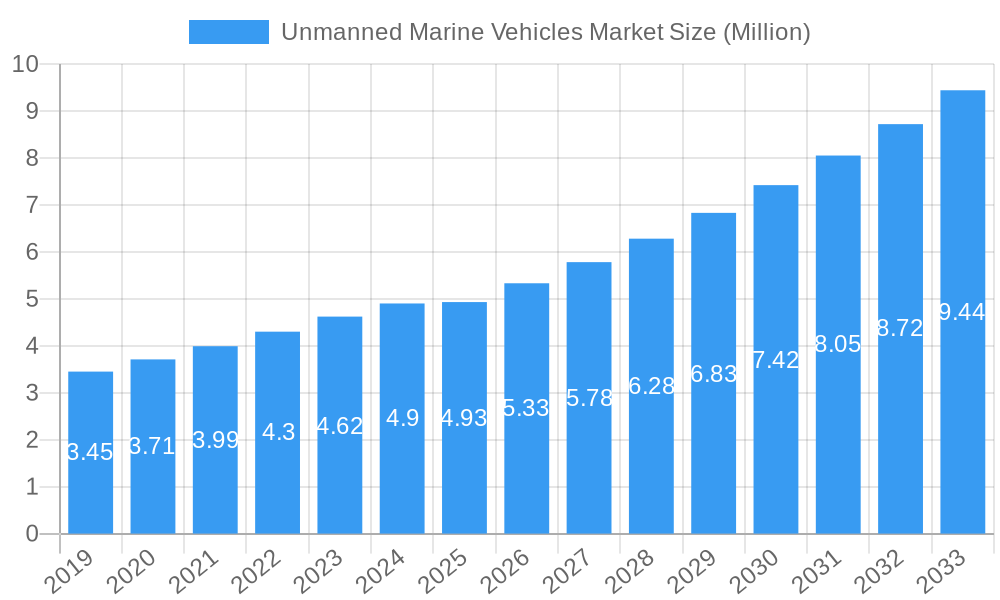
The Unmanned Marine Vehicles (UMV) Market is poised for significant expansion, projected to reach USD 4.93 billion in 2025 and grow at a robust Compound Annual Growth Rate (CAGR) of 8.51% through 2033. This surge is primarily driven by escalating defense spending worldwide, coupled with the increasing adoption of autonomous systems for maritime surveillance, mine countermeasures, and anti-submarine warfare. The growing emphasis on enhanced operational efficiency, reduced personnel risk, and cost-effectiveness in naval operations further fuels this market. Furthermore, advancements in sensor technology, AI-powered navigation, and communication systems are continuously improving UMV capabilities, making them indispensable tools for modern navies. The demand for sophisticated unmanned solutions for both surface and underwater applications is expected to remain strong, as governments and defense organizations prioritize technological superiority in their maritime security strategies.
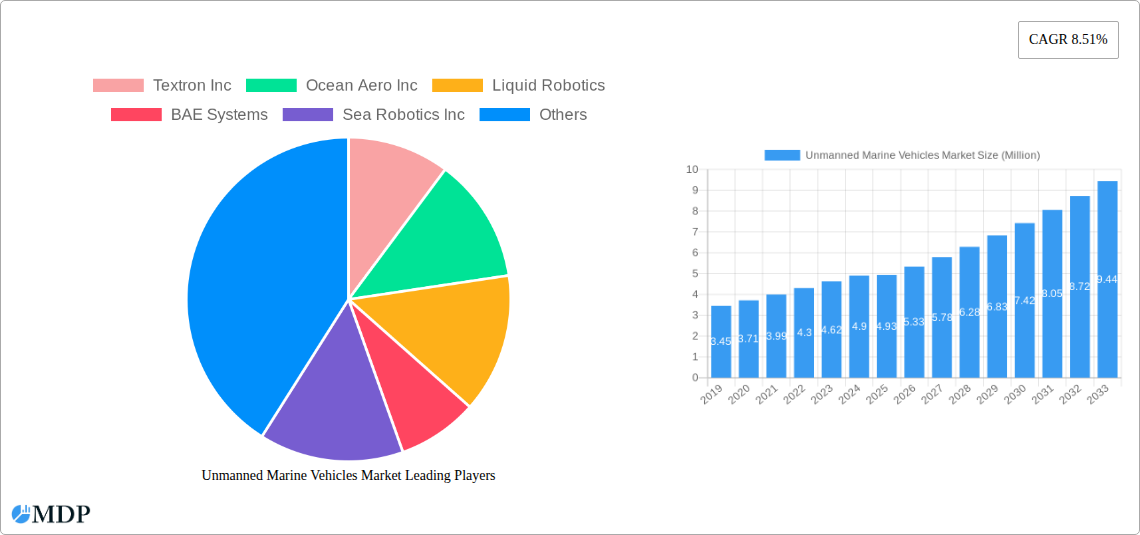
Unmanned Marine Vehicles Market Market Size (In Million)

Beyond defense, the UMV market is also witnessing substantial growth in research and commercial sectors. Marine research institutions are increasingly relying on UMVs for oceanographic studies, environmental monitoring, and data collection in challenging underwater environments. In the commercial realm, applications such as offshore infrastructure inspection, subsea cable laying and maintenance, and autonomous cargo delivery are gaining traction. This diversified application landscape, encompassing both surface and underwater vehicles with remotely operated and autonomous control types, underscores the broad utility and adaptability of UMV technology. Key players in this dynamic market are actively investing in research and development to introduce innovative solutions that cater to the evolving needs of these diverse sectors, further stimulating market expansion and technological innovation.
Unmanned Marine Vehicles Market Company Market Share
Unmanned Marine Vehicles Market: Comprehensive Analysis and Future Outlook (2025-2033)
Unlock the potential of the global Unmanned Marine Vehicles (UMV) market with this in-depth report. Covering the period 2019–2033, with a base year of 2025, this analysis delves into market dynamics, technological advancements, leading players, and future growth trajectories for autonomous surface and underwater vehicles. Essential for defense contractors, maritime research institutions, commercial operators, and technology providers seeking to capitalize on the rapidly expanding UMV ecosystem. This report provides actionable insights into key segments, including Surface Vehicles, Underwater Vehicles, Remotely Operated, Autonomous, Defense, Research, Commercial, and Other Applications.
Unmanned Marine Vehicles Market Market Dynamics & Concentration
The Unmanned Marine Vehicles (UMV) market exhibits a moderate to high concentration, driven by significant capital investment, sophisticated technological expertise, and stringent regulatory oversight, particularly within the defense sector. Key innovation drivers include advancements in artificial intelligence (AI) for autonomous navigation, improved sensor technologies for enhanced data collection, extended endurance capabilities, and miniaturization of components. Regulatory frameworks are evolving, with a focus on safety, security, and operational standards, especially for commercial applications. Product substitutes, while limited in direct comparison, can include manned vessels for certain survey or patrol missions, though UMVs offer distinct advantages in cost-efficiency, risk mitigation, and persistent presence. End-user trends are shifting towards increased adoption of autonomous systems for cost savings, operational efficiency, and accessing hazardous environments. Mergers and acquisitions (M&A) activities are notable, indicating consolidation and strategic expansion. For instance, in recent years, the market has seen several strategic partnerships and technology integrations aimed at enhancing UMV capabilities and market reach. The market share of leading players is substantial, with a few key companies dominating specific niches. The number of M&A deals is projected to increase as larger players seek to acquire innovative technologies and expand their product portfolios to meet growing demand from defense and commercial sectors, potentially reaching 20-30 significant deals annually by the forecast period.
Unmanned Marine Vehicles Market Industry Trends & Analysis
The Unmanned Marine Vehicles (UMV) market is experiencing robust growth, propelled by a confluence of technological advancements, escalating defense expenditures, and burgeoning commercial applications. The Compound Annual Growth Rate (CAGR) for this sector is projected to be approximately 15-20% over the forecast period (2025–2033), significantly outpacing many other industrial markets. This expansion is fundamentally driven by the inherent advantages UMVs offer, including reduced operational costs, enhanced safety by removing human personnel from hazardous environments, superior data acquisition capabilities, and the ability to conduct long-duration missions with persistent surveillance and monitoring. The increasing demand for maritime domain awareness, seabed mapping, environmental monitoring, and offshore infrastructure inspection are key market growth drivers.
Technological disruptions are at the forefront of UMV market evolution. Innovations in AI and machine learning are enabling greater autonomy, allowing vehicles to navigate complex environments, adapt to changing conditions, and make real-time decisions without constant human intervention. Advances in battery technology and propulsion systems are significantly extending operational endurance, enabling UMVs to cover vast oceanic areas for extended periods. Furthermore, the integration of sophisticated sensor suites, including sonar, lidar, hyperspectral imaging, and chemical sensors, is enhancing the data collection capabilities of these platforms for diverse applications.
Consumer preferences are increasingly aligning with the cost-effectiveness and efficiency offered by UMVs. In the defense sector, the need for advanced surveillance, reconnaissance, and mine countermeasures is driving significant investment. For research purposes, UMVs provide unprecedented access to deep-sea environments and remote oceanic regions for scientific exploration and data gathering. In the commercial realm, applications such as offshore wind farm inspection, pipeline monitoring, aquaculture management, and cargo delivery are gaining traction.
Competitive dynamics within the UMV market are intensifying. Established defense and aerospace companies are expanding their UMV portfolios, while specialized UMV manufacturers are innovating rapidly to capture market share. Strategic partnerships and collaborations are common, fostering innovation and expanding market reach. The market penetration of UMVs is expected to rise dramatically, moving from niche applications to mainstream deployment across various maritime industries. By 2033, it is estimated that UMVs will account for over 40% of new maritime platform acquisitions in specific commercial sectors like offshore energy and scientific research.
Leading Markets & Segments in Unmanned Marine Vehicles Market
The Unmanned Marine Vehicles (UMV) market is characterized by several dominant regions and segments, each fueled by distinct economic, geopolitical, and technological drivers.
Dominant Region: North America, particularly the United States, is a leading market for UMVs, primarily driven by substantial defense spending and a robust ecosystem of research institutions and technology developers. Government initiatives aimed at modernizing naval capabilities and enhancing maritime security are significant catalysts. Economic policies supporting technological innovation and substantial R&D investments by both government agencies and private companies contribute to this dominance.
Dominant Country: Within North America, the United States holds a commanding position. Its extensive coastline, global maritime interests, and proactive adoption of advanced technologies for defense and scientific exploration underpin this leadership. The U.S. Navy's continuous procurement of unmanned systems for reconnaissance, mine warfare, and intelligence, surveillance, and reconnaissance (ISR) missions plays a crucial role.
Key Segment Dominance:
Type:
- Surface Vehicle: Surface vehicles are experiencing rapid growth due to their versatility, cost-effectiveness for certain missions, and ease of deployment. They are crucial for persistent surveillance, environmental monitoring, and hydrographic surveys.
- Drivers: Lower development and operational costs compared to UUVs, extended mission durations with solar-electric power, and suitability for wide-area coverage.
- Underwater Vehicle (UUV): UUVs are critical for deep-sea exploration, intelligence gathering, and mine countermeasures, commanding significant investment in specialized defense and research applications.
- Drivers: Ability to operate in denied environments, access to extreme depths, and crucial for covert operations and precise seabed mapping.
- Surface Vehicle: Surface vehicles are experiencing rapid growth due to their versatility, cost-effectiveness for certain missions, and ease of deployment. They are crucial for persistent surveillance, environmental monitoring, and hydrographic surveys.
Control Type:
- Autonomous: The shift towards fully autonomous control is a defining trend. Autonomous systems reduce the need for continuous human oversight, enabling complex missions and swarm operations.
- Drivers: Advancements in AI and machine learning, reduced manning requirements, and enhanced mission efficiency.
- Remotely Operated: Remotely operated vehicles (ROVs) remain vital for tasks requiring direct human control and intervention, particularly in complex and unpredictable environments.
- Drivers: Precision control for delicate operations, real-time human judgment, and suitability for hazardous tasks like repair and maintenance.
- Autonomous: The shift towards fully autonomous control is a defining trend. Autonomous systems reduce the need for continuous human oversight, enabling complex missions and swarm operations.
Application:
- Defense: This is the largest and most significant application segment, driven by national security concerns, the need for advanced ISR capabilities, and force protection.
- Drivers: Geopolitical tensions, maritime border security, anti-submarine warfare, and mine countermeasures.
- Research: Scientific exploration of oceans, climate monitoring, and marine biology research are increasingly relying on UMVs for data collection in hard-to-reach areas.
- Drivers: Growing understanding of oceanographic importance, need for long-term environmental data, and exploration of undiscovered marine life.
- Commercial: This segment is rapidly expanding, encompassing offshore energy, environmental monitoring, maritime security, and logistics.
- Drivers: Cost reduction in offshore operations, demand for efficient infrastructure inspection, and innovative logistical solutions.
- Defense: This is the largest and most significant application segment, driven by national security concerns, the need for advanced ISR capabilities, and force protection.
The interplay of these segments, driven by the strategic priorities of defense, the insatiable curiosity of research, and the efficiency demands of commercial enterprises, is shaping a dynamic and rapidly evolving UMV market.
Unmanned Marine Vehicles Market Product Developments
Product developments in the Unmanned Marine Vehicles (UMV) market are characterized by an unwavering focus on enhancing autonomy, endurance, and payload capabilities. Innovations in AI are enabling vehicles to perform increasingly complex tasks independently, such as adaptive mission planning and multi-vehicle coordination. Extended endurance is being achieved through advancements in battery technology, solar-electric hybrid systems, and more efficient propulsion. Payload integration is becoming more modular and adaptable, allowing UMVs to carry a wider array of sensors for diverse applications like high-resolution sonar mapping, environmental sampling, and advanced surveillance. These advancements are creating competitive advantages by offering solutions that are more cost-effective, safer, and capable of longer, more complex missions than ever before, fitting precisely into the evolving needs of defense, research, and commercial sectors.
Key Drivers of Unmanned Marine Vehicles Market Growth
Several key factors are propelling the growth of the Unmanned Marine Vehicles (UMV) market.
- Technological Advancements: Continuous innovation in AI, sensor technology, battery efficiency, and propulsion systems enables more capable, cost-effective, and autonomous UMVs.
- Increased Defense Spending: Nations worldwide are investing heavily in advanced unmanned systems to enhance maritime surveillance, reconnaissance, mine warfare, and force protection capabilities.
- Growing Demand for Maritime Domain Awareness (MDA): The need for comprehensive monitoring of maritime activities for security, environmental protection, and resource management is driving UMV adoption.
- Cost Efficiency and Operational Benefits: UMVs offer significant cost savings by reducing manning requirements, fuel consumption, and the risks associated with manned operations in hazardous environments.
- Expansion of Commercial Applications: The exploration of offshore energy resources, underwater infrastructure inspection, and scientific research are creating substantial demand for specialized UMVs.
Challenges in the Unmanned Marine Vehicles Market Market
Despite its strong growth trajectory, the Unmanned Marine Vehicles (UMV) market faces several challenges.
- Regulatory Hurdles and Standardization: The lack of universally standardized regulations for UMV operation and data sharing can create complexities for deployment, especially in international waters and for commercial use.
- Cybersecurity Threats: The increasing reliance on networked systems makes UMVs vulnerable to cyberattacks, necessitating robust security protocols to protect sensitive data and operational integrity.
- High Initial Investment Costs: While offering long-term cost savings, the initial procurement and development costs for advanced UMV systems can be substantial, posing a barrier for some smaller entities.
- Infrastructure and Maintenance: The need for specialized support infrastructure, including launch and recovery systems, maintenance facilities, and skilled personnel, can be a logistical challenge.
- Public Perception and Acceptance: For certain commercial applications, gaining public trust and acceptance for autonomous operations in maritime environments may require time and demonstrated reliability.
Emerging Opportunities in Unmanned Marine Vehicles Market
The Unmanned Marine Vehicles (UMV) market is ripe with emerging opportunities poised to drive long-term growth and innovation.
- AI-Driven Swarm Operations: The development of sophisticated AI algorithms will enable coordinated deployment of multiple UMVs for complex tasks, significantly amplifying their operational effectiveness in surveillance, search and rescue, and environmental monitoring.
- Integration with Offshore Renewable Energy Sector: The burgeoning offshore wind and tidal energy industries present a massive opportunity for UMVs in inspection, maintenance, and monitoring of these critical infrastructures, ensuring their efficiency and longevity.
- Advancements in Underwater Communications: Breakthroughs in underwater acoustic and optical communication technologies will facilitate seamless, high-bandwidth data transfer from UUVs, enabling real-time analysis and decision-making in deep-sea operations.
- Expansion into Blue Economy Applications: Beyond traditional sectors, UMVs will find growing applications in areas like sustainable aquaculture, deep-sea resource exploration (e.g., minerals), and marine protected area management, contributing to the sustainable development of the 'blue economy'.
- Strategic Partnerships for Global Reach: Collaborations between UMV manufacturers, sensor providers, software developers, and end-users will accelerate market penetration and tailor solutions for specific regional needs and global maritime challenges.
Leading Players in the Unmanned Marine Vehicles Market Sector
- Textron Inc
- Ocean Aero Inc
- Liquid Robotics
- BAE Systems
- Sea Robotics Inc
- ECA Group
- Rafael Advanced Defense Systems
- Atlas Elektronik
- Thales Group
- General Dynamics
- Northrop Grumman
- Pelorus Naval Systems
- ASV Globa
- Teledyne Technologies Inc
Key Milestones in Unmanned Marine Vehicles Market Industry
- August 2022: Austal USA announced a partnership with California-based Saildrone for building the Saildrone Surveyor autonomous 'uncrewed' surface vehicle in Alabama. This collaboration aims to provide advanced maritime domain awareness, hydrographic survey, and persistent wide-area coverage solutions to the U.S. Navy and other government agency customers.
- November 2021: Teledyne Marine partnered with Seatronics to broaden the distribution of Bowtech underwater cameras, lights, and underwater strobes across Europe, the Americas, and the Asia-Pacific. This partnership also bolstered global after-sale support through Teledyne's regional service centers in the United Kingdom, Singapore, and the United States.
- July 2021: Textron Systems announced its pre-award of the United States Marine Corps Advanced Reconnaissance Vehicle (ARV) prototype agreement for its CottonmouthTM vehicle. This initiative involves rigorous testing and evaluation of the Cottonmouth vehicle, with the data potentially informing a U.S. Marine Corps decision point in 2023.
- March 2021: BAE Systems unveiled its Riptide UUV-12, an unmanned undersea vehicle designed for adaptability to a wide range of mission requirements, including those demanding significant and power-intensive payloads.
Strategic Outlook for Unmanned Marine Vehicles Market Market
The strategic outlook for the Unmanned Marine Vehicles (UMV) market is exceptionally positive, characterized by accelerating technological integration and expanding application frontiers. Future growth will be significantly driven by the increasing sophistication of AI, enabling highly autonomous operations and coordinated swarm capabilities. Strategic partnerships between technology providers, defense contractors, and commercial entities will be crucial for developing integrated solutions that address complex maritime challenges. The expanding demand from the defense sector for enhanced ISR and force projection, coupled with the growing adoption in commercial areas such as offshore energy, environmental monitoring, and logistics, will fuel sustained market expansion. Investments in developing longer-endurance, more versatile, and secure UMV platforms will unlock new market potential and solidify the UMV's role as an indispensable component of modern maritime operations, projecting substantial growth towards USD 30-40 Billion by 2033.
Unmanned Marine Vehicles Market Segmentation
-
1. Type
- 1.1. Surface Vehicle
- 1.2. Underwater Vehicle
-
2. Control Type
- 2.1. Remotely Operated
- 2.2. Autonomous
-
3. Application
- 3.1. Defense
- 3.2. Research
- 3.3. Commercial
- 3.4. Other Applications
Unmanned Marine Vehicles Market Segmentation By Geography
-
1. North America
- 1.1. United States
- 1.2. Canada
-
2. Europe
- 2.1. Germany
- 2.2. Italy
- 2.3. France
- 2.4. Rest of Europe
-
3. Asia Pacific
- 3.1. China
- 3.2. Japan
- 3.3. India
- 3.4. Australia
- 3.5. Rest of Asia Pacific
-
4. Latin America
- 4.1. Brazil
- 4.2. Rest of Latin America
-
5. Middle East and Africa
- 5.1. South Africa
- 5.2. Rest of Middle East and Africa
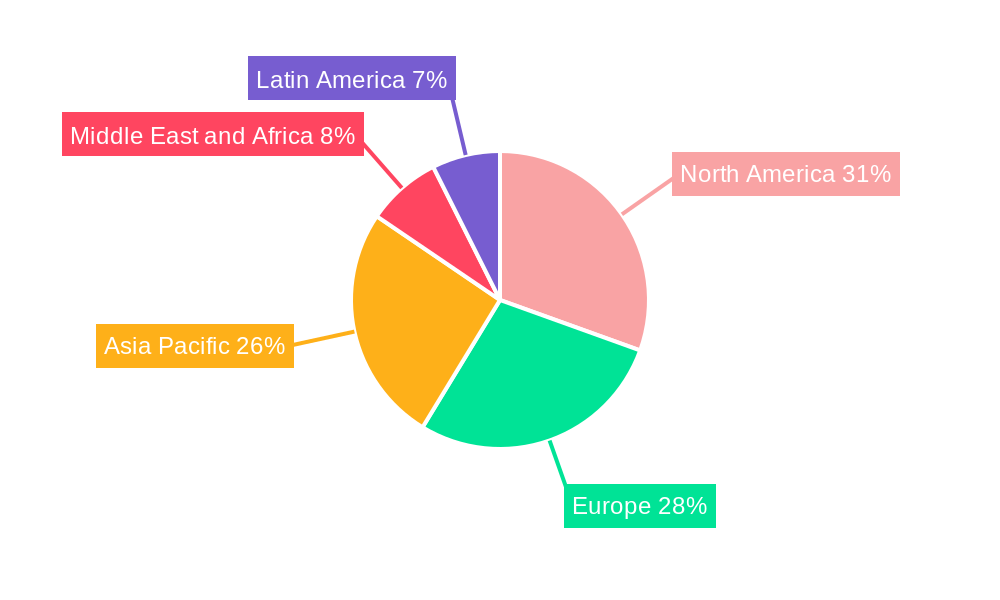
Unmanned Marine Vehicles Market Regional Market Share
Geographic Coverage of Unmanned Marine Vehicles Market
Unmanned Marine Vehicles Market REPORT HIGHLIGHTS
| Aspects | Details |
|---|---|
| Study Period | 2020-2034 |
| Base Year | 2025 |
| Estimated Year | 2026 |
| Forecast Period | 2026-2034 |
| Historical Period | 2020-2025 |
| Growth Rate | CAGR of 8.51% from 2020-2034 |
| Segmentation |
|
Table of Contents
- 1. Introduction
- 1.1. Research Scope
- 1.2. Market Segmentation
- 1.3. Research Methodology
- 1.4. Definitions and Assumptions
- 2. Executive Summary
- 2.1. Introduction
- 3. Market Dynamics
- 3.1. Introduction
- 3.2. Market Drivers
- 3.2.1. Oceanic Surveillance for Defense Purposes; Increased Usage of Unmanned Marine Vehicles for Underwater Mapping for Marine Geoscience Studies
- 3.3. Market Restrains
- 3.3.1. High Cost for the Equipment and Maintenance Issues
- 3.4. Market Trends
- 3.4.1. The Defense Industry is Expected to Grow Significantly in the Market
- 4. Market Factor Analysis
- 4.1. Porters Five Forces
- 4.2. Supply/Value Chain
- 4.3. PESTEL analysis
- 4.4. Market Entropy
- 4.5. Patent/Trademark Analysis
- 5. Global Unmanned Marine Vehicles Market Analysis, Insights and Forecast, 2020-2032
- 5.1. Market Analysis, Insights and Forecast - by Type
- 5.1.1. Surface Vehicle
- 5.1.2. Underwater Vehicle
- 5.2. Market Analysis, Insights and Forecast - by Control Type
- 5.2.1. Remotely Operated
- 5.2.2. Autonomous
- 5.3. Market Analysis, Insights and Forecast - by Application
- 5.3.1. Defense
- 5.3.2. Research
- 5.3.3. Commercial
- 5.3.4. Other Applications
- 5.4. Market Analysis, Insights and Forecast - by Region
- 5.4.1. North America
- 5.4.2. Europe
- 5.4.3. Asia Pacific
- 5.4.4. Latin America
- 5.4.5. Middle East and Africa
- 5.1. Market Analysis, Insights and Forecast - by Type
- 6. North America Unmanned Marine Vehicles Market Analysis, Insights and Forecast, 2020-2032
- 6.1. Market Analysis, Insights and Forecast - by Type
- 6.1.1. Surface Vehicle
- 6.1.2. Underwater Vehicle
- 6.2. Market Analysis, Insights and Forecast - by Control Type
- 6.2.1. Remotely Operated
- 6.2.2. Autonomous
- 6.3. Market Analysis, Insights and Forecast - by Application
- 6.3.1. Defense
- 6.3.2. Research
- 6.3.3. Commercial
- 6.3.4. Other Applications
- 6.1. Market Analysis, Insights and Forecast - by Type
- 7. Europe Unmanned Marine Vehicles Market Analysis, Insights and Forecast, 2020-2032
- 7.1. Market Analysis, Insights and Forecast - by Type
- 7.1.1. Surface Vehicle
- 7.1.2. Underwater Vehicle
- 7.2. Market Analysis, Insights and Forecast - by Control Type
- 7.2.1. Remotely Operated
- 7.2.2. Autonomous
- 7.3. Market Analysis, Insights and Forecast - by Application
- 7.3.1. Defense
- 7.3.2. Research
- 7.3.3. Commercial
- 7.3.4. Other Applications
- 7.1. Market Analysis, Insights and Forecast - by Type
- 8. Asia Pacific Unmanned Marine Vehicles Market Analysis, Insights and Forecast, 2020-2032
- 8.1. Market Analysis, Insights and Forecast - by Type
- 8.1.1. Surface Vehicle
- 8.1.2. Underwater Vehicle
- 8.2. Market Analysis, Insights and Forecast - by Control Type
- 8.2.1. Remotely Operated
- 8.2.2. Autonomous
- 8.3. Market Analysis, Insights and Forecast - by Application
- 8.3.1. Defense
- 8.3.2. Research
- 8.3.3. Commercial
- 8.3.4. Other Applications
- 8.1. Market Analysis, Insights and Forecast - by Type
- 9. Latin America Unmanned Marine Vehicles Market Analysis, Insights and Forecast, 2020-2032
- 9.1. Market Analysis, Insights and Forecast - by Type
- 9.1.1. Surface Vehicle
- 9.1.2. Underwater Vehicle
- 9.2. Market Analysis, Insights and Forecast - by Control Type
- 9.2.1. Remotely Operated
- 9.2.2. Autonomous
- 9.3. Market Analysis, Insights and Forecast - by Application
- 9.3.1. Defense
- 9.3.2. Research
- 9.3.3. Commercial
- 9.3.4. Other Applications
- 9.1. Market Analysis, Insights and Forecast - by Type
- 10. Middle East and Africa Unmanned Marine Vehicles Market Analysis, Insights and Forecast, 2020-2032
- 10.1. Market Analysis, Insights and Forecast - by Type
- 10.1.1. Surface Vehicle
- 10.1.2. Underwater Vehicle
- 10.2. Market Analysis, Insights and Forecast - by Control Type
- 10.2.1. Remotely Operated
- 10.2.2. Autonomous
- 10.3. Market Analysis, Insights and Forecast - by Application
- 10.3.1. Defense
- 10.3.2. Research
- 10.3.3. Commercial
- 10.3.4. Other Applications
- 10.1. Market Analysis, Insights and Forecast - by Type
- 11. Competitive Analysis
- 11.1. Global Market Share Analysis 2025
- 11.2. Company Profiles
- 11.2.1 Textron Inc
- 11.2.1.1. Overview
- 11.2.1.2. Products
- 11.2.1.3. SWOT Analysis
- 11.2.1.4. Recent Developments
- 11.2.1.5. Financials (Based on Availability)
- 11.2.2 Ocean Aero Inc
- 11.2.2.1. Overview
- 11.2.2.2. Products
- 11.2.2.3. SWOT Analysis
- 11.2.2.4. Recent Developments
- 11.2.2.5. Financials (Based on Availability)
- 11.2.3 Liquid Robotics
- 11.2.3.1. Overview
- 11.2.3.2. Products
- 11.2.3.3. SWOT Analysis
- 11.2.3.4. Recent Developments
- 11.2.3.5. Financials (Based on Availability)
- 11.2.4 BAE Systems
- 11.2.4.1. Overview
- 11.2.4.2. Products
- 11.2.4.3. SWOT Analysis
- 11.2.4.4. Recent Developments
- 11.2.4.5. Financials (Based on Availability)
- 11.2.5 Sea Robotics Inc
- 11.2.5.1. Overview
- 11.2.5.2. Products
- 11.2.5.3. SWOT Analysis
- 11.2.5.4. Recent Developments
- 11.2.5.5. Financials (Based on Availability)
- 11.2.6 ECA Group
- 11.2.6.1. Overview
- 11.2.6.2. Products
- 11.2.6.3. SWOT Analysis
- 11.2.6.4. Recent Developments
- 11.2.6.5. Financials (Based on Availability)
- 11.2.7 Rafael Advanced Defense Systems
- 11.2.7.1. Overview
- 11.2.7.2. Products
- 11.2.7.3. SWOT Analysis
- 11.2.7.4. Recent Developments
- 11.2.7.5. Financials (Based on Availability)
- 11.2.8 Atlas Elektronik
- 11.2.8.1. Overview
- 11.2.8.2. Products
- 11.2.8.3. SWOT Analysis
- 11.2.8.4. Recent Developments
- 11.2.8.5. Financials (Based on Availability)
- 11.2.9 Thales Group
- 11.2.9.1. Overview
- 11.2.9.2. Products
- 11.2.9.3. SWOT Analysis
- 11.2.9.4. Recent Developments
- 11.2.9.5. Financials (Based on Availability)
- 11.2.10 General Dynamics
- 11.2.10.1. Overview
- 11.2.10.2. Products
- 11.2.10.3. SWOT Analysis
- 11.2.10.4. Recent Developments
- 11.2.10.5. Financials (Based on Availability)
- 11.2.11 Northrop Grumman
- 11.2.11.1. Overview
- 11.2.11.2. Products
- 11.2.11.3. SWOT Analysis
- 11.2.11.4. Recent Developments
- 11.2.11.5. Financials (Based on Availability)
- 11.2.12 Pelorus Naval Systems
- 11.2.12.1. Overview
- 11.2.12.2. Products
- 11.2.12.3. SWOT Analysis
- 11.2.12.4. Recent Developments
- 11.2.12.5. Financials (Based on Availability)
- 11.2.13 ASV Globa
- 11.2.13.1. Overview
- 11.2.13.2. Products
- 11.2.13.3. SWOT Analysis
- 11.2.13.4. Recent Developments
- 11.2.13.5. Financials (Based on Availability)
- 11.2.14 Teledyne Technologies Inc
- 11.2.14.1. Overview
- 11.2.14.2. Products
- 11.2.14.3. SWOT Analysis
- 11.2.14.4. Recent Developments
- 11.2.14.5. Financials (Based on Availability)
- 11.2.1 Textron Inc
List of Figures
- Figure 1: Global Unmanned Marine Vehicles Market Revenue Breakdown (Million, %) by Region 2025 & 2033
- Figure 2: Global Unmanned Marine Vehicles Market Volume Breakdown (K Unit, %) by Region 2025 & 2033
- Figure 3: North America Unmanned Marine Vehicles Market Revenue (Million), by Type 2025 & 2033
- Figure 4: North America Unmanned Marine Vehicles Market Volume (K Unit), by Type 2025 & 2033
- Figure 5: North America Unmanned Marine Vehicles Market Revenue Share (%), by Type 2025 & 2033
- Figure 6: North America Unmanned Marine Vehicles Market Volume Share (%), by Type 2025 & 2033
- Figure 7: North America Unmanned Marine Vehicles Market Revenue (Million), by Control Type 2025 & 2033
- Figure 8: North America Unmanned Marine Vehicles Market Volume (K Unit), by Control Type 2025 & 2033
- Figure 9: North America Unmanned Marine Vehicles Market Revenue Share (%), by Control Type 2025 & 2033
- Figure 10: North America Unmanned Marine Vehicles Market Volume Share (%), by Control Type 2025 & 2033
- Figure 11: North America Unmanned Marine Vehicles Market Revenue (Million), by Application 2025 & 2033
- Figure 12: North America Unmanned Marine Vehicles Market Volume (K Unit), by Application 2025 & 2033
- Figure 13: North America Unmanned Marine Vehicles Market Revenue Share (%), by Application 2025 & 2033
- Figure 14: North America Unmanned Marine Vehicles Market Volume Share (%), by Application 2025 & 2033
- Figure 15: North America Unmanned Marine Vehicles Market Revenue (Million), by Country 2025 & 2033
- Figure 16: North America Unmanned Marine Vehicles Market Volume (K Unit), by Country 2025 & 2033
- Figure 17: North America Unmanned Marine Vehicles Market Revenue Share (%), by Country 2025 & 2033
- Figure 18: North America Unmanned Marine Vehicles Market Volume Share (%), by Country 2025 & 2033
- Figure 19: Europe Unmanned Marine Vehicles Market Revenue (Million), by Type 2025 & 2033
- Figure 20: Europe Unmanned Marine Vehicles Market Volume (K Unit), by Type 2025 & 2033
- Figure 21: Europe Unmanned Marine Vehicles Market Revenue Share (%), by Type 2025 & 2033
- Figure 22: Europe Unmanned Marine Vehicles Market Volume Share (%), by Type 2025 & 2033
- Figure 23: Europe Unmanned Marine Vehicles Market Revenue (Million), by Control Type 2025 & 2033
- Figure 24: Europe Unmanned Marine Vehicles Market Volume (K Unit), by Control Type 2025 & 2033
- Figure 25: Europe Unmanned Marine Vehicles Market Revenue Share (%), by Control Type 2025 & 2033
- Figure 26: Europe Unmanned Marine Vehicles Market Volume Share (%), by Control Type 2025 & 2033
- Figure 27: Europe Unmanned Marine Vehicles Market Revenue (Million), by Application 2025 & 2033
- Figure 28: Europe Unmanned Marine Vehicles Market Volume (K Unit), by Application 2025 & 2033
- Figure 29: Europe Unmanned Marine Vehicles Market Revenue Share (%), by Application 2025 & 2033
- Figure 30: Europe Unmanned Marine Vehicles Market Volume Share (%), by Application 2025 & 2033
- Figure 31: Europe Unmanned Marine Vehicles Market Revenue (Million), by Country 2025 & 2033
- Figure 32: Europe Unmanned Marine Vehicles Market Volume (K Unit), by Country 2025 & 2033
- Figure 33: Europe Unmanned Marine Vehicles Market Revenue Share (%), by Country 2025 & 2033
- Figure 34: Europe Unmanned Marine Vehicles Market Volume Share (%), by Country 2025 & 2033
- Figure 35: Asia Pacific Unmanned Marine Vehicles Market Revenue (Million), by Type 2025 & 2033
- Figure 36: Asia Pacific Unmanned Marine Vehicles Market Volume (K Unit), by Type 2025 & 2033
- Figure 37: Asia Pacific Unmanned Marine Vehicles Market Revenue Share (%), by Type 2025 & 2033
- Figure 38: Asia Pacific Unmanned Marine Vehicles Market Volume Share (%), by Type 2025 & 2033
- Figure 39: Asia Pacific Unmanned Marine Vehicles Market Revenue (Million), by Control Type 2025 & 2033
- Figure 40: Asia Pacific Unmanned Marine Vehicles Market Volume (K Unit), by Control Type 2025 & 2033
- Figure 41: Asia Pacific Unmanned Marine Vehicles Market Revenue Share (%), by Control Type 2025 & 2033
- Figure 42: Asia Pacific Unmanned Marine Vehicles Market Volume Share (%), by Control Type 2025 & 2033
- Figure 43: Asia Pacific Unmanned Marine Vehicles Market Revenue (Million), by Application 2025 & 2033
- Figure 44: Asia Pacific Unmanned Marine Vehicles Market Volume (K Unit), by Application 2025 & 2033
- Figure 45: Asia Pacific Unmanned Marine Vehicles Market Revenue Share (%), by Application 2025 & 2033
- Figure 46: Asia Pacific Unmanned Marine Vehicles Market Volume Share (%), by Application 2025 & 2033
- Figure 47: Asia Pacific Unmanned Marine Vehicles Market Revenue (Million), by Country 2025 & 2033
- Figure 48: Asia Pacific Unmanned Marine Vehicles Market Volume (K Unit), by Country 2025 & 2033
- Figure 49: Asia Pacific Unmanned Marine Vehicles Market Revenue Share (%), by Country 2025 & 2033
- Figure 50: Asia Pacific Unmanned Marine Vehicles Market Volume Share (%), by Country 2025 & 2033
- Figure 51: Latin America Unmanned Marine Vehicles Market Revenue (Million), by Type 2025 & 2033
- Figure 52: Latin America Unmanned Marine Vehicles Market Volume (K Unit), by Type 2025 & 2033
- Figure 53: Latin America Unmanned Marine Vehicles Market Revenue Share (%), by Type 2025 & 2033
- Figure 54: Latin America Unmanned Marine Vehicles Market Volume Share (%), by Type 2025 & 2033
- Figure 55: Latin America Unmanned Marine Vehicles Market Revenue (Million), by Control Type 2025 & 2033
- Figure 56: Latin America Unmanned Marine Vehicles Market Volume (K Unit), by Control Type 2025 & 2033
- Figure 57: Latin America Unmanned Marine Vehicles Market Revenue Share (%), by Control Type 2025 & 2033
- Figure 58: Latin America Unmanned Marine Vehicles Market Volume Share (%), by Control Type 2025 & 2033
- Figure 59: Latin America Unmanned Marine Vehicles Market Revenue (Million), by Application 2025 & 2033
- Figure 60: Latin America Unmanned Marine Vehicles Market Volume (K Unit), by Application 2025 & 2033
- Figure 61: Latin America Unmanned Marine Vehicles Market Revenue Share (%), by Application 2025 & 2033
- Figure 62: Latin America Unmanned Marine Vehicles Market Volume Share (%), by Application 2025 & 2033
- Figure 63: Latin America Unmanned Marine Vehicles Market Revenue (Million), by Country 2025 & 2033
- Figure 64: Latin America Unmanned Marine Vehicles Market Volume (K Unit), by Country 2025 & 2033
- Figure 65: Latin America Unmanned Marine Vehicles Market Revenue Share (%), by Country 2025 & 2033
- Figure 66: Latin America Unmanned Marine Vehicles Market Volume Share (%), by Country 2025 & 2033
- Figure 67: Middle East and Africa Unmanned Marine Vehicles Market Revenue (Million), by Type 2025 & 2033
- Figure 68: Middle East and Africa Unmanned Marine Vehicles Market Volume (K Unit), by Type 2025 & 2033
- Figure 69: Middle East and Africa Unmanned Marine Vehicles Market Revenue Share (%), by Type 2025 & 2033
- Figure 70: Middle East and Africa Unmanned Marine Vehicles Market Volume Share (%), by Type 2025 & 2033
- Figure 71: Middle East and Africa Unmanned Marine Vehicles Market Revenue (Million), by Control Type 2025 & 2033
- Figure 72: Middle East and Africa Unmanned Marine Vehicles Market Volume (K Unit), by Control Type 2025 & 2033
- Figure 73: Middle East and Africa Unmanned Marine Vehicles Market Revenue Share (%), by Control Type 2025 & 2033
- Figure 74: Middle East and Africa Unmanned Marine Vehicles Market Volume Share (%), by Control Type 2025 & 2033
- Figure 75: Middle East and Africa Unmanned Marine Vehicles Market Revenue (Million), by Application 2025 & 2033
- Figure 76: Middle East and Africa Unmanned Marine Vehicles Market Volume (K Unit), by Application 2025 & 2033
- Figure 77: Middle East and Africa Unmanned Marine Vehicles Market Revenue Share (%), by Application 2025 & 2033
- Figure 78: Middle East and Africa Unmanned Marine Vehicles Market Volume Share (%), by Application 2025 & 2033
- Figure 79: Middle East and Africa Unmanned Marine Vehicles Market Revenue (Million), by Country 2025 & 2033
- Figure 80: Middle East and Africa Unmanned Marine Vehicles Market Volume (K Unit), by Country 2025 & 2033
- Figure 81: Middle East and Africa Unmanned Marine Vehicles Market Revenue Share (%), by Country 2025 & 2033
- Figure 82: Middle East and Africa Unmanned Marine Vehicles Market Volume Share (%), by Country 2025 & 2033
List of Tables
- Table 1: Global Unmanned Marine Vehicles Market Revenue Million Forecast, by Type 2020 & 2033
- Table 2: Global Unmanned Marine Vehicles Market Volume K Unit Forecast, by Type 2020 & 2033
- Table 3: Global Unmanned Marine Vehicles Market Revenue Million Forecast, by Control Type 2020 & 2033
- Table 4: Global Unmanned Marine Vehicles Market Volume K Unit Forecast, by Control Type 2020 & 2033
- Table 5: Global Unmanned Marine Vehicles Market Revenue Million Forecast, by Application 2020 & 2033
- Table 6: Global Unmanned Marine Vehicles Market Volume K Unit Forecast, by Application 2020 & 2033
- Table 7: Global Unmanned Marine Vehicles Market Revenue Million Forecast, by Region 2020 & 2033
- Table 8: Global Unmanned Marine Vehicles Market Volume K Unit Forecast, by Region 2020 & 2033
- Table 9: Global Unmanned Marine Vehicles Market Revenue Million Forecast, by Type 2020 & 2033
- Table 10: Global Unmanned Marine Vehicles Market Volume K Unit Forecast, by Type 2020 & 2033
- Table 11: Global Unmanned Marine Vehicles Market Revenue Million Forecast, by Control Type 2020 & 2033
- Table 12: Global Unmanned Marine Vehicles Market Volume K Unit Forecast, by Control Type 2020 & 2033
- Table 13: Global Unmanned Marine Vehicles Market Revenue Million Forecast, by Application 2020 & 2033
- Table 14: Global Unmanned Marine Vehicles Market Volume K Unit Forecast, by Application 2020 & 2033
- Table 15: Global Unmanned Marine Vehicles Market Revenue Million Forecast, by Country 2020 & 2033
- Table 16: Global Unmanned Marine Vehicles Market Volume K Unit Forecast, by Country 2020 & 2033
- Table 17: United States Unmanned Marine Vehicles Market Revenue (Million) Forecast, by Application 2020 & 2033
- Table 18: United States Unmanned Marine Vehicles Market Volume (K Unit) Forecast, by Application 2020 & 2033
- Table 19: Canada Unmanned Marine Vehicles Market Revenue (Million) Forecast, by Application 2020 & 2033
- Table 20: Canada Unmanned Marine Vehicles Market Volume (K Unit) Forecast, by Application 2020 & 2033
- Table 21: Global Unmanned Marine Vehicles Market Revenue Million Forecast, by Type 2020 & 2033
- Table 22: Global Unmanned Marine Vehicles Market Volume K Unit Forecast, by Type 2020 & 2033
- Table 23: Global Unmanned Marine Vehicles Market Revenue Million Forecast, by Control Type 2020 & 2033
- Table 24: Global Unmanned Marine Vehicles Market Volume K Unit Forecast, by Control Type 2020 & 2033
- Table 25: Global Unmanned Marine Vehicles Market Revenue Million Forecast, by Application 2020 & 2033
- Table 26: Global Unmanned Marine Vehicles Market Volume K Unit Forecast, by Application 2020 & 2033
- Table 27: Global Unmanned Marine Vehicles Market Revenue Million Forecast, by Country 2020 & 2033
- Table 28: Global Unmanned Marine Vehicles Market Volume K Unit Forecast, by Country 2020 & 2033
- Table 29: Germany Unmanned Marine Vehicles Market Revenue (Million) Forecast, by Application 2020 & 2033
- Table 30: Germany Unmanned Marine Vehicles Market Volume (K Unit) Forecast, by Application 2020 & 2033
- Table 31: Italy Unmanned Marine Vehicles Market Revenue (Million) Forecast, by Application 2020 & 2033
- Table 32: Italy Unmanned Marine Vehicles Market Volume (K Unit) Forecast, by Application 2020 & 2033
- Table 33: France Unmanned Marine Vehicles Market Revenue (Million) Forecast, by Application 2020 & 2033
- Table 34: France Unmanned Marine Vehicles Market Volume (K Unit) Forecast, by Application 2020 & 2033
- Table 35: Rest of Europe Unmanned Marine Vehicles Market Revenue (Million) Forecast, by Application 2020 & 2033
- Table 36: Rest of Europe Unmanned Marine Vehicles Market Volume (K Unit) Forecast, by Application 2020 & 2033
- Table 37: Global Unmanned Marine Vehicles Market Revenue Million Forecast, by Type 2020 & 2033
- Table 38: Global Unmanned Marine Vehicles Market Volume K Unit Forecast, by Type 2020 & 2033
- Table 39: Global Unmanned Marine Vehicles Market Revenue Million Forecast, by Control Type 2020 & 2033
- Table 40: Global Unmanned Marine Vehicles Market Volume K Unit Forecast, by Control Type 2020 & 2033
- Table 41: Global Unmanned Marine Vehicles Market Revenue Million Forecast, by Application 2020 & 2033
- Table 42: Global Unmanned Marine Vehicles Market Volume K Unit Forecast, by Application 2020 & 2033
- Table 43: Global Unmanned Marine Vehicles Market Revenue Million Forecast, by Country 2020 & 2033
- Table 44: Global Unmanned Marine Vehicles Market Volume K Unit Forecast, by Country 2020 & 2033
- Table 45: China Unmanned Marine Vehicles Market Revenue (Million) Forecast, by Application 2020 & 2033
- Table 46: China Unmanned Marine Vehicles Market Volume (K Unit) Forecast, by Application 2020 & 2033
- Table 47: Japan Unmanned Marine Vehicles Market Revenue (Million) Forecast, by Application 2020 & 2033
- Table 48: Japan Unmanned Marine Vehicles Market Volume (K Unit) Forecast, by Application 2020 & 2033
- Table 49: India Unmanned Marine Vehicles Market Revenue (Million) Forecast, by Application 2020 & 2033
- Table 50: India Unmanned Marine Vehicles Market Volume (K Unit) Forecast, by Application 2020 & 2033
- Table 51: Australia Unmanned Marine Vehicles Market Revenue (Million) Forecast, by Application 2020 & 2033
- Table 52: Australia Unmanned Marine Vehicles Market Volume (K Unit) Forecast, by Application 2020 & 2033
- Table 53: Rest of Asia Pacific Unmanned Marine Vehicles Market Revenue (Million) Forecast, by Application 2020 & 2033
- Table 54: Rest of Asia Pacific Unmanned Marine Vehicles Market Volume (K Unit) Forecast, by Application 2020 & 2033
- Table 55: Global Unmanned Marine Vehicles Market Revenue Million Forecast, by Type 2020 & 2033
- Table 56: Global Unmanned Marine Vehicles Market Volume K Unit Forecast, by Type 2020 & 2033
- Table 57: Global Unmanned Marine Vehicles Market Revenue Million Forecast, by Control Type 2020 & 2033
- Table 58: Global Unmanned Marine Vehicles Market Volume K Unit Forecast, by Control Type 2020 & 2033
- Table 59: Global Unmanned Marine Vehicles Market Revenue Million Forecast, by Application 2020 & 2033
- Table 60: Global Unmanned Marine Vehicles Market Volume K Unit Forecast, by Application 2020 & 2033
- Table 61: Global Unmanned Marine Vehicles Market Revenue Million Forecast, by Country 2020 & 2033
- Table 62: Global Unmanned Marine Vehicles Market Volume K Unit Forecast, by Country 2020 & 2033
- Table 63: Brazil Unmanned Marine Vehicles Market Revenue (Million) Forecast, by Application 2020 & 2033
- Table 64: Brazil Unmanned Marine Vehicles Market Volume (K Unit) Forecast, by Application 2020 & 2033
- Table 65: Rest of Latin America Unmanned Marine Vehicles Market Revenue (Million) Forecast, by Application 2020 & 2033
- Table 66: Rest of Latin America Unmanned Marine Vehicles Market Volume (K Unit) Forecast, by Application 2020 & 2033
- Table 67: Global Unmanned Marine Vehicles Market Revenue Million Forecast, by Type 2020 & 2033
- Table 68: Global Unmanned Marine Vehicles Market Volume K Unit Forecast, by Type 2020 & 2033
- Table 69: Global Unmanned Marine Vehicles Market Revenue Million Forecast, by Control Type 2020 & 2033
- Table 70: Global Unmanned Marine Vehicles Market Volume K Unit Forecast, by Control Type 2020 & 2033
- Table 71: Global Unmanned Marine Vehicles Market Revenue Million Forecast, by Application 2020 & 2033
- Table 72: Global Unmanned Marine Vehicles Market Volume K Unit Forecast, by Application 2020 & 2033
- Table 73: Global Unmanned Marine Vehicles Market Revenue Million Forecast, by Country 2020 & 2033
- Table 74: Global Unmanned Marine Vehicles Market Volume K Unit Forecast, by Country 2020 & 2033
- Table 75: South Africa Unmanned Marine Vehicles Market Revenue (Million) Forecast, by Application 2020 & 2033
- Table 76: South Africa Unmanned Marine Vehicles Market Volume (K Unit) Forecast, by Application 2020 & 2033
- Table 77: Rest of Middle East and Africa Unmanned Marine Vehicles Market Revenue (Million) Forecast, by Application 2020 & 2033
- Table 78: Rest of Middle East and Africa Unmanned Marine Vehicles Market Volume (K Unit) Forecast, by Application 2020 & 2033
Frequently Asked Questions
1. What is the projected Compound Annual Growth Rate (CAGR) of the Unmanned Marine Vehicles Market?
The projected CAGR is approximately 8.51%.
2. Which companies are prominent players in the Unmanned Marine Vehicles Market?
Key companies in the market include Textron Inc, Ocean Aero Inc, Liquid Robotics, BAE Systems, Sea Robotics Inc, ECA Group, Rafael Advanced Defense Systems, Atlas Elektronik, Thales Group, General Dynamics, Northrop Grumman, Pelorus Naval Systems, ASV Globa, Teledyne Technologies Inc.
3. What are the main segments of the Unmanned Marine Vehicles Market?
The market segments include Type, Control Type, Application.
4. Can you provide details about the market size?
The market size is estimated to be USD 4.93 Million as of 2022.
5. What are some drivers contributing to market growth?
Oceanic Surveillance for Defense Purposes; Increased Usage of Unmanned Marine Vehicles for Underwater Mapping for Marine Geoscience Studies.
6. What are the notable trends driving market growth?
The Defense Industry is Expected to Grow Significantly in the Market.
7. Are there any restraints impacting market growth?
High Cost for the Equipment and Maintenance Issues.
8. Can you provide examples of recent developments in the market?
August 2022 - Austal USA announced to partner with California-based Saildrone for building Saildrone Surveyor autonomous 'uncrewed' surface vehicle in Alabama. The partnership aims to provide a cutting-edge solution for maritime domain awareness, hydrographic survey, and other missions requiring persistent wide area coverage to the U.S. Navy and other government agency customers.
9. What pricing options are available for accessing the report?
Pricing options include single-user, multi-user, and enterprise licenses priced at USD 4750, USD 5250, and USD 8750 respectively.
10. Is the market size provided in terms of value or volume?
The market size is provided in terms of value, measured in Million and volume, measured in K Unit.
11. Are there any specific market keywords associated with the report?
Yes, the market keyword associated with the report is "Unmanned Marine Vehicles Market," which aids in identifying and referencing the specific market segment covered.
12. How do I determine which pricing option suits my needs best?
The pricing options vary based on user requirements and access needs. Individual users may opt for single-user licenses, while businesses requiring broader access may choose multi-user or enterprise licenses for cost-effective access to the report.
13. Are there any additional resources or data provided in the Unmanned Marine Vehicles Market report?
While the report offers comprehensive insights, it's advisable to review the specific contents or supplementary materials provided to ascertain if additional resources or data are available.
14. How can I stay updated on further developments or reports in the Unmanned Marine Vehicles Market?
To stay informed about further developments, trends, and reports in the Unmanned Marine Vehicles Market, consider subscribing to industry newsletters, following relevant companies and organizations, or regularly checking reputable industry news sources and publications.
Methodology
Step 1 - Identification of Relevant Samples Size from Population Database



Step 2 - Approaches for Defining Global Market Size (Value, Volume* & Price*)

Note*: In applicable scenarios
Step 3 - Data Sources
Primary Research
- Web Analytics
- Survey Reports
- Research Institute
- Latest Research Reports
- Opinion Leaders
Secondary Research
- Annual Reports
- White Paper
- Latest Press Release
- Industry Association
- Paid Database
- Investor Presentations

Step 4 - Data Triangulation
Involves using different sources of information in order to increase the validity of a study
These sources are likely to be stakeholders in a program - participants, other researchers, program staff, other community members, and so on.
Then we put all data in single framework & apply various statistical tools to find out the dynamic on the market.
During the analysis stage, feedback from the stakeholder groups would be compared to determine areas of agreement as well as areas of divergence