

Key Insights
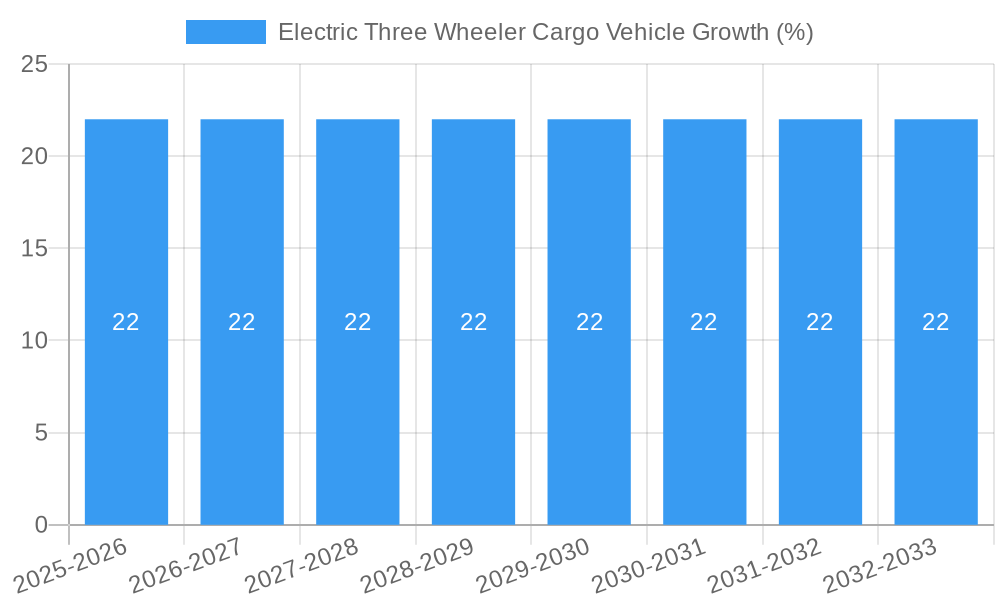
The global Electric Three Wheeler Cargo Vehicle market is poised for significant expansion, projected to reach an estimated USD 3,500 million by 2025 and continue its robust growth trajectory through 2033. Driven by a Compound Annual Growth Rate (CAGR) of approximately 22%, this burgeoning sector is fundamentally reshaped by a confluence of economic, environmental, and technological factors. Key market drivers include stringent government regulations promoting electric vehicle adoption and emission reduction mandates, coupled with escalating fuel prices that make electric alternatives increasingly cost-effective for logistics and last-mile delivery operations. Furthermore, the growing e-commerce boom and the resultant surge in demand for efficient and sustainable urban logistics solutions are providing a powerful impetus. The inherent advantages of electric three-wheelers – their maneuverability in congested urban environments, lower operational costs, and zero tailpipe emissions – position them as ideal solutions for small and medium-sized businesses, as well as for individual entrepreneurs seeking to optimize their delivery networks. The increasing availability of advanced battery technologies, leading to longer ranges and reduced charging times, is also playing a crucial role in overcoming previous adoption barriers.
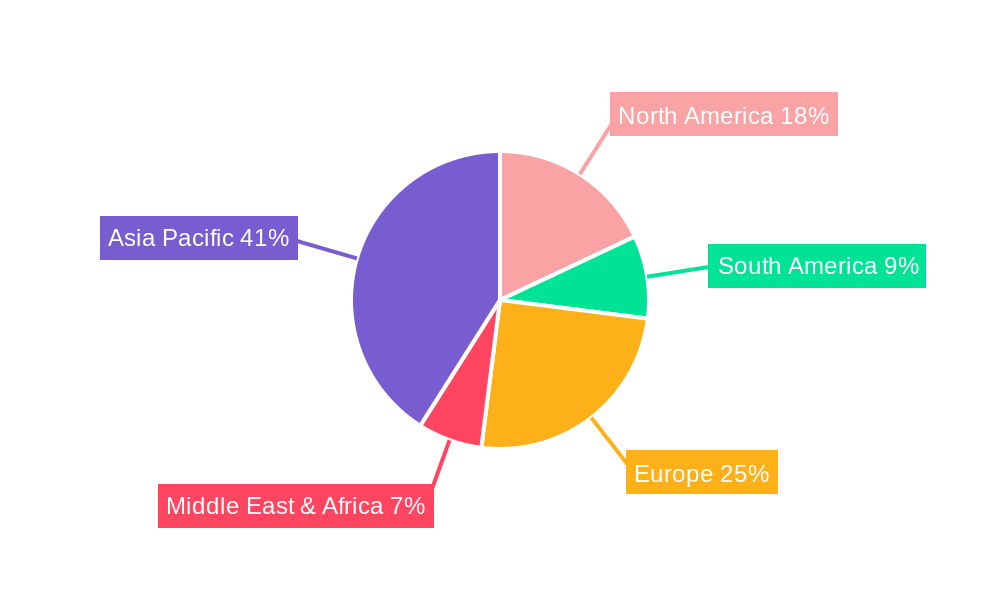
The market landscape for Electric Three Wheeler Cargo Vehicles is characterized by a dynamic interplay of innovation and market penetration across diverse segments and regions. The application spectrum is broadly categorized into Household and Commercial uses, with the Commercial segment, particularly for last-mile delivery and logistics, demonstrating the highest growth potential. Within the vehicle types, both Folding and Non-Folding Three Wheeler Cargo Vehicles are gaining traction, catering to different storage and operational needs. Asia Pacific, led by the strong demand from India and China, is expected to dominate the market share due to favorable government policies, a large existing two and three-wheeler user base, and a growing logistics infrastructure. North America and Europe are also witnessing considerable growth, driven by increasing environmental consciousness and the push for sustainable urban mobility solutions. Key players like Lohia Auto, Kinetic Green, Euler Motors, and Terra Motors India are at the forefront of this transformation, investing heavily in research and development to offer innovative, cost-effective, and high-performance electric cargo solutions, thereby shaping the competitive dynamics and accelerating market adoption.
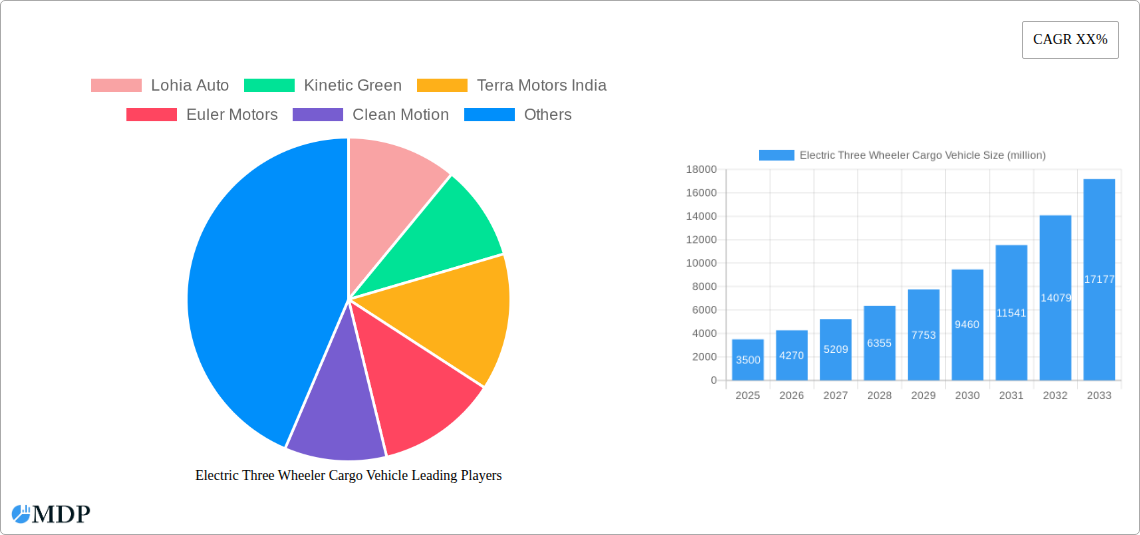
Electric Three Wheeler Cargo Vehicle Market: A Comprehensive Growth Analysis & Forecast (2019-2033)
This in-depth report offers a panoramic view of the burgeoning electric three-wheeler cargo vehicle market, a segment poised for exponential growth driven by sustainability mandates, operational efficiencies, and evolving last-mile delivery needs. Covering the historical period from 2019-2024, the base year of 2025, and a robust forecast period extending to 2033, this analysis provides invaluable insights for manufacturers, investors, policymakers, and logistics providers. We delve into market dynamics, industry trends, leading segments, product innovations, growth drivers, challenges, and emerging opportunities, equipping stakeholders with the actionable intelligence needed to navigate and capitalize on this dynamic sector. The report analyzes the market concentration, innovation drivers, regulatory frameworks, product substitutes, end-user trends, and M&A activities, alongside a detailed exploration of market growth drivers, technological disruptions, consumer preferences, and competitive dynamics.
Electric Three Wheeler Cargo Vehicle Market Dynamics & Concentration
The electric three-wheeler cargo vehicle market is characterized by a moderate to high concentration, with a growing number of established automotive players and agile startups vying for market share. Innovation drivers are primarily centered around improving battery technology for extended range, faster charging capabilities, enhanced payload capacity, and advanced telematics for fleet management. Regulatory frameworks globally are increasingly favoring electric mobility through subsidies, tax incentives, and stricter emission norms for internal combustion engine vehicles, acting as significant catalysts for adoption. Product substitutes, while present in the form of traditional three-wheelers and smaller electric vans, are rapidly losing ground to the superior operational cost and environmental benefits offered by electric cargo trikes. End-user trends highlight a strong preference for Commercial applications due to their reduced running costs, maneuverability in urban environments, and suitability for last-mile delivery services. M&A activities are on the rise as larger companies seek to acquire innovative technologies or expand their EV portfolio. We anticipate significant M&A deal counts in the coming years as consolidation occurs. Market share analysis reveals a competitive landscape with a few dominant players, but with substantial opportunities for new entrants with differentiated offerings.
- Market Concentration: Moderate to High, with increasing competition.
- Innovation Drivers: Battery technology, range, charging speed, payload, telematics.
- Regulatory Frameworks: Favorable government policies, subsidies, emission norms.
- Product Substitutes: Traditional ICE three-wheelers, small electric vans.
- End-User Trends: Strong demand for Commercial applications, particularly last-mile delivery.
- M&A Activities: Increasing trend for strategic acquisitions and partnerships.
Electric Three Wheeler Cargo Vehicle Industry Trends & Analysis
The electric three-wheeler cargo vehicle industry is experiencing an unprecedented surge in growth, driven by a confluence of technological advancements, supportive government policies, and a growing awareness of environmental sustainability. The market is projected to witness a Compound Annual Growth Rate (CAGR) of over 15% during the forecast period, a testament to its robust expansion. Technological disruptions, particularly in battery energy density and charging infrastructure, are significantly enhancing the practicality and appeal of these vehicles. Consumers, especially in the commercial sector, are increasingly recognizing the substantial savings in operational expenses, including fuel costs and maintenance, compared to their internal combustion engine counterparts. This economic advantage, coupled with the growing pressure to reduce carbon footprints, is fueling widespread adoption. The competitive dynamics are intensifying, with both traditional automotive manufacturers and new-age electric vehicle startups innovating rapidly to capture market share. Furthermore, the increasing penetration of electric three-wheeler cargo vehicles into diverse logistical operations, from e-commerce delivery to agricultural produce transportation, underscores their versatility and growing importance in the modern economy. The market penetration of electric three-wheeler cargo vehicles is expanding rapidly across urban and semi-urban areas, displacing traditional modes of transport.
Leading Markets & Segments in Electric Three Wheeler Cargo Vehicle
The Commercial segment is the undeniable leader within the electric three-wheeler cargo vehicle market, driven by its critical role in last-mile delivery, logistics, and urban transportation of goods. Within the Commercial segment, applications range from e-commerce fulfillment and grocery delivery to food service and small business logistics. The Non-Folding Three Wheeler Cargo Vehicle type dominates owing to its superior payload capacity, stability, and robustness, making it ideal for commercial operations.
Dominant Application:
- Commercial: This segment accounts for the largest market share, fueled by the need for efficient and cost-effective goods transportation in urban and semi-urban areas. Key drivers include the exponential growth of e-commerce, increasing demand for rapid delivery services, and the inherent operational cost savings offered by electric propulsion. Government incentives for commercial EV adoption also play a crucial role.
Dominant Type:
- Non-Folding Three Wheeler Cargo Vehicle: These vehicles offer higher load-carrying capabilities and enhanced durability, making them the preferred choice for most commercial applications. Their design prioritizes cargo space and stability, essential for transporting a variety of goods.
Key Regional Dominance (Anticipated):
- Asia Pacific: Specifically, countries like India and China are leading the charge due to a large existing market for three-wheelers, supportive government initiatives for electric mobility, and a burgeoning logistics sector. Favorable economic policies and the rapid development of charging infrastructure are critical drivers in this region.
Electric Three Wheeler Cargo Vehicle Product Developments
Recent product developments in the electric three-wheeler cargo vehicle sector are focused on enhancing efficiency, sustainability, and user experience. Innovations include the integration of advanced lithium-ion battery technologies for extended range and faster charging, lightweight yet robust chassis designs for improved payload capacity, and smart features like GPS tracking and remote diagnostics for fleet management. Many manufacturers are also introducing modular cargo bay designs to cater to diverse business needs, alongside enhanced safety features for drivers and improved ergonomics. These advancements ensure a better market fit and provide a significant competitive advantage in the rapidly evolving landscape.
Key Drivers of Electric Three Wheeler Cargo Vehicle Growth
The growth of the electric three-wheeler cargo vehicle market is propelled by a confluence of compelling factors. Technological advancements in battery technology are leading to longer ranges and faster charging, addressing previous range anxiety. Economic incentives from governments, including subsidies and tax benefits, significantly reduce the upfront cost of ownership. Furthermore, the increasing regulatory push towards cleaner transportation and the desire to reduce operational expenditure by businesses are creating a fertile ground for electric cargo trikes. The growing e-commerce sector and the need for efficient last-mile delivery solutions further amplify this demand.
Challenges in the Electric Three Wheeler Cargo Vehicle Market
Despite its promising trajectory, the electric three-wheeler cargo vehicle market faces several challenges. High upfront costs compared to traditional ICE vehicles can be a barrier for some small businesses. Limited charging infrastructure in certain regions, especially in rural areas, can hinder widespread adoption. Battery replacement costs and the availability of skilled technicians for maintenance are also concerns. Additionally, intense competition from established players and the continuous need for innovation to stay ahead of market trends present ongoing pressures.
Emerging Opportunities in Electric Three Wheeler Cargo Vehicle
The future of the electric three-wheeler cargo vehicle market is brimming with exciting opportunities. Technological breakthroughs in solid-state batteries promise even longer ranges and faster charging times, further boosting practicality. Strategic partnerships between manufacturers, logistics companies, and charging infrastructure providers can accelerate adoption and create integrated solutions. Market expansion into developing economies with a strong need for affordable and sustainable transportation solutions also presents significant potential. Furthermore, the development of specialized cargo variants for niche applications will unlock new revenue streams.
Leading Players in the Electric Three Wheeler Cargo Vehicle Sector
- Lohia Auto
- Kinetic Green
- Terra Motors India
- Euler Motors
- Clean Motion
- Hero Electric
- Saera Electric Auto
- Chongqing Zongshen Tricycle
- Wuxi Southeast Vehicle Technology
- Langfang Sandi Electric Tricycle Company
- Henan Zipstar Tricycle Manufacturing
- Dongguan Tailing Electric Vehicle
- Euler HiLoad
- Etrio
- 3evi
- Keto Motors
- Omega Seiki Mobility
Key Milestones in Electric Three Wheeler Cargo Vehicle Industry
- 2019: Increased government subsidies for electric vehicles in key markets, boosting initial adoption.
- 2020: Launch of new battery management systems leading to improved efficiency and lifespan.
- 2021: Significant growth in e-commerce demand, creating a surge in the need for last-mile delivery solutions.
- 2022: Introduction of faster charging technologies, reducing downtime for commercial operators.
- 2023: Major automotive players increase their investment in electric three-wheeler cargo vehicle development and production.
- 2024: Expansion of charging network infrastructure in urban centers, improving usability.
- 2025: Expected widespread adoption of advanced battery chemistries offering superior energy density.
- 2026-2030: Anticipated regulatory mandates for zero-emission last-mile delivery vehicles.
- 2031-2033: Maturation of the market with enhanced fleet management solutions and vehicle-to-grid capabilities.
Strategic Outlook for Electric Three Wheeler Cargo Vehicle Market
The strategic outlook for the electric three-wheeler cargo vehicle market is exceptionally positive, with sustained growth projected over the coming decade. Key accelerators include the continued evolution of battery technology, leading to enhanced performance and affordability, and the increasing stringency of environmental regulations globally. Manufacturers focusing on developing robust, cost-effective, and feature-rich cargo solutions tailored to specific commercial needs will likely gain a significant competitive edge. Furthermore, strategic collaborations to build out charging infrastructure and optimize supply chains will be crucial for market expansion. The market's potential for innovation in areas like autonomous cargo delivery and integrated logistics platforms presents exciting long-term opportunities.
Electric Three Wheeler Cargo Vehicle Segmentation
-
1. Application
- 1.1. Household
- 1.2. Commercial
-
2. Types
- 2.1. Folding Three Wheeler Cargo Vehicle
- 2.2. Non-Folding Three Wheeler Cargo Vehicle
Electric Three Wheeler Cargo Vehicle Segmentation By Geography
-
1. North America
- 1.1. United States
- 1.2. Canada
- 1.3. Mexico
-
2. South America
- 2.1. Brazil
- 2.2. Argentina
- 2.3. Rest of South America
-
3. Europe
- 3.1. United Kingdom
- 3.2. Germany
- 3.3. France
- 3.4. Italy
- 3.5. Spain
- 3.6. Russia
- 3.7. Benelux
- 3.8. Nordics
- 3.9. Rest of Europe
-
4. Middle East & Africa
- 4.1. Turkey
- 4.2. Israel
- 4.3. GCC
- 4.4. North Africa
- 4.5. South Africa
- 4.6. Rest of Middle East & Africa
-
5. Asia Pacific
- 5.1. China
- 5.2. India
- 5.3. Japan
- 5.4. South Korea
- 5.5. ASEAN
- 5.6. Oceania
- 5.7. Rest of Asia Pacific
Electric Three Wheeler Cargo Vehicle REPORT HIGHLIGHTS
| Aspects | Details |
|---|---|
| Study Period | 2019-2033 |
| Base Year | 2024 |
| Estimated Year | 2025 |
| Forecast Period | 2025-2033 |
| Historical Period | 2019-2024 |
| Growth Rate | CAGR of XX% from 2019-2033 |
| Segmentation |
|
Table of Contents
- 1. Introduction
- 1.1. Research Scope
- 1.2. Market Segmentation
- 1.3. Research Methodology
- 1.4. Definitions and Assumptions
- 2. Executive Summary
- 2.1. Introduction
- 3. Market Dynamics
- 3.1. Introduction
- 3.2. Market Drivers
- 3.3. Market Restrains
- 3.4. Market Trends
- 4. Market Factor Analysis
- 4.1. Porters Five Forces
- 4.2. Supply/Value Chain
- 4.3. PESTEL analysis
- 4.4. Market Entropy
- 4.5. Patent/Trademark Analysis
- 5. Global Electric Three Wheeler Cargo Vehicle Analysis, Insights and Forecast, 2019-2031
- 5.1. Market Analysis, Insights and Forecast - by Application
- 5.1.1. Household
- 5.1.2. Commercial
- 5.2. Market Analysis, Insights and Forecast - by Types
- 5.2.1. Folding Three Wheeler Cargo Vehicle
- 5.2.2. Non-Folding Three Wheeler Cargo Vehicle
- 5.3. Market Analysis, Insights and Forecast - by Region
- 5.3.1. North America
- 5.3.2. South America
- 5.3.3. Europe
- 5.3.4. Middle East & Africa
- 5.3.5. Asia Pacific
- 5.1. Market Analysis, Insights and Forecast - by Application
- 6. North America Electric Three Wheeler Cargo Vehicle Analysis, Insights and Forecast, 2019-2031
- 6.1. Market Analysis, Insights and Forecast - by Application
- 6.1.1. Household
- 6.1.2. Commercial
- 6.2. Market Analysis, Insights and Forecast - by Types
- 6.2.1. Folding Three Wheeler Cargo Vehicle
- 6.2.2. Non-Folding Three Wheeler Cargo Vehicle
- 6.1. Market Analysis, Insights and Forecast - by Application
- 7. South America Electric Three Wheeler Cargo Vehicle Analysis, Insights and Forecast, 2019-2031
- 7.1. Market Analysis, Insights and Forecast - by Application
- 7.1.1. Household
- 7.1.2. Commercial
- 7.2. Market Analysis, Insights and Forecast - by Types
- 7.2.1. Folding Three Wheeler Cargo Vehicle
- 7.2.2. Non-Folding Three Wheeler Cargo Vehicle
- 7.1. Market Analysis, Insights and Forecast - by Application
- 8. Europe Electric Three Wheeler Cargo Vehicle Analysis, Insights and Forecast, 2019-2031
- 8.1. Market Analysis, Insights and Forecast - by Application
- 8.1.1. Household
- 8.1.2. Commercial
- 8.2. Market Analysis, Insights and Forecast - by Types
- 8.2.1. Folding Three Wheeler Cargo Vehicle
- 8.2.2. Non-Folding Three Wheeler Cargo Vehicle
- 8.1. Market Analysis, Insights and Forecast - by Application
- 9. Middle East & Africa Electric Three Wheeler Cargo Vehicle Analysis, Insights and Forecast, 2019-2031
- 9.1. Market Analysis, Insights and Forecast - by Application
- 9.1.1. Household
- 9.1.2. Commercial
- 9.2. Market Analysis, Insights and Forecast - by Types
- 9.2.1. Folding Three Wheeler Cargo Vehicle
- 9.2.2. Non-Folding Three Wheeler Cargo Vehicle
- 9.1. Market Analysis, Insights and Forecast - by Application
- 10. Asia Pacific Electric Three Wheeler Cargo Vehicle Analysis, Insights and Forecast, 2019-2031
- 10.1. Market Analysis, Insights and Forecast - by Application
- 10.1.1. Household
- 10.1.2. Commercial
- 10.2. Market Analysis, Insights and Forecast - by Types
- 10.2.1. Folding Three Wheeler Cargo Vehicle
- 10.2.2. Non-Folding Three Wheeler Cargo Vehicle
- 10.1. Market Analysis, Insights and Forecast - by Application
- 11. Competitive Analysis
- 11.1. Global Market Share Analysis 2024
- 11.2. Company Profiles
- 11.2.1 Lohia Auto
- 11.2.1.1. Overview
- 11.2.1.2. Products
- 11.2.1.3. SWOT Analysis
- 11.2.1.4. Recent Developments
- 11.2.1.5. Financials (Based on Availability)
- 11.2.2 Kinetic Green
- 11.2.2.1. Overview
- 11.2.2.2. Products
- 11.2.2.3. SWOT Analysis
- 11.2.2.4. Recent Developments
- 11.2.2.5. Financials (Based on Availability)
- 11.2.3 Terra Motors India
- 11.2.3.1. Overview
- 11.2.3.2. Products
- 11.2.3.3. SWOT Analysis
- 11.2.3.4. Recent Developments
- 11.2.3.5. Financials (Based on Availability)
- 11.2.4 Euler Motors
- 11.2.4.1. Overview
- 11.2.4.2. Products
- 11.2.4.3. SWOT Analysis
- 11.2.4.4. Recent Developments
- 11.2.4.5. Financials (Based on Availability)
- 11.2.5 Clean Motion
- 11.2.5.1. Overview
- 11.2.5.2. Products
- 11.2.5.3. SWOT Analysis
- 11.2.5.4. Recent Developments
- 11.2.5.5. Financials (Based on Availability)
- 11.2.6 Hero Electric
- 11.2.6.1. Overview
- 11.2.6.2. Products
- 11.2.6.3. SWOT Analysis
- 11.2.6.4. Recent Developments
- 11.2.6.5. Financials (Based on Availability)
- 11.2.7 Saera Electric Auto
- 11.2.7.1. Overview
- 11.2.7.2. Products
- 11.2.7.3. SWOT Analysis
- 11.2.7.4. Recent Developments
- 11.2.7.5. Financials (Based on Availability)
- 11.2.8 Chongqing Zongshen Tricycle
- 11.2.8.1. Overview
- 11.2.8.2. Products
- 11.2.8.3. SWOT Analysis
- 11.2.8.4. Recent Developments
- 11.2.8.5. Financials (Based on Availability)
- 11.2.9 Wuxi Southeast Vehicle Technology
- 11.2.9.1. Overview
- 11.2.9.2. Products
- 11.2.9.3. SWOT Analysis
- 11.2.9.4. Recent Developments
- 11.2.9.5. Financials (Based on Availability)
- 11.2.10 Langfang Sandi Electric Tricycle Company
- 11.2.10.1. Overview
- 11.2.10.2. Products
- 11.2.10.3. SWOT Analysis
- 11.2.10.4. Recent Developments
- 11.2.10.5. Financials (Based on Availability)
- 11.2.11 Henan Zipstar Tricycle Manufacturing
- 11.2.11.1. Overview
- 11.2.11.2. Products
- 11.2.11.3. SWOT Analysis
- 11.2.11.4. Recent Developments
- 11.2.11.5. Financials (Based on Availability)
- 11.2.12 Dongguan Tailing Electric Vehicle
- 11.2.12.1. Overview
- 11.2.12.2. Products
- 11.2.12.3. SWOT Analysis
- 11.2.12.4. Recent Developments
- 11.2.12.5. Financials (Based on Availability)
- 11.2.13 Euler HiLoad
- 11.2.13.1. Overview
- 11.2.13.2. Products
- 11.2.13.3. SWOT Analysis
- 11.2.13.4. Recent Developments
- 11.2.13.5. Financials (Based on Availability)
- 11.2.14 Etrio
- 11.2.14.1. Overview
- 11.2.14.2. Products
- 11.2.14.3. SWOT Analysis
- 11.2.14.4. Recent Developments
- 11.2.14.5. Financials (Based on Availability)
- 11.2.15 3evi
- 11.2.15.1. Overview
- 11.2.15.2. Products
- 11.2.15.3. SWOT Analysis
- 11.2.15.4. Recent Developments
- 11.2.15.5. Financials (Based on Availability)
- 11.2.16 Keto Motors
- 11.2.16.1. Overview
- 11.2.16.2. Products
- 11.2.16.3. SWOT Analysis
- 11.2.16.4. Recent Developments
- 11.2.16.5. Financials (Based on Availability)
- 11.2.17 Omega Seiki Mobility
- 11.2.17.1. Overview
- 11.2.17.2. Products
- 11.2.17.3. SWOT Analysis
- 11.2.17.4. Recent Developments
- 11.2.17.5. Financials (Based on Availability)
- 11.2.1 Lohia Auto
List of Figures
- Figure 1: Global Electric Three Wheeler Cargo Vehicle Revenue Breakdown (million, %) by Region 2024 & 2032
- Figure 2: North America Electric Three Wheeler Cargo Vehicle Revenue (million), by Application 2024 & 2032
- Figure 3: North America Electric Three Wheeler Cargo Vehicle Revenue Share (%), by Application 2024 & 2032
- Figure 4: North America Electric Three Wheeler Cargo Vehicle Revenue (million), by Types 2024 & 2032
- Figure 5: North America Electric Three Wheeler Cargo Vehicle Revenue Share (%), by Types 2024 & 2032
- Figure 6: North America Electric Three Wheeler Cargo Vehicle Revenue (million), by Country 2024 & 2032
- Figure 7: North America Electric Three Wheeler Cargo Vehicle Revenue Share (%), by Country 2024 & 2032
- Figure 8: South America Electric Three Wheeler Cargo Vehicle Revenue (million), by Application 2024 & 2032
- Figure 9: South America Electric Three Wheeler Cargo Vehicle Revenue Share (%), by Application 2024 & 2032
- Figure 10: South America Electric Three Wheeler Cargo Vehicle Revenue (million), by Types 2024 & 2032
- Figure 11: South America Electric Three Wheeler Cargo Vehicle Revenue Share (%), by Types 2024 & 2032
- Figure 12: South America Electric Three Wheeler Cargo Vehicle Revenue (million), by Country 2024 & 2032
- Figure 13: South America Electric Three Wheeler Cargo Vehicle Revenue Share (%), by Country 2024 & 2032
- Figure 14: Europe Electric Three Wheeler Cargo Vehicle Revenue (million), by Application 2024 & 2032
- Figure 15: Europe Electric Three Wheeler Cargo Vehicle Revenue Share (%), by Application 2024 & 2032
- Figure 16: Europe Electric Three Wheeler Cargo Vehicle Revenue (million), by Types 2024 & 2032
- Figure 17: Europe Electric Three Wheeler Cargo Vehicle Revenue Share (%), by Types 2024 & 2032
- Figure 18: Europe Electric Three Wheeler Cargo Vehicle Revenue (million), by Country 2024 & 2032
- Figure 19: Europe Electric Three Wheeler Cargo Vehicle Revenue Share (%), by Country 2024 & 2032
- Figure 20: Middle East & Africa Electric Three Wheeler Cargo Vehicle Revenue (million), by Application 2024 & 2032
- Figure 21: Middle East & Africa Electric Three Wheeler Cargo Vehicle Revenue Share (%), by Application 2024 & 2032
- Figure 22: Middle East & Africa Electric Three Wheeler Cargo Vehicle Revenue (million), by Types 2024 & 2032
- Figure 23: Middle East & Africa Electric Three Wheeler Cargo Vehicle Revenue Share (%), by Types 2024 & 2032
- Figure 24: Middle East & Africa Electric Three Wheeler Cargo Vehicle Revenue (million), by Country 2024 & 2032
- Figure 25: Middle East & Africa Electric Three Wheeler Cargo Vehicle Revenue Share (%), by Country 2024 & 2032
- Figure 26: Asia Pacific Electric Three Wheeler Cargo Vehicle Revenue (million), by Application 2024 & 2032
- Figure 27: Asia Pacific Electric Three Wheeler Cargo Vehicle Revenue Share (%), by Application 2024 & 2032
- Figure 28: Asia Pacific Electric Three Wheeler Cargo Vehicle Revenue (million), by Types 2024 & 2032
- Figure 29: Asia Pacific Electric Three Wheeler Cargo Vehicle Revenue Share (%), by Types 2024 & 2032
- Figure 30: Asia Pacific Electric Three Wheeler Cargo Vehicle Revenue (million), by Country 2024 & 2032
- Figure 31: Asia Pacific Electric Three Wheeler Cargo Vehicle Revenue Share (%), by Country 2024 & 2032
List of Tables
- Table 1: Global Electric Three Wheeler Cargo Vehicle Revenue million Forecast, by Region 2019 & 2032
- Table 2: Global Electric Three Wheeler Cargo Vehicle Revenue million Forecast, by Application 2019 & 2032
- Table 3: Global Electric Three Wheeler Cargo Vehicle Revenue million Forecast, by Types 2019 & 2032
- Table 4: Global Electric Three Wheeler Cargo Vehicle Revenue million Forecast, by Region 2019 & 2032
- Table 5: Global Electric Three Wheeler Cargo Vehicle Revenue million Forecast, by Application 2019 & 2032
- Table 6: Global Electric Three Wheeler Cargo Vehicle Revenue million Forecast, by Types 2019 & 2032
- Table 7: Global Electric Three Wheeler Cargo Vehicle Revenue million Forecast, by Country 2019 & 2032
- Table 8: United States Electric Three Wheeler Cargo Vehicle Revenue (million) Forecast, by Application 2019 & 2032
- Table 9: Canada Electric Three Wheeler Cargo Vehicle Revenue (million) Forecast, by Application 2019 & 2032
- Table 10: Mexico Electric Three Wheeler Cargo Vehicle Revenue (million) Forecast, by Application 2019 & 2032
- Table 11: Global Electric Three Wheeler Cargo Vehicle Revenue million Forecast, by Application 2019 & 2032
- Table 12: Global Electric Three Wheeler Cargo Vehicle Revenue million Forecast, by Types 2019 & 2032
- Table 13: Global Electric Three Wheeler Cargo Vehicle Revenue million Forecast, by Country 2019 & 2032
- Table 14: Brazil Electric Three Wheeler Cargo Vehicle Revenue (million) Forecast, by Application 2019 & 2032
- Table 15: Argentina Electric Three Wheeler Cargo Vehicle Revenue (million) Forecast, by Application 2019 & 2032
- Table 16: Rest of South America Electric Three Wheeler Cargo Vehicle Revenue (million) Forecast, by Application 2019 & 2032
- Table 17: Global Electric Three Wheeler Cargo Vehicle Revenue million Forecast, by Application 2019 & 2032
- Table 18: Global Electric Three Wheeler Cargo Vehicle Revenue million Forecast, by Types 2019 & 2032
- Table 19: Global Electric Three Wheeler Cargo Vehicle Revenue million Forecast, by Country 2019 & 2032
- Table 20: United Kingdom Electric Three Wheeler Cargo Vehicle Revenue (million) Forecast, by Application 2019 & 2032
- Table 21: Germany Electric Three Wheeler Cargo Vehicle Revenue (million) Forecast, by Application 2019 & 2032
- Table 22: France Electric Three Wheeler Cargo Vehicle Revenue (million) Forecast, by Application 2019 & 2032
- Table 23: Italy Electric Three Wheeler Cargo Vehicle Revenue (million) Forecast, by Application 2019 & 2032
- Table 24: Spain Electric Three Wheeler Cargo Vehicle Revenue (million) Forecast, by Application 2019 & 2032
- Table 25: Russia Electric Three Wheeler Cargo Vehicle Revenue (million) Forecast, by Application 2019 & 2032
- Table 26: Benelux Electric Three Wheeler Cargo Vehicle Revenue (million) Forecast, by Application 2019 & 2032
- Table 27: Nordics Electric Three Wheeler Cargo Vehicle Revenue (million) Forecast, by Application 2019 & 2032
- Table 28: Rest of Europe Electric Three Wheeler Cargo Vehicle Revenue (million) Forecast, by Application 2019 & 2032
- Table 29: Global Electric Three Wheeler Cargo Vehicle Revenue million Forecast, by Application 2019 & 2032
- Table 30: Global Electric Three Wheeler Cargo Vehicle Revenue million Forecast, by Types 2019 & 2032
- Table 31: Global Electric Three Wheeler Cargo Vehicle Revenue million Forecast, by Country 2019 & 2032
- Table 32: Turkey Electric Three Wheeler Cargo Vehicle Revenue (million) Forecast, by Application 2019 & 2032
- Table 33: Israel Electric Three Wheeler Cargo Vehicle Revenue (million) Forecast, by Application 2019 & 2032
- Table 34: GCC Electric Three Wheeler Cargo Vehicle Revenue (million) Forecast, by Application 2019 & 2032
- Table 35: North Africa Electric Three Wheeler Cargo Vehicle Revenue (million) Forecast, by Application 2019 & 2032
- Table 36: South Africa Electric Three Wheeler Cargo Vehicle Revenue (million) Forecast, by Application 2019 & 2032
- Table 37: Rest of Middle East & Africa Electric Three Wheeler Cargo Vehicle Revenue (million) Forecast, by Application 2019 & 2032
- Table 38: Global Electric Three Wheeler Cargo Vehicle Revenue million Forecast, by Application 2019 & 2032
- Table 39: Global Electric Three Wheeler Cargo Vehicle Revenue million Forecast, by Types 2019 & 2032
- Table 40: Global Electric Three Wheeler Cargo Vehicle Revenue million Forecast, by Country 2019 & 2032
- Table 41: China Electric Three Wheeler Cargo Vehicle Revenue (million) Forecast, by Application 2019 & 2032
- Table 42: India Electric Three Wheeler Cargo Vehicle Revenue (million) Forecast, by Application 2019 & 2032
- Table 43: Japan Electric Three Wheeler Cargo Vehicle Revenue (million) Forecast, by Application 2019 & 2032
- Table 44: South Korea Electric Three Wheeler Cargo Vehicle Revenue (million) Forecast, by Application 2019 & 2032
- Table 45: ASEAN Electric Three Wheeler Cargo Vehicle Revenue (million) Forecast, by Application 2019 & 2032
- Table 46: Oceania Electric Three Wheeler Cargo Vehicle Revenue (million) Forecast, by Application 2019 & 2032
- Table 47: Rest of Asia Pacific Electric Three Wheeler Cargo Vehicle Revenue (million) Forecast, by Application 2019 & 2032
Frequently Asked Questions
1. What is the projected Compound Annual Growth Rate (CAGR) of the Electric Three Wheeler Cargo Vehicle?
The projected CAGR is approximately XX%.
2. Which companies are prominent players in the Electric Three Wheeler Cargo Vehicle?
Key companies in the market include Lohia Auto, Kinetic Green, Terra Motors India, Euler Motors, Clean Motion, Hero Electric, Saera Electric Auto, Chongqing Zongshen Tricycle, Wuxi Southeast Vehicle Technology, Langfang Sandi Electric Tricycle Company, Henan Zipstar Tricycle Manufacturing, Dongguan Tailing Electric Vehicle, Euler HiLoad, Etrio, 3evi, Keto Motors, Omega Seiki Mobility.
3. What are the main segments of the Electric Three Wheeler Cargo Vehicle?
The market segments include Application, Types.
4. Can you provide details about the market size?
The market size is estimated to be USD XXX million as of 2022.
5. What are some drivers contributing to market growth?
N/A
6. What are the notable trends driving market growth?
N/A
7. Are there any restraints impacting market growth?
N/A
8. Can you provide examples of recent developments in the market?
N/A
9. What pricing options are available for accessing the report?
Pricing options include single-user, multi-user, and enterprise licenses priced at USD 4900.00, USD 7350.00, and USD 9800.00 respectively.
10. Is the market size provided in terms of value or volume?
The market size is provided in terms of value, measured in million.
11. Are there any specific market keywords associated with the report?
Yes, the market keyword associated with the report is "Electric Three Wheeler Cargo Vehicle," which aids in identifying and referencing the specific market segment covered.
12. How do I determine which pricing option suits my needs best?
The pricing options vary based on user requirements and access needs. Individual users may opt for single-user licenses, while businesses requiring broader access may choose multi-user or enterprise licenses for cost-effective access to the report.
13. Are there any additional resources or data provided in the Electric Three Wheeler Cargo Vehicle report?
While the report offers comprehensive insights, it's advisable to review the specific contents or supplementary materials provided to ascertain if additional resources or data are available.
14. How can I stay updated on further developments or reports in the Electric Three Wheeler Cargo Vehicle?
To stay informed about further developments, trends, and reports in the Electric Three Wheeler Cargo Vehicle, consider subscribing to industry newsletters, following relevant companies and organizations, or regularly checking reputable industry news sources and publications.
Methodology
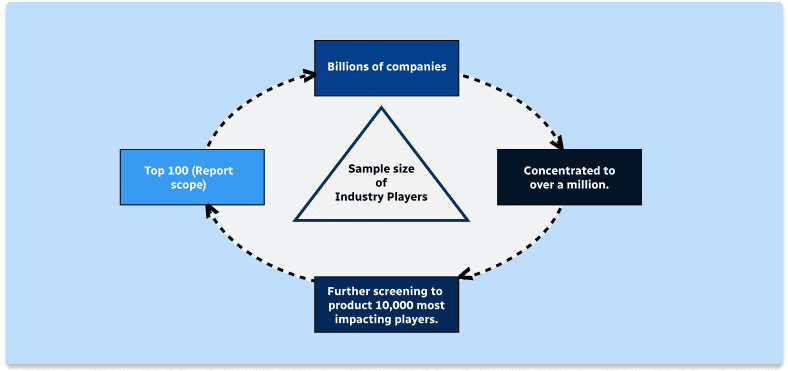
Step 1 - Identification of Relevant Samples Size from Population Database

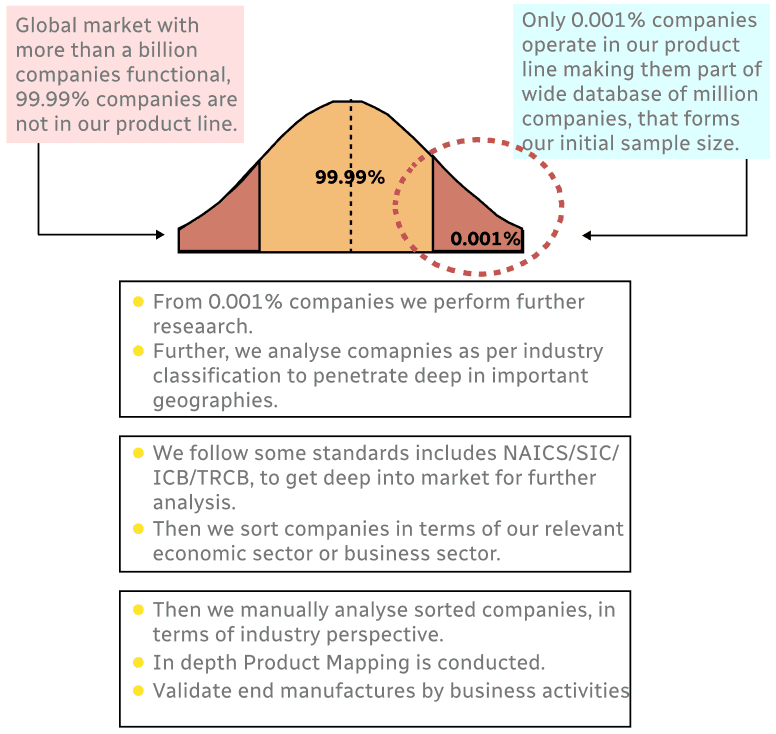
Step 2 - Approaches for Defining Global Market Size (Value, Volume* & Price*)
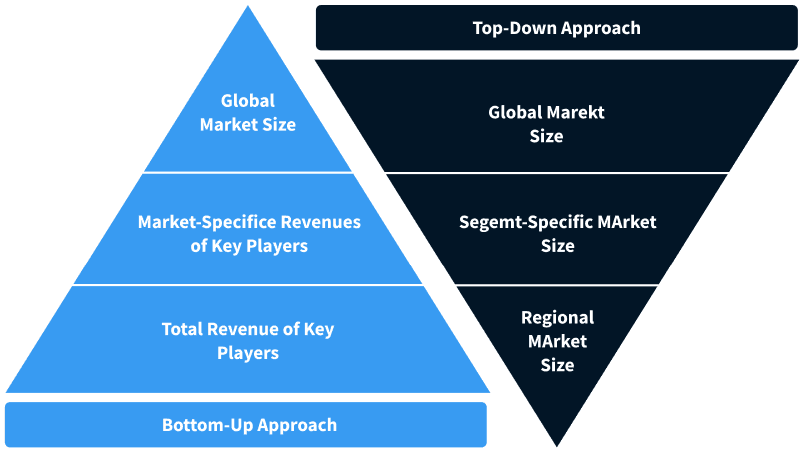
Note*: In applicable scenarios
Step 3 - Data Sources
Primary Research
- Web Analytics
- Survey Reports
- Research Institute
- Latest Research Reports
- Opinion Leaders
Secondary Research
- Annual Reports
- White Paper
- Latest Press Release
- Industry Association
- Paid Database
- Investor Presentations

Step 4 - Data Triangulation
Involves using different sources of information in order to increase the validity of a study
These sources are likely to be stakeholders in a program - participants, other researchers, program staff, other community members, and so on.
Then we put all data in single framework & apply various statistical tools to find out the dynamic on the market.
During the analysis stage, feedback from the stakeholder groups would be compared to determine areas of agreement as well as areas of divergence