


Key Insights
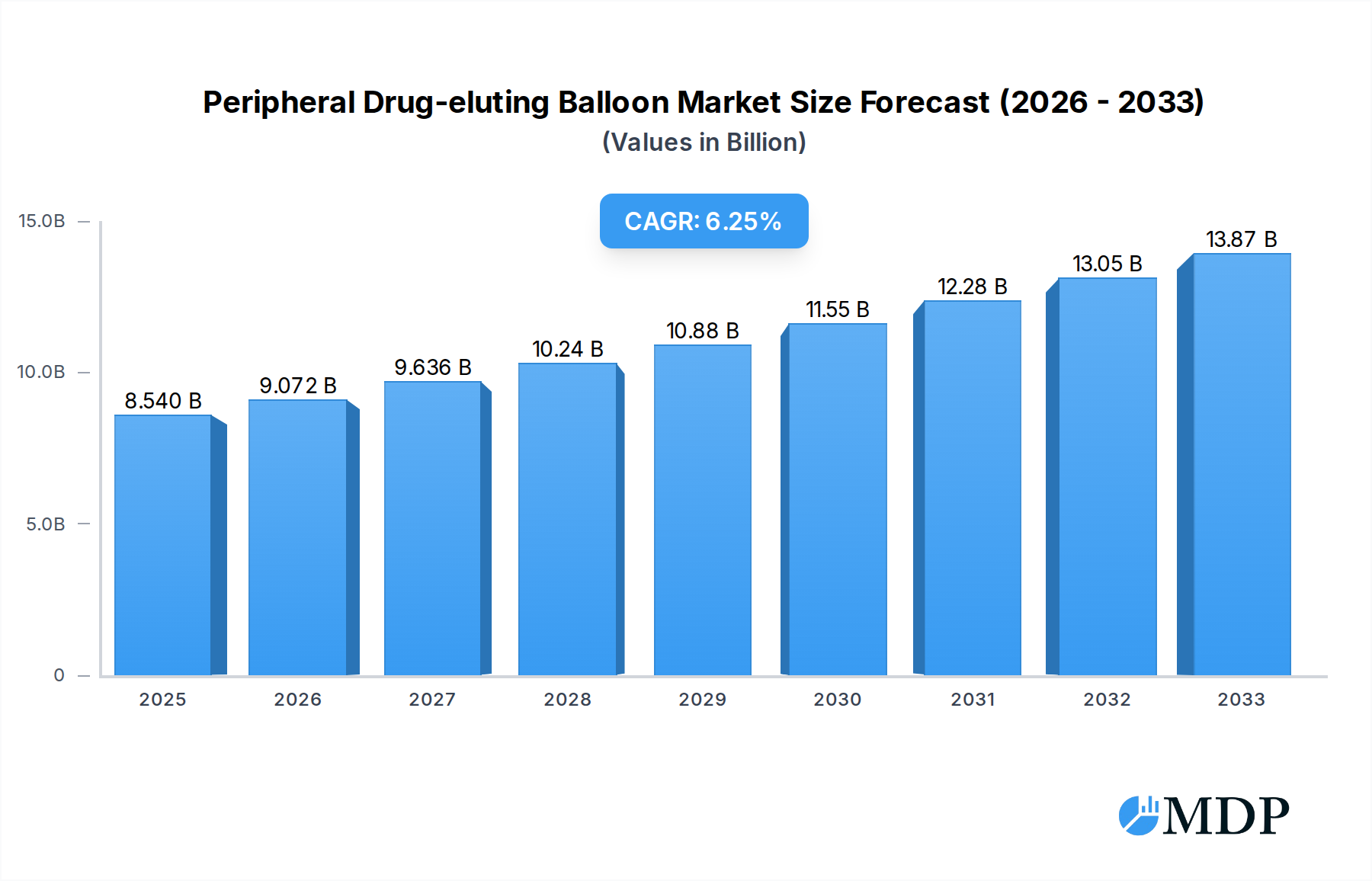
The global Peripheral Drug-Eluting Balloon market is poised for substantial growth, projected to reach USD 8.54 billion in 2025, with a robust Compound Annual Growth Rate (CAGR) of 6.12%. This upward trajectory is primarily fueled by the increasing prevalence of peripheral artery diseases (PAD) worldwide, driven by an aging population, sedentary lifestyles, and rising rates of diabetes and obesity. The minimally invasive nature of drug-eluting balloons, offering reduced recovery times and improved patient outcomes compared to traditional surgical interventions, further propels their adoption. Technological advancements in drug delivery systems and balloon catheter designs are enhancing efficacy and safety, making these devices a preferred choice for treating complex vascular lesions. The expanding healthcare infrastructure and increasing awareness of advanced treatment options in emerging economies are also contributing significantly to market expansion.
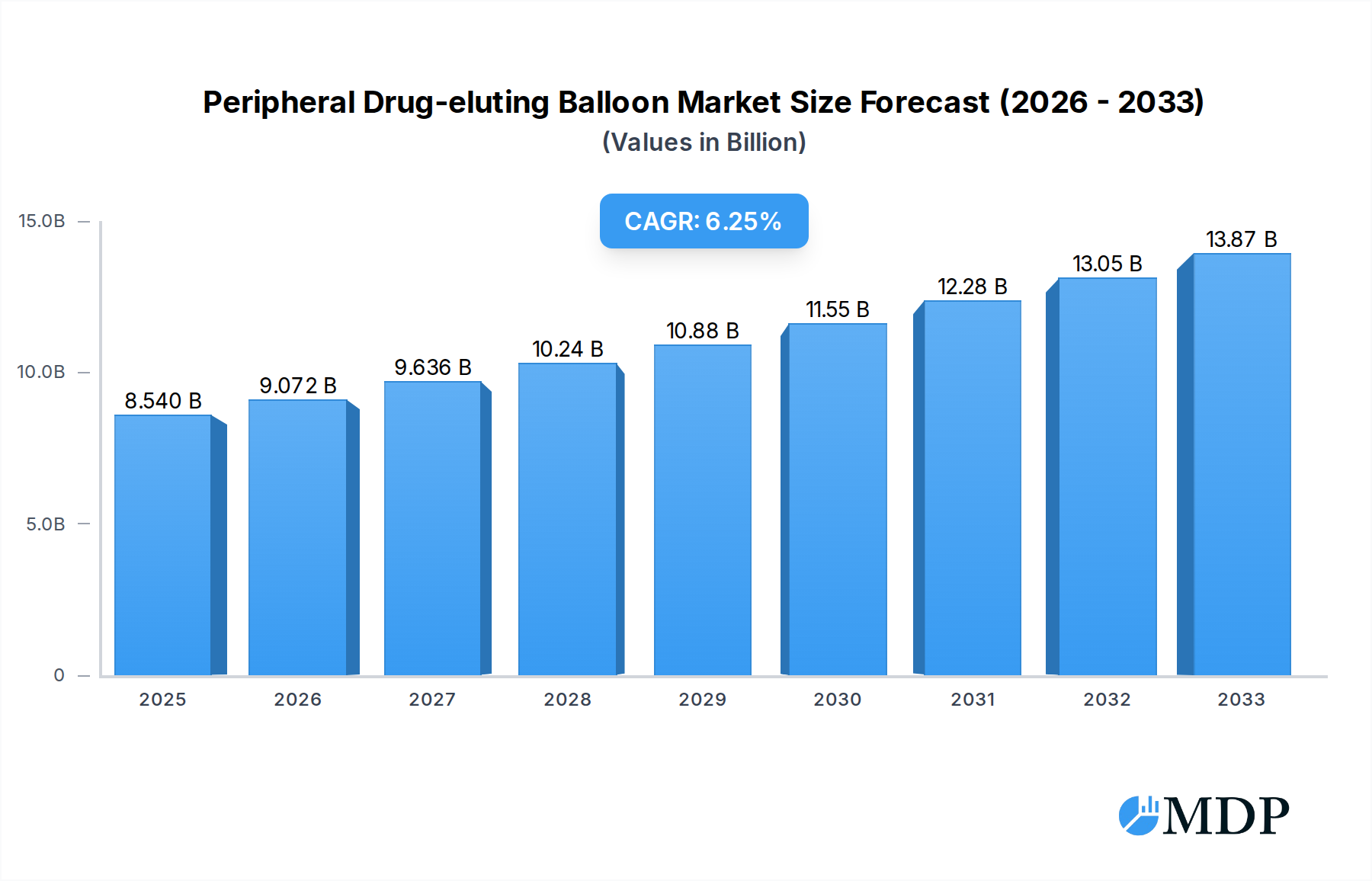
Peripheral Drug-eluting Balloon Market Size (In Billion)

Key drivers of this market include the growing demand for interventional cardiology and radiology procedures, the development of innovative drug-eluting technologies that reduce restenosis rates, and favorable reimbursement policies in many regions. The market is segmented by application, with Lower Limbs representing a dominant segment due to the high incidence of PAD in this area, followed by Renal Artery and Carotid Artery applications. Paclitaxel remains the leading drug used in these balloons, though research into alternative and more potent therapeutic agents is ongoing. Major players like Medtronic, Boston Scientific, and Terumo Corporation are heavily investing in research and development to introduce next-generation devices and expand their global footprint. Despite the positive outlook, challenges such as stringent regulatory approvals and the high cost of advanced devices may pose some restraints, but the overall market sentiment remains highly optimistic due to the clear clinical benefits and expanding application scope.
Peripheral Drug-eluting Balloon Company Market Share
Peripheral Drug-Eluting Balloon Market: Comprehensive Analysis and Future Outlook (2019–2033)
This in-depth report provides a comprehensive analysis of the global Peripheral Drug-Eluting Balloon (PDEB) market, offering invaluable insights for stakeholders seeking to navigate this rapidly evolving sector. With a detailed study period spanning 2019–2033, a base year of 2025, and a forecast period of 2025–2033, this report delves into market dynamics, trends, leading segments, product developments, growth drivers, challenges, emerging opportunities, key players, significant milestones, and strategic outlook. The market is projected to reach a value of several billion dollars by 2033, driven by increasing prevalence of peripheral artery disease (PAD), advancements in minimally invasive procedures, and favorable reimbursement policies.
Peripheral Drug-eluting Balloon Market Dynamics & Concentration
The Peripheral Drug-Eluting Balloon (PDEB) market exhibits a moderate to high level of concentration, with several key players dominating a significant portion of the market share. Leading companies like Medtronic, Boston Scientific, and Terumo Corporation are at the forefront, leveraging their established distribution networks and extensive R&D capabilities. Innovation remains a primary driver, with continuous efforts to develop balloons with enhanced drug delivery efficacy, improved biocompatibility, and novel drug formulations. Regulatory frameworks, while essential for ensuring patient safety, can also present hurdles, demanding rigorous clinical trials and adherence to stringent approval processes. The emergence of new drug-eluting agents and advanced balloon technologies poses a continuous threat of product substitution, compelling established players to invest heavily in next-generation solutions. End-user trends lean towards minimally invasive approaches due to their reduced recovery times and lower complication rates, fueling the adoption of PDEBs. Mergers and acquisitions (M&A) activities are expected to play a crucial role in market consolidation and expansion, with a projected XX number of deals in the forecast period, further shaping the competitive landscape. Market share for leading players is estimated to be in the range of 15-25%.
Peripheral Drug-eluting Balloon Industry Trends & Analysis
The Peripheral Drug-Eluting Balloon (PDEB) industry is poised for substantial growth, driven by a confluence of technological advancements, an increasing global burden of peripheral artery disease (PAD), and a growing preference for minimally invasive surgical interventions. The rising prevalence of cardiovascular diseases, coupled with an aging global population, directly translates into a larger patient pool requiring treatment for conditions like claudication, critical limb ischemia, and arterial stenosis. This demographic shift is a fundamental market growth driver, pushing the demand for effective and less invasive treatment options. Technological disruptions are at the heart of the industry's evolution. Innovations in drug-coating technologies, material science for balloon manufacturing, and the development of novel antiproliferative drugs are continuously enhancing the efficacy and safety profile of PDEBs. For instance, the ability to deliver higher drug concentrations locally, reducing systemic exposure and associated side effects, is a significant technological leap. Furthermore, advancements in imaging and navigation technologies are improving procedural accuracy and patient outcomes, further boosting the confidence of interventional cardiologists and vascular surgeons in utilizing PDEBs. Consumer preferences are increasingly tilting towards outpatient procedures and faster recovery times, aligning perfectly with the benefits offered by PDEB technology. The competitive dynamics are intensifying, with established giants actively investing in R&D and smaller, agile companies focusing on niche innovations. The market penetration of PDEBs is expected to rise significantly, moving from an estimated XX% in the base year to an anticipated XX% by the end of the forecast period. The Compound Annual Growth Rate (CAGR) for the PDEB market is projected to be in the range of 8-10% over the forecast period, reaching an estimated market value of several billion dollars.
Leading Markets & Segments in Peripheral Drug-Eluting Balloon
The Peripheral Drug-Eluting Balloon (PDEB) market is characterized by distinct regional and segmental dominance, driven by varying healthcare infrastructures, disease prevalence, and regulatory landscapes.
Application Dominance: Lower Limbs
The Lower Limbs segment is unequivocally the largest and fastest-growing application area for Peripheral Drug-Eluting Balloons. This dominance stems from the widespread prevalence of Peripheral Artery Disease (PAD) affecting the legs and feet, leading to conditions like intermittent claudication and critical limb ischemia.
- Key Drivers for Lower Limbs Dominance:
- High Disease Prevalence: The escalating rates of diabetes, obesity, and sedentary lifestyles worldwide have contributed to a surge in PAD cases affecting the lower extremities.
- Aging Population: As the global population ages, the incidence of vascular diseases, including PAD, naturally increases.
- Minimally Invasive Preference: Patients and physicians increasingly favor less invasive treatments over traditional surgical bypass procedures for lower limb revascularization.
- Improved QoL: PDEBs offer significant improvements in quality of life for patients suffering from debilitating leg pain and mobility issues.
- Favorable Reimbursement: In many developed economies, reimbursement policies for endovascular interventions in the lower limbs are well-established, encouraging adoption.
Segment Dominance: Paclitaxel
Within the types of drug-eluting balloons, Paclitaxel currently holds the dominant position. This is attributed to its well-established efficacy in inhibiting smooth muscle cell proliferation, a key mechanism in preventing restenosis after angioplasty.
- Key Drivers for Paclitaxel Dominance:
- Proven Efficacy and Safety: Decades of clinical use and extensive research have established Paclitaxel as a safe and effective antiproliferative agent for vascular applications.
- Regulatory Approvals: Many regulatory bodies have a significant history of approving Paclitaxel-eluting devices, leading to broader market access.
- Cost-Effectiveness: Compared to some newer drug formulations, Paclitaxel-based PDEBs can offer a more cost-effective treatment option.
- Extensive Clinical Data: A vast body of clinical evidence supports the long-term benefits of Paclitaxel in reducing restenosis rates.
Regional Dominance: North America and Europe
Geographically, North America and Europe are leading markets for Peripheral Drug-Eluting Balloons.
- Key Drivers for Regional Dominance:
- Advanced Healthcare Infrastructure: Both regions boast highly developed healthcare systems with advanced medical technology and widespread access to specialized care.
- High Healthcare Expenditure: Significant investment in healthcare services allows for the adoption of innovative and often more expensive medical devices.
- Established Regulatory Pathways: Robust regulatory frameworks, while stringent, facilitate the approval and market entry of new medical technologies.
- Awareness and Education: High levels of public and physician awareness regarding vascular diseases and treatment options contribute to market growth.
- Strong R&D Ecosystem: The presence of leading medical device manufacturers and research institutions fosters continuous innovation and product development.
The Renal Artery and Carotid Artery segments are also crucial, experiencing steady growth driven by the need to manage renal artery stenosis (a cause of hypertension and kidney disease) and carotid artery disease (a major risk factor for stroke). While "Others" in terms of drug types may see growth with novel drug introductions, Paclitaxel remains the benchmark.
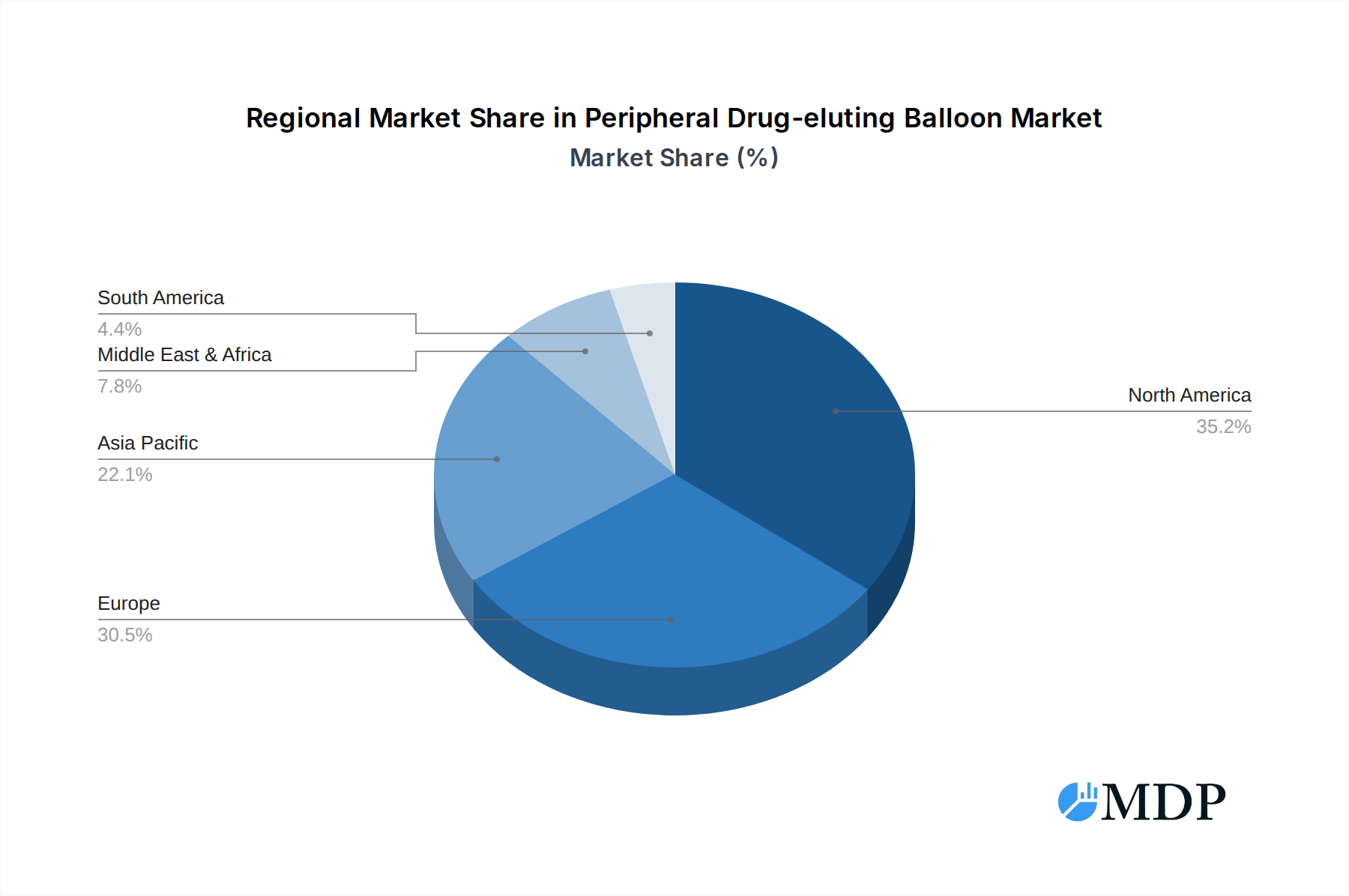
Peripheral Drug-eluting Balloon Regional Market Share
Peripheral Drug-Eluting Balloon Product Developments
Ongoing product developments in the Peripheral Drug-Eluting Balloon (PDEB) market are focused on enhancing drug efficacy, improving delivery systems, and expanding therapeutic applications. Innovations include advanced balloon materials for better conformability and radial strength, and novel drug elution profiles to optimize therapeutic delivery over specific timeframes. Companies are also exploring new drug formulations beyond Paclitaxel, aiming for improved safety and efficacy against restenosis. These advancements are crucial for addressing unmet clinical needs in complex lesion subsets and for improving patient outcomes in lower limb, renal artery, and carotid artery interventions. The competitive advantage lies in demonstrating superior patency rates and reduced complication profiles through rigorous clinical validation.
Key Drivers of Peripheral Drug-Eluting Balloon Growth
The growth of the Peripheral Drug-Eluting Balloon (PDEB) market is propelled by several interconnected factors. Firstly, the escalating global prevalence of peripheral artery disease (PAD) due to an aging population and rising rates of comorbidities like diabetes and obesity creates a continuously expanding patient pool. Secondly, advancements in medical technology, particularly in minimally invasive endovascular techniques, are making PDEBs a preferred treatment option over traditional open surgeries, leading to improved patient outcomes and faster recovery times. Thirdly, favorable reimbursement policies and increasing healthcare expenditure in both developed and emerging economies are enhancing access to these innovative devices. Finally, ongoing research and development efforts are leading to more effective drug formulations and improved balloon designs, further driving adoption.
Challenges in the Peripheral Drug-Eluting Balloon Market
Despite robust growth, the Peripheral Drug-Eluting Balloon (PDEB) market faces several challenges. Stringent and evolving regulatory approval processes across different regions can lead to extended market entry timelines and increased R&D costs. Supply chain disruptions, particularly concerning specialized drug coatings and biocompatible materials, can impact production and availability, leading to increased costs. Furthermore, the competitive pressure from alternative treatment modalities, including bare metal stents, drug-eluting stents, and atherectomy devices, necessitates continuous innovation and demonstration of superior clinical benefits. Pricing pressures from healthcare payers and the need for extensive post-market surveillance also pose significant challenges, requiring substantial investment.
Emerging Opportunities in Peripheral Drug-Eluting Balloon
Emerging opportunities in the Peripheral Drug-Eluting Balloon (PDEB) market are centered around unmet clinical needs and technological innovation. The development of novel drug formulations with improved safety profiles and broader therapeutic targets, moving beyond solely antiproliferative agents, presents a significant avenue for growth. Expanding the application of PDEBs to more complex lesion types and less commonly treated peripheral arteries offers new market potential. Strategic partnerships between medical device manufacturers, pharmaceutical companies, and research institutions can accelerate the development and commercialization of next-generation PDEBs. Furthermore, increasing adoption in emerging markets with a growing burden of vascular diseases and improving healthcare infrastructure offers substantial long-term growth prospects.
Leading Players in the Peripheral Drug-Eluting Balloon Sector
- Medtronic
- Boston Scientific
- Terumo Corporation
- Acotec
- BD
- Surmodics
- Biotronik
- Shanghai MicroPort Endovascular MedTech(Group)Co.,Ltd.
- Zylox-Tonbridge Medical Technology Co.,Ltd.
Key Milestones in Peripheral Drug-Eluting Balloon Industry
- 2019: Significant increase in clinical trials evaluating novel drug combinations for PDEBs.
- 2020: Introduction of new balloon designs with enhanced flexibility and drug elution profiles.
- 2021: Growing regulatory scrutiny and focus on long-term safety data for drug-eluting devices.
- 2022: Increased M&A activities signaling market consolidation and strategic partnerships.
- 2023: Emergence of PDEBs with biodegradable drug coatings gaining traction.
- 2024: Expanded indications for existing PDEBs in more complex patient anatomies.
- 2025 (Projected): Anticipated approval of novel drug-eluting balloons with extended therapeutic effects.
- 2026–2033 (Projected): Continuous innovation in drug delivery mechanisms and personalized treatment approaches.
Strategic Outlook for Peripheral Drug-Eluting Balloon Market
The strategic outlook for the Peripheral Drug-Eluting Balloon (PDEB) market is overwhelmingly positive, driven by sustained innovation and increasing clinical acceptance. Growth accelerators will include the development of advanced drug-eluting technologies, such as those offering controlled and targeted drug release, and the exploration of novel therapeutic agents to combat restenosis and inflammation more effectively. Expanding indications to treat a wider spectrum of peripheral vascular lesions, including those in smaller, more distal vessels, will unlock new market segments. Furthermore, strategic collaborations and acquisitions will play a pivotal role in consolidating market share and expanding global reach, particularly in high-growth emerging economies. The focus on improving patient outcomes, reducing hospital stays, and enhancing the overall quality of life for patients with PAD will continue to fuel demand for these advanced endovascular solutions.
Peripheral Drug-eluting Balloon Segmentation
-
1. Application
- 1.1. Lower Limbs
- 1.2. Renal Artery
- 1.3. Carotid Artery
-
2. Types
- 2.1. Paclitaxel
- 2.2. Others
Peripheral Drug-eluting Balloon Segmentation By Geography
-
1. North America
- 1.1. United States
- 1.2. Canada
- 1.3. Mexico
-
2. South America
- 2.1. Brazil
- 2.2. Argentina
- 2.3. Rest of South America
-
3. Europe
- 3.1. United Kingdom
- 3.2. Germany
- 3.3. France
- 3.4. Italy
- 3.5. Spain
- 3.6. Russia
- 3.7. Benelux
- 3.8. Nordics
- 3.9. Rest of Europe
-
4. Middle East & Africa
- 4.1. Turkey
- 4.2. Israel
- 4.3. GCC
- 4.4. North Africa
- 4.5. South Africa
- 4.6. Rest of Middle East & Africa
-
5. Asia Pacific
- 5.1. China
- 5.2. India
- 5.3. Japan
- 5.4. South Korea
- 5.5. ASEAN
- 5.6. Oceania
- 5.7. Rest of Asia Pacific
Peripheral Drug-eluting Balloon Regional Market Share
Geographic Coverage of Peripheral Drug-eluting Balloon
Peripheral Drug-eluting Balloon REPORT HIGHLIGHTS
| Aspects | Details |
|---|---|
| Study Period | 2020-2034 |
| Base Year | 2025 |
| Estimated Year | 2026 |
| Forecast Period | 2026-2034 |
| Historical Period | 2020-2025 |
| Growth Rate | CAGR of 6.12% from 2020-2034 |
| Segmentation |
|
Table of Contents
- 1. Introduction
- 1.1. Research Scope
- 1.2. Market Segmentation
- 1.3. Research Methodology
- 1.4. Definitions and Assumptions
- 2. Executive Summary
- 2.1. Introduction
- 3. Market Dynamics
- 3.1. Introduction
- 3.2. Market Drivers
- 3.3. Market Restrains
- 3.4. Market Trends
- 4. Market Factor Analysis
- 4.1. Porters Five Forces
- 4.2. Supply/Value Chain
- 4.3. PESTEL analysis
- 4.4. Market Entropy
- 4.5. Patent/Trademark Analysis
- 5. Global Peripheral Drug-eluting Balloon Analysis, Insights and Forecast, 2020-2032
- 5.1. Market Analysis, Insights and Forecast - by Application
- 5.1.1. Lower Limbs
- 5.1.2. Renal Artery
- 5.1.3. Carotid Artery
- 5.2. Market Analysis, Insights and Forecast - by Types
- 5.2.1. Paclitaxel
- 5.2.2. Others
- 5.3. Market Analysis, Insights and Forecast - by Region
- 5.3.1. North America
- 5.3.2. South America
- 5.3.3. Europe
- 5.3.4. Middle East & Africa
- 5.3.5. Asia Pacific
- 5.1. Market Analysis, Insights and Forecast - by Application
- 6. North America Peripheral Drug-eluting Balloon Analysis, Insights and Forecast, 2020-2032
- 6.1. Market Analysis, Insights and Forecast - by Application
- 6.1.1. Lower Limbs
- 6.1.2. Renal Artery
- 6.1.3. Carotid Artery
- 6.2. Market Analysis, Insights and Forecast - by Types
- 6.2.1. Paclitaxel
- 6.2.2. Others
- 6.1. Market Analysis, Insights and Forecast - by Application
- 7. South America Peripheral Drug-eluting Balloon Analysis, Insights and Forecast, 2020-2032
- 7.1. Market Analysis, Insights and Forecast - by Application
- 7.1.1. Lower Limbs
- 7.1.2. Renal Artery
- 7.1.3. Carotid Artery
- 7.2. Market Analysis, Insights and Forecast - by Types
- 7.2.1. Paclitaxel
- 7.2.2. Others
- 7.1. Market Analysis, Insights and Forecast - by Application
- 8. Europe Peripheral Drug-eluting Balloon Analysis, Insights and Forecast, 2020-2032
- 8.1. Market Analysis, Insights and Forecast - by Application
- 8.1.1. Lower Limbs
- 8.1.2. Renal Artery
- 8.1.3. Carotid Artery
- 8.2. Market Analysis, Insights and Forecast - by Types
- 8.2.1. Paclitaxel
- 8.2.2. Others
- 8.1. Market Analysis, Insights and Forecast - by Application
- 9. Middle East & Africa Peripheral Drug-eluting Balloon Analysis, Insights and Forecast, 2020-2032
- 9.1. Market Analysis, Insights and Forecast - by Application
- 9.1.1. Lower Limbs
- 9.1.2. Renal Artery
- 9.1.3. Carotid Artery
- 9.2. Market Analysis, Insights and Forecast - by Types
- 9.2.1. Paclitaxel
- 9.2.2. Others
- 9.1. Market Analysis, Insights and Forecast - by Application
- 10. Asia Pacific Peripheral Drug-eluting Balloon Analysis, Insights and Forecast, 2020-2032
- 10.1. Market Analysis, Insights and Forecast - by Application
- 10.1.1. Lower Limbs
- 10.1.2. Renal Artery
- 10.1.3. Carotid Artery
- 10.2. Market Analysis, Insights and Forecast - by Types
- 10.2.1. Paclitaxel
- 10.2.2. Others
- 10.1. Market Analysis, Insights and Forecast - by Application
- 11. Competitive Analysis
- 11.1. Global Market Share Analysis 2025
- 11.2. Company Profiles
- 11.2.1 Medtronic
- 11.2.1.1. Overview
- 11.2.1.2. Products
- 11.2.1.3. SWOT Analysis
- 11.2.1.4. Recent Developments
- 11.2.1.5. Financials (Based on Availability)
- 11.2.2 Boston Scientific
- 11.2.2.1. Overview
- 11.2.2.2. Products
- 11.2.2.3. SWOT Analysis
- 11.2.2.4. Recent Developments
- 11.2.2.5. Financials (Based on Availability)
- 11.2.3 Terumo Corporation
- 11.2.3.1. Overview
- 11.2.3.2. Products
- 11.2.3.3. SWOT Analysis
- 11.2.3.4. Recent Developments
- 11.2.3.5. Financials (Based on Availability)
- 11.2.4 Acotec
- 11.2.4.1. Overview
- 11.2.4.2. Products
- 11.2.4.3. SWOT Analysis
- 11.2.4.4. Recent Developments
- 11.2.4.5. Financials (Based on Availability)
- 11.2.5 BD
- 11.2.5.1. Overview
- 11.2.5.2. Products
- 11.2.5.3. SWOT Analysis
- 11.2.5.4. Recent Developments
- 11.2.5.5. Financials (Based on Availability)
- 11.2.6 Surmodics
- 11.2.6.1. Overview
- 11.2.6.2. Products
- 11.2.6.3. SWOT Analysis
- 11.2.6.4. Recent Developments
- 11.2.6.5. Financials (Based on Availability)
- 11.2.7 Biotronik
- 11.2.7.1. Overview
- 11.2.7.2. Products
- 11.2.7.3. SWOT Analysis
- 11.2.7.4. Recent Developments
- 11.2.7.5. Financials (Based on Availability)
- 11.2.8 Shanghai MicroPort Endovascular MedTech(Group)Co.
- 11.2.8.1. Overview
- 11.2.8.2. Products
- 11.2.8.3. SWOT Analysis
- 11.2.8.4. Recent Developments
- 11.2.8.5. Financials (Based on Availability)
- 11.2.9 Ltd.
- 11.2.9.1. Overview
- 11.2.9.2. Products
- 11.2.9.3. SWOT Analysis
- 11.2.9.4. Recent Developments
- 11.2.9.5. Financials (Based on Availability)
- 11.2.10 Zylox-Tonbridge Medical Technology Co.
- 11.2.10.1. Overview
- 11.2.10.2. Products
- 11.2.10.3. SWOT Analysis
- 11.2.10.4. Recent Developments
- 11.2.10.5. Financials (Based on Availability)
- 11.2.11 Ltd.
- 11.2.11.1. Overview
- 11.2.11.2. Products
- 11.2.11.3. SWOT Analysis
- 11.2.11.4. Recent Developments
- 11.2.11.5. Financials (Based on Availability)
- 11.2.1 Medtronic
List of Figures
- Figure 1: Global Peripheral Drug-eluting Balloon Revenue Breakdown (undefined, %) by Region 2025 & 2033
- Figure 2: Global Peripheral Drug-eluting Balloon Volume Breakdown (K, %) by Region 2025 & 2033
- Figure 3: North America Peripheral Drug-eluting Balloon Revenue (undefined), by Application 2025 & 2033
- Figure 4: North America Peripheral Drug-eluting Balloon Volume (K), by Application 2025 & 2033
- Figure 5: North America Peripheral Drug-eluting Balloon Revenue Share (%), by Application 2025 & 2033
- Figure 6: North America Peripheral Drug-eluting Balloon Volume Share (%), by Application 2025 & 2033
- Figure 7: North America Peripheral Drug-eluting Balloon Revenue (undefined), by Types 2025 & 2033
- Figure 8: North America Peripheral Drug-eluting Balloon Volume (K), by Types 2025 & 2033
- Figure 9: North America Peripheral Drug-eluting Balloon Revenue Share (%), by Types 2025 & 2033
- Figure 10: North America Peripheral Drug-eluting Balloon Volume Share (%), by Types 2025 & 2033
- Figure 11: North America Peripheral Drug-eluting Balloon Revenue (undefined), by Country 2025 & 2033
- Figure 12: North America Peripheral Drug-eluting Balloon Volume (K), by Country 2025 & 2033
- Figure 13: North America Peripheral Drug-eluting Balloon Revenue Share (%), by Country 2025 & 2033
- Figure 14: North America Peripheral Drug-eluting Balloon Volume Share (%), by Country 2025 & 2033
- Figure 15: South America Peripheral Drug-eluting Balloon Revenue (undefined), by Application 2025 & 2033
- Figure 16: South America Peripheral Drug-eluting Balloon Volume (K), by Application 2025 & 2033
- Figure 17: South America Peripheral Drug-eluting Balloon Revenue Share (%), by Application 2025 & 2033
- Figure 18: South America Peripheral Drug-eluting Balloon Volume Share (%), by Application 2025 & 2033
- Figure 19: South America Peripheral Drug-eluting Balloon Revenue (undefined), by Types 2025 & 2033
- Figure 20: South America Peripheral Drug-eluting Balloon Volume (K), by Types 2025 & 2033
- Figure 21: South America Peripheral Drug-eluting Balloon Revenue Share (%), by Types 2025 & 2033
- Figure 22: South America Peripheral Drug-eluting Balloon Volume Share (%), by Types 2025 & 2033
- Figure 23: South America Peripheral Drug-eluting Balloon Revenue (undefined), by Country 2025 & 2033
- Figure 24: South America Peripheral Drug-eluting Balloon Volume (K), by Country 2025 & 2033
- Figure 25: South America Peripheral Drug-eluting Balloon Revenue Share (%), by Country 2025 & 2033
- Figure 26: South America Peripheral Drug-eluting Balloon Volume Share (%), by Country 2025 & 2033
- Figure 27: Europe Peripheral Drug-eluting Balloon Revenue (undefined), by Application 2025 & 2033
- Figure 28: Europe Peripheral Drug-eluting Balloon Volume (K), by Application 2025 & 2033
- Figure 29: Europe Peripheral Drug-eluting Balloon Revenue Share (%), by Application 2025 & 2033
- Figure 30: Europe Peripheral Drug-eluting Balloon Volume Share (%), by Application 2025 & 2033
- Figure 31: Europe Peripheral Drug-eluting Balloon Revenue (undefined), by Types 2025 & 2033
- Figure 32: Europe Peripheral Drug-eluting Balloon Volume (K), by Types 2025 & 2033
- Figure 33: Europe Peripheral Drug-eluting Balloon Revenue Share (%), by Types 2025 & 2033
- Figure 34: Europe Peripheral Drug-eluting Balloon Volume Share (%), by Types 2025 & 2033
- Figure 35: Europe Peripheral Drug-eluting Balloon Revenue (undefined), by Country 2025 & 2033
- Figure 36: Europe Peripheral Drug-eluting Balloon Volume (K), by Country 2025 & 2033
- Figure 37: Europe Peripheral Drug-eluting Balloon Revenue Share (%), by Country 2025 & 2033
- Figure 38: Europe Peripheral Drug-eluting Balloon Volume Share (%), by Country 2025 & 2033
- Figure 39: Middle East & Africa Peripheral Drug-eluting Balloon Revenue (undefined), by Application 2025 & 2033
- Figure 40: Middle East & Africa Peripheral Drug-eluting Balloon Volume (K), by Application 2025 & 2033
- Figure 41: Middle East & Africa Peripheral Drug-eluting Balloon Revenue Share (%), by Application 2025 & 2033
- Figure 42: Middle East & Africa Peripheral Drug-eluting Balloon Volume Share (%), by Application 2025 & 2033
- Figure 43: Middle East & Africa Peripheral Drug-eluting Balloon Revenue (undefined), by Types 2025 & 2033
- Figure 44: Middle East & Africa Peripheral Drug-eluting Balloon Volume (K), by Types 2025 & 2033
- Figure 45: Middle East & Africa Peripheral Drug-eluting Balloon Revenue Share (%), by Types 2025 & 2033
- Figure 46: Middle East & Africa Peripheral Drug-eluting Balloon Volume Share (%), by Types 2025 & 2033
- Figure 47: Middle East & Africa Peripheral Drug-eluting Balloon Revenue (undefined), by Country 2025 & 2033
- Figure 48: Middle East & Africa Peripheral Drug-eluting Balloon Volume (K), by Country 2025 & 2033
- Figure 49: Middle East & Africa Peripheral Drug-eluting Balloon Revenue Share (%), by Country 2025 & 2033
- Figure 50: Middle East & Africa Peripheral Drug-eluting Balloon Volume Share (%), by Country 2025 & 2033
- Figure 51: Asia Pacific Peripheral Drug-eluting Balloon Revenue (undefined), by Application 2025 & 2033
- Figure 52: Asia Pacific Peripheral Drug-eluting Balloon Volume (K), by Application 2025 & 2033
- Figure 53: Asia Pacific Peripheral Drug-eluting Balloon Revenue Share (%), by Application 2025 & 2033
- Figure 54: Asia Pacific Peripheral Drug-eluting Balloon Volume Share (%), by Application 2025 & 2033
- Figure 55: Asia Pacific Peripheral Drug-eluting Balloon Revenue (undefined), by Types 2025 & 2033
- Figure 56: Asia Pacific Peripheral Drug-eluting Balloon Volume (K), by Types 2025 & 2033
- Figure 57: Asia Pacific Peripheral Drug-eluting Balloon Revenue Share (%), by Types 2025 & 2033
- Figure 58: Asia Pacific Peripheral Drug-eluting Balloon Volume Share (%), by Types 2025 & 2033
- Figure 59: Asia Pacific Peripheral Drug-eluting Balloon Revenue (undefined), by Country 2025 & 2033
- Figure 60: Asia Pacific Peripheral Drug-eluting Balloon Volume (K), by Country 2025 & 2033
- Figure 61: Asia Pacific Peripheral Drug-eluting Balloon Revenue Share (%), by Country 2025 & 2033
- Figure 62: Asia Pacific Peripheral Drug-eluting Balloon Volume Share (%), by Country 2025 & 2033
List of Tables
- Table 1: Global Peripheral Drug-eluting Balloon Revenue undefined Forecast, by Application 2020 & 2033
- Table 2: Global Peripheral Drug-eluting Balloon Volume K Forecast, by Application 2020 & 2033
- Table 3: Global Peripheral Drug-eluting Balloon Revenue undefined Forecast, by Types 2020 & 2033
- Table 4: Global Peripheral Drug-eluting Balloon Volume K Forecast, by Types 2020 & 2033
- Table 5: Global Peripheral Drug-eluting Balloon Revenue undefined Forecast, by Region 2020 & 2033
- Table 6: Global Peripheral Drug-eluting Balloon Volume K Forecast, by Region 2020 & 2033
- Table 7: Global Peripheral Drug-eluting Balloon Revenue undefined Forecast, by Application 2020 & 2033
- Table 8: Global Peripheral Drug-eluting Balloon Volume K Forecast, by Application 2020 & 2033
- Table 9: Global Peripheral Drug-eluting Balloon Revenue undefined Forecast, by Types 2020 & 2033
- Table 10: Global Peripheral Drug-eluting Balloon Volume K Forecast, by Types 2020 & 2033
- Table 11: Global Peripheral Drug-eluting Balloon Revenue undefined Forecast, by Country 2020 & 2033
- Table 12: Global Peripheral Drug-eluting Balloon Volume K Forecast, by Country 2020 & 2033
- Table 13: United States Peripheral Drug-eluting Balloon Revenue (undefined) Forecast, by Application 2020 & 2033
- Table 14: United States Peripheral Drug-eluting Balloon Volume (K) Forecast, by Application 2020 & 2033
- Table 15: Canada Peripheral Drug-eluting Balloon Revenue (undefined) Forecast, by Application 2020 & 2033
- Table 16: Canada Peripheral Drug-eluting Balloon Volume (K) Forecast, by Application 2020 & 2033
- Table 17: Mexico Peripheral Drug-eluting Balloon Revenue (undefined) Forecast, by Application 2020 & 2033
- Table 18: Mexico Peripheral Drug-eluting Balloon Volume (K) Forecast, by Application 2020 & 2033
- Table 19: Global Peripheral Drug-eluting Balloon Revenue undefined Forecast, by Application 2020 & 2033
- Table 20: Global Peripheral Drug-eluting Balloon Volume K Forecast, by Application 2020 & 2033
- Table 21: Global Peripheral Drug-eluting Balloon Revenue undefined Forecast, by Types 2020 & 2033
- Table 22: Global Peripheral Drug-eluting Balloon Volume K Forecast, by Types 2020 & 2033
- Table 23: Global Peripheral Drug-eluting Balloon Revenue undefined Forecast, by Country 2020 & 2033
- Table 24: Global Peripheral Drug-eluting Balloon Volume K Forecast, by Country 2020 & 2033
- Table 25: Brazil Peripheral Drug-eluting Balloon Revenue (undefined) Forecast, by Application 2020 & 2033
- Table 26: Brazil Peripheral Drug-eluting Balloon Volume (K) Forecast, by Application 2020 & 2033
- Table 27: Argentina Peripheral Drug-eluting Balloon Revenue (undefined) Forecast, by Application 2020 & 2033
- Table 28: Argentina Peripheral Drug-eluting Balloon Volume (K) Forecast, by Application 2020 & 2033
- Table 29: Rest of South America Peripheral Drug-eluting Balloon Revenue (undefined) Forecast, by Application 2020 & 2033
- Table 30: Rest of South America Peripheral Drug-eluting Balloon Volume (K) Forecast, by Application 2020 & 2033
- Table 31: Global Peripheral Drug-eluting Balloon Revenue undefined Forecast, by Application 2020 & 2033
- Table 32: Global Peripheral Drug-eluting Balloon Volume K Forecast, by Application 2020 & 2033
- Table 33: Global Peripheral Drug-eluting Balloon Revenue undefined Forecast, by Types 2020 & 2033
- Table 34: Global Peripheral Drug-eluting Balloon Volume K Forecast, by Types 2020 & 2033
- Table 35: Global Peripheral Drug-eluting Balloon Revenue undefined Forecast, by Country 2020 & 2033
- Table 36: Global Peripheral Drug-eluting Balloon Volume K Forecast, by Country 2020 & 2033
- Table 37: United Kingdom Peripheral Drug-eluting Balloon Revenue (undefined) Forecast, by Application 2020 & 2033
- Table 38: United Kingdom Peripheral Drug-eluting Balloon Volume (K) Forecast, by Application 2020 & 2033
- Table 39: Germany Peripheral Drug-eluting Balloon Revenue (undefined) Forecast, by Application 2020 & 2033
- Table 40: Germany Peripheral Drug-eluting Balloon Volume (K) Forecast, by Application 2020 & 2033
- Table 41: France Peripheral Drug-eluting Balloon Revenue (undefined) Forecast, by Application 2020 & 2033
- Table 42: France Peripheral Drug-eluting Balloon Volume (K) Forecast, by Application 2020 & 2033
- Table 43: Italy Peripheral Drug-eluting Balloon Revenue (undefined) Forecast, by Application 2020 & 2033
- Table 44: Italy Peripheral Drug-eluting Balloon Volume (K) Forecast, by Application 2020 & 2033
- Table 45: Spain Peripheral Drug-eluting Balloon Revenue (undefined) Forecast, by Application 2020 & 2033
- Table 46: Spain Peripheral Drug-eluting Balloon Volume (K) Forecast, by Application 2020 & 2033
- Table 47: Russia Peripheral Drug-eluting Balloon Revenue (undefined) Forecast, by Application 2020 & 2033
- Table 48: Russia Peripheral Drug-eluting Balloon Volume (K) Forecast, by Application 2020 & 2033
- Table 49: Benelux Peripheral Drug-eluting Balloon Revenue (undefined) Forecast, by Application 2020 & 2033
- Table 50: Benelux Peripheral Drug-eluting Balloon Volume (K) Forecast, by Application 2020 & 2033
- Table 51: Nordics Peripheral Drug-eluting Balloon Revenue (undefined) Forecast, by Application 2020 & 2033
- Table 52: Nordics Peripheral Drug-eluting Balloon Volume (K) Forecast, by Application 2020 & 2033
- Table 53: Rest of Europe Peripheral Drug-eluting Balloon Revenue (undefined) Forecast, by Application 2020 & 2033
- Table 54: Rest of Europe Peripheral Drug-eluting Balloon Volume (K) Forecast, by Application 2020 & 2033
- Table 55: Global Peripheral Drug-eluting Balloon Revenue undefined Forecast, by Application 2020 & 2033
- Table 56: Global Peripheral Drug-eluting Balloon Volume K Forecast, by Application 2020 & 2033
- Table 57: Global Peripheral Drug-eluting Balloon Revenue undefined Forecast, by Types 2020 & 2033
- Table 58: Global Peripheral Drug-eluting Balloon Volume K Forecast, by Types 2020 & 2033
- Table 59: Global Peripheral Drug-eluting Balloon Revenue undefined Forecast, by Country 2020 & 2033
- Table 60: Global Peripheral Drug-eluting Balloon Volume K Forecast, by Country 2020 & 2033
- Table 61: Turkey Peripheral Drug-eluting Balloon Revenue (undefined) Forecast, by Application 2020 & 2033
- Table 62: Turkey Peripheral Drug-eluting Balloon Volume (K) Forecast, by Application 2020 & 2033
- Table 63: Israel Peripheral Drug-eluting Balloon Revenue (undefined) Forecast, by Application 2020 & 2033
- Table 64: Israel Peripheral Drug-eluting Balloon Volume (K) Forecast, by Application 2020 & 2033
- Table 65: GCC Peripheral Drug-eluting Balloon Revenue (undefined) Forecast, by Application 2020 & 2033
- Table 66: GCC Peripheral Drug-eluting Balloon Volume (K) Forecast, by Application 2020 & 2033
- Table 67: North Africa Peripheral Drug-eluting Balloon Revenue (undefined) Forecast, by Application 2020 & 2033
- Table 68: North Africa Peripheral Drug-eluting Balloon Volume (K) Forecast, by Application 2020 & 2033
- Table 69: South Africa Peripheral Drug-eluting Balloon Revenue (undefined) Forecast, by Application 2020 & 2033
- Table 70: South Africa Peripheral Drug-eluting Balloon Volume (K) Forecast, by Application 2020 & 2033
- Table 71: Rest of Middle East & Africa Peripheral Drug-eluting Balloon Revenue (undefined) Forecast, by Application 2020 & 2033
- Table 72: Rest of Middle East & Africa Peripheral Drug-eluting Balloon Volume (K) Forecast, by Application 2020 & 2033
- Table 73: Global Peripheral Drug-eluting Balloon Revenue undefined Forecast, by Application 2020 & 2033
- Table 74: Global Peripheral Drug-eluting Balloon Volume K Forecast, by Application 2020 & 2033
- Table 75: Global Peripheral Drug-eluting Balloon Revenue undefined Forecast, by Types 2020 & 2033
- Table 76: Global Peripheral Drug-eluting Balloon Volume K Forecast, by Types 2020 & 2033
- Table 77: Global Peripheral Drug-eluting Balloon Revenue undefined Forecast, by Country 2020 & 2033
- Table 78: Global Peripheral Drug-eluting Balloon Volume K Forecast, by Country 2020 & 2033
- Table 79: China Peripheral Drug-eluting Balloon Revenue (undefined) Forecast, by Application 2020 & 2033
- Table 80: China Peripheral Drug-eluting Balloon Volume (K) Forecast, by Application 2020 & 2033
- Table 81: India Peripheral Drug-eluting Balloon Revenue (undefined) Forecast, by Application 2020 & 2033
- Table 82: India Peripheral Drug-eluting Balloon Volume (K) Forecast, by Application 2020 & 2033
- Table 83: Japan Peripheral Drug-eluting Balloon Revenue (undefined) Forecast, by Application 2020 & 2033
- Table 84: Japan Peripheral Drug-eluting Balloon Volume (K) Forecast, by Application 2020 & 2033
- Table 85: South Korea Peripheral Drug-eluting Balloon Revenue (undefined) Forecast, by Application 2020 & 2033
- Table 86: South Korea Peripheral Drug-eluting Balloon Volume (K) Forecast, by Application 2020 & 2033
- Table 87: ASEAN Peripheral Drug-eluting Balloon Revenue (undefined) Forecast, by Application 2020 & 2033
- Table 88: ASEAN Peripheral Drug-eluting Balloon Volume (K) Forecast, by Application 2020 & 2033
- Table 89: Oceania Peripheral Drug-eluting Balloon Revenue (undefined) Forecast, by Application 2020 & 2033
- Table 90: Oceania Peripheral Drug-eluting Balloon Volume (K) Forecast, by Application 2020 & 2033
- Table 91: Rest of Asia Pacific Peripheral Drug-eluting Balloon Revenue (undefined) Forecast, by Application 2020 & 2033
- Table 92: Rest of Asia Pacific Peripheral Drug-eluting Balloon Volume (K) Forecast, by Application 2020 & 2033
Frequently Asked Questions
1. What is the projected Compound Annual Growth Rate (CAGR) of the Peripheral Drug-eluting Balloon?
The projected CAGR is approximately 6.12%.
2. Which companies are prominent players in the Peripheral Drug-eluting Balloon?
Key companies in the market include Medtronic, Boston Scientific, Terumo Corporation, Acotec, BD, Surmodics, Biotronik, Shanghai MicroPort Endovascular MedTech(Group)Co., Ltd., Zylox-Tonbridge Medical Technology Co., Ltd..
3. What are the main segments of the Peripheral Drug-eluting Balloon?
The market segments include Application, Types.
4. Can you provide details about the market size?
The market size is estimated to be USD XXX N/A as of 2022.
5. What are some drivers contributing to market growth?
N/A
6. What are the notable trends driving market growth?
N/A
7. Are there any restraints impacting market growth?
N/A
8. Can you provide examples of recent developments in the market?
N/A
9. What pricing options are available for accessing the report?
Pricing options include single-user, multi-user, and enterprise licenses priced at USD 3350.00, USD 5025.00, and USD 6700.00 respectively.
10. Is the market size provided in terms of value or volume?
The market size is provided in terms of value, measured in N/A and volume, measured in K.
11. Are there any specific market keywords associated with the report?
Yes, the market keyword associated with the report is "Peripheral Drug-eluting Balloon," which aids in identifying and referencing the specific market segment covered.
12. How do I determine which pricing option suits my needs best?
The pricing options vary based on user requirements and access needs. Individual users may opt for single-user licenses, while businesses requiring broader access may choose multi-user or enterprise licenses for cost-effective access to the report.
13. Are there any additional resources or data provided in the Peripheral Drug-eluting Balloon report?
While the report offers comprehensive insights, it's advisable to review the specific contents or supplementary materials provided to ascertain if additional resources or data are available.
14. How can I stay updated on further developments or reports in the Peripheral Drug-eluting Balloon?
To stay informed about further developments, trends, and reports in the Peripheral Drug-eluting Balloon, consider subscribing to industry newsletters, following relevant companies and organizations, or regularly checking reputable industry news sources and publications.
Methodology
Step 1 - Identification of Relevant Samples Size from Population Database



Step 2 - Approaches for Defining Global Market Size (Value, Volume* & Price*)

Note*: In applicable scenarios
Step 3 - Data Sources
Primary Research
- Web Analytics
- Survey Reports
- Research Institute
- Latest Research Reports
- Opinion Leaders
Secondary Research
- Annual Reports
- White Paper
- Latest Press Release
- Industry Association
- Paid Database
- Investor Presentations

Step 4 - Data Triangulation
Involves using different sources of information in order to increase the validity of a study
These sources are likely to be stakeholders in a program - participants, other researchers, program staff, other community members, and so on.
Then we put all data in single framework & apply various statistical tools to find out the dynamic on the market.
During the analysis stage, feedback from the stakeholder groups would be compared to determine areas of agreement as well as areas of divergence