


Key Insights
The BPA-Free Hemodialyzer market is projected to reach $1054.8 million in 2025, demonstrating a steady 2.2% CAGR over the forecast period of 2025-2033. This growth is underpinned by a significant shift towards safer and more biocompatible medical devices, driven by increasing awareness of the potential health risks associated with Bisphenol A (BPA). Regulatory pressures and a growing patient base for kidney dialysis are also contributing factors. Hospitals and clinics, the primary end-users, are actively seeking alternatives to traditional dialyzers to enhance patient outcomes and minimize adverse reactions. The market segments, encompassing High Flux Membrane and Low Flux Membrane hemodialyzers, are both expected to experience sustained demand as healthcare providers prioritize patient safety in dialysis procedures.
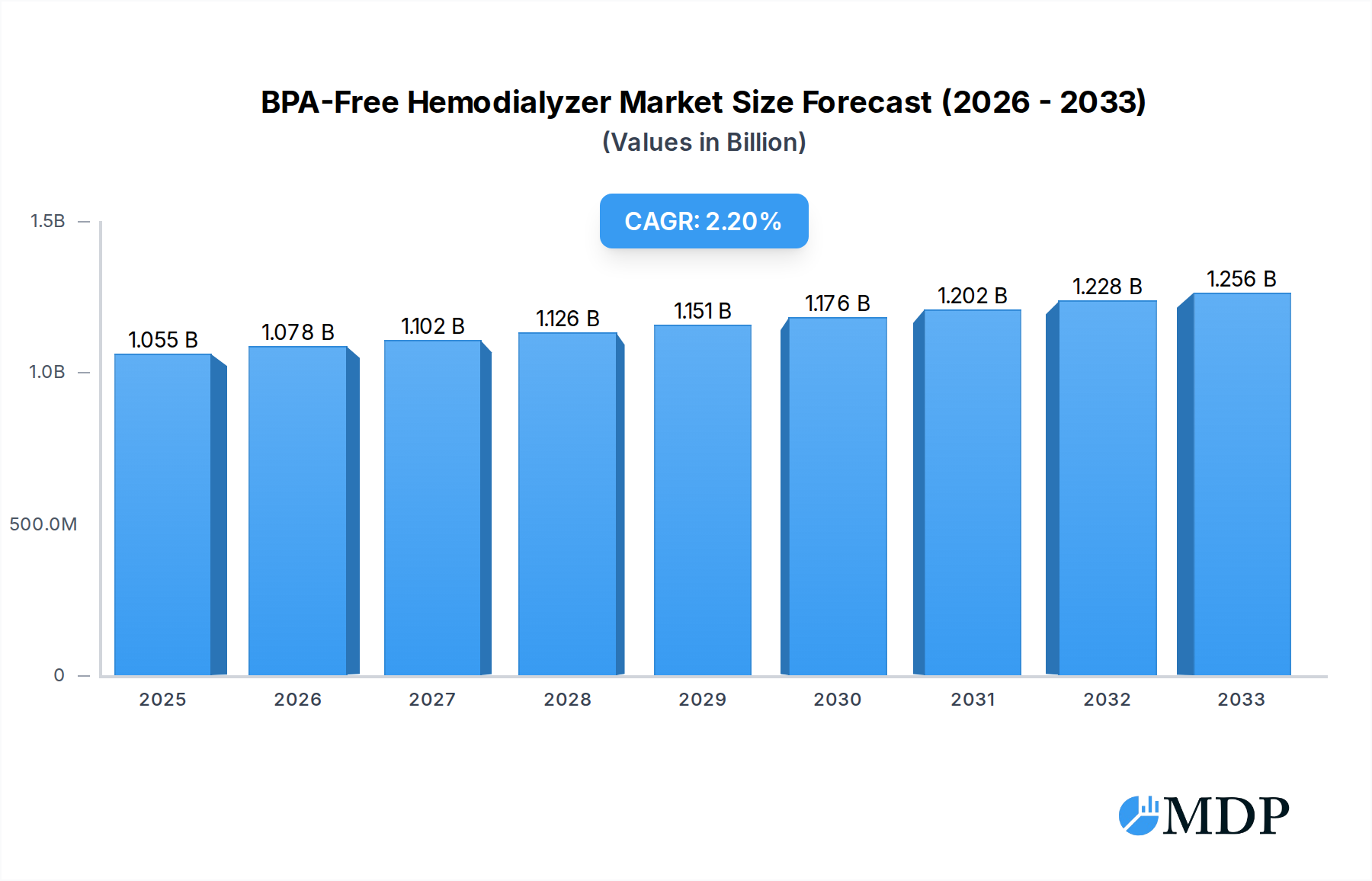
BPA-Free Hemodialyzer Market Size (In Billion)

The global adoption of BPA-free hemodialyzers is being propelled by a confluence of factors including rising incidences of chronic kidney disease (CKD) worldwide, an aging population, and advancements in dialysis technology. Key market drivers include stringent government regulations mandating the use of safer materials and a proactive approach by leading manufacturers to innovate and offer superior products. While the market benefits from these positive trends, potential restraints could include the initial higher cost of BPA-free alternatives compared to conventional options and the need for widespread education and training for healthcare professionals on the benefits and proper utilization of these advanced dialyzers. However, the long-term advantages in terms of reduced patient morbidity and improved treatment efficacy are expected to outweigh these challenges, ensuring robust market expansion across all major geographic regions, including North America, Europe, and the rapidly growing Asia Pacific market.
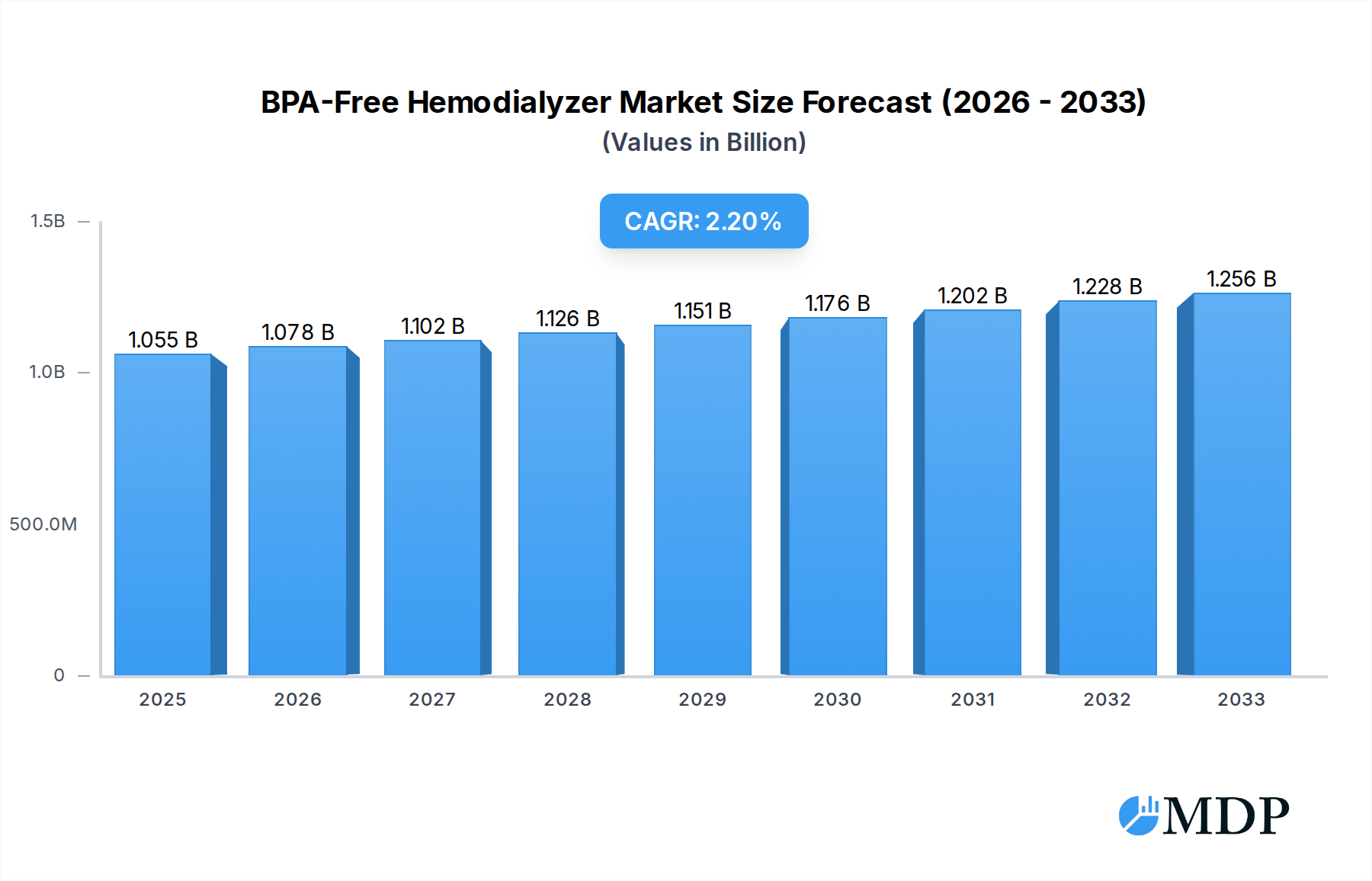
BPA-Free Hemodialyzer Company Market Share
Unlocking Growth in the BPA-Free Hemodialyzer Market: A Comprehensive Analysis (2019-2033)
Gain unparalleled insights into the burgeoning BPA-free hemodialyzer market with this definitive report. Spanning from 2019 to 2033, with a deep dive into the Base Year (2025) and Forecast Period (2025-2033), this analysis provides actionable intelligence for manufacturers, suppliers, and healthcare providers. Discover market concentration, innovative drivers, critical trends, leading segments, and strategic outlooks for this vital segment of the renal care industry. This report is essential for stakeholders aiming to navigate the complexities and capitalize on the significant growth opportunities within the BPA-free hemodialyzer landscape.
BPA-Free Hemodialyzer Market Dynamics & Concentration
The BPA-free hemodialyzer market exhibits a dynamic landscape characterized by increasing regulatory scrutiny and a strong consumer preference for safer, biocompatible medical devices. Market concentration is moderately high, with key players like Fresenius, B. Braun, and Nipro holding significant market share, estimated to be over 60% collectively in the base year. Innovation drivers are predominantly focused on enhancing biocompatibility, improving dialyzer efficiency, and reducing patient adverse events. Regulatory frameworks, particularly in North America and Europe, are increasingly mandating the phasing out of bisphenol-A (BPA) in medical devices, accelerating the adoption of BPA-free alternatives. Product substitutes, while limited in the direct hemodialyzer space, include advancements in peritoneal dialysis and other renal replacement therapies. End-user trends highlight a growing demand from hospitals and clinics seeking to align with patient safety initiatives and evolving clinical guidelines. Mergers and acquisitions (M&A) activity, while moderate, is anticipated to increase as larger companies seek to consolidate their portfolios and expand their reach in the BPA-free segment. Recent M&A deal counts suggest a focus on acquiring innovative technologies and expanding manufacturing capabilities to meet rising demand.
BPA-Free Hemodialyzer Industry Trends & Analysis
The global BPA-free hemodialyzer market is experiencing robust growth, driven by a confluence of factors including increasing prevalence of end-stage renal disease (ESRD), growing awareness of the potential health risks associated with BPA exposure, and favorable regulatory mandates. The Compound Annual Growth Rate (CAGR) for this market is projected to be a healthy 7.5% during the forecast period, indicating substantial expansion. Technological advancements are at the forefront of this growth, with manufacturers investing heavily in research and development to produce hemodialyzers with superior biocompatibility and enhanced filtration capabilities. Innovations in membrane technology, such as the development of novel polymeric materials and advanced surface treatments, are crucial in improving dialyzer performance and patient outcomes. Consumer preferences are increasingly shifting towards products that offer a higher degree of safety and efficacy, with healthcare providers responding by prioritizing BPA-free options in their procurement decisions. Competitive dynamics are intensifying, with established players facing pressure from emerging manufacturers, particularly from the Asia Pacific region. Market penetration of BPA-free hemodialyzers is expected to surpass 80% by the end of the forecast period, underscoring its widespread adoption as the standard of care. The demand for high-flux membranes, offering more efficient toxin removal, continues to outpace that for low-flux membranes, reflecting a trend towards more sophisticated dialysis treatments. Strategic collaborations and partnerships are becoming prevalent as companies seek to leverage each other's expertise and expand their market reach. The economic impact of managing chronic kidney disease, coupled with the preventative benefits of safer dialysis, further fuels market expansion.
Leading Markets & Segments in BPA-Free Hemodialyzer
The North American region currently dominates the BPA-free hemodialyzer market, largely due to stringent regulatory requirements and a well-established healthcare infrastructure with a high patient pool requiring renal replacement therapy. Within North America, the United States stands out as a leading country, driven by extensive research and development activities and a significant number of dialysis centers. In terms of applications, the Hospital segment is the largest, accounting for an estimated 70% of the market share in the base year. This dominance is attributed to the high volume of dialysis procedures conducted in inpatient settings and the established procurement channels within hospitals.
- Key Drivers for Hospital Segment Dominance:
- High Patient Volume: Hospitals are the primary treatment centers for ESRD patients undergoing hemodialysis.
- Clinical Guidelines & Protocols: Adoption of new technologies and safer materials is often driven by established hospital protocols and physician recommendations.
- Economies of Scale: Large hospital systems can negotiate better pricing for bulk purchases of hemodialyzers.
The Clinic segment, while smaller, is experiencing rapid growth due to the increasing establishment of specialized outpatient dialysis clinics that offer convenience and a more patient-centric approach.
- Key Drivers for Clinic Segment Growth:
- Patient Convenience: Outpatient clinics offer more flexible scheduling and a less intimidating environment.
- Cost-Effectiveness: Clinics can sometimes offer services at a lower cost than hospitals.
- Government Initiatives: Support for community-based healthcare solutions encourages clinic expansion.
In terms of product types, High Flux Membrane hemodialyzers are significantly outpacing Low Flux Membrane counterparts. The market share for high flux membranes is estimated to be around 65% in the base year and is projected to grow at a higher CAGR than low flux membranes. This preference is driven by their superior ability to remove larger molecular weight solutes, such as beta-2 microglobulin, and their association with improved patient outcomes and reduced inflammatory responses.
- Key Drivers for High Flux Membrane Dominance:
- Enhanced Toxin Removal: Higher convective transport leads to more efficient removal of uremic toxins.
- Improved Patient Outcomes: Studies suggest better biocompatibility and reduced risk of certain complications.
- Technological Advancements: Continuous innovation in membrane materials and pore structures enhances performance.
BPA-Free Hemodialyzer Product Developments
BPA-free hemodialyzer product development is intensely focused on enhancing biocompatibility, maximizing dialyzer efficiency, and ensuring patient safety. Innovations in biomaterials, such as advanced synthetic polymers and surface modifications, are leading to hemodialyzers with reduced bio-incompatibility and improved blood compatibility. Companies are also developing thinner, more efficient membranes that allow for faster treatment times and better removal of uremic toxins. The integration of advanced design features further optimizes fluid dynamics and minimizes cellular activation, contributing to improved patient outcomes and a reduction in treatment-related complications.
Key Drivers of BPA-Free Hemodialyzer Growth
The growth of the BPA-free hemodialyzer market is propelled by a multifaceted set of drivers. Foremost among these is the increasing global incidence of chronic kidney disease (CKD) and end-stage renal disease (ESRD), necessitating a greater volume of dialysis treatments. Concurrently, a growing body of scientific evidence highlighting the potential health risks associated with BPA exposure in medical devices has led to heightened consumer and healthcare provider demand for safer alternatives. Favorable regulatory mandates in key markets, such as the US FDA's recommendations and similar directives in Europe, are actively phasing out BPA-containing medical products, thereby creating a robust market for BPA-free options. Technological advancements in membrane science and manufacturing processes are also crucial, enabling the production of more efficient and biocompatible hemodialyzers.
Challenges in the BPA-Free Hemodialyzer Market
Despite the strong growth trajectory, the BPA-free hemodialyzer market faces several challenges. One significant hurdle is the higher manufacturing cost associated with BPA-free materials and processes, which can translate into higher product prices, potentially impacting affordability for some healthcare systems and patients. Supply chain complexities for specialized BPA-free polymers and components can also lead to production bottlenecks and lead time issues. Furthermore, while awareness is growing, certain regions may still have lower adoption rates due to limited access to advanced medical technologies or entrenched preferences for traditional materials. Intense competition among manufacturers also exerts downward pressure on pricing, requiring companies to focus on innovation and efficiency to maintain profitability.
Emerging Opportunities in BPA-Free Hemodialyzer
Emerging opportunities in the BPA-free hemodialyzer market are abundant and driven by several key catalysts. The ongoing advancements in nanotechnology and materials science promise the development of next-generation hemodialyzers with even greater biocompatibility and enhanced solute removal capabilities, potentially leading to improved patient outcomes and reduced treatment duration. Strategic partnerships and collaborations between hemodialyzer manufacturers and research institutions are crucial for accelerating innovation and bringing novel technologies to market faster. The expanding healthcare infrastructure and increasing disposable incomes in emerging economies, particularly in Asia Pacific and Latin America, present significant untapped market potential for BPA-free hemodialyzers. Furthermore, the development of specialized hemodialyzers tailored for specific patient populations or disease comorbidities could unlock niche market segments and drive further growth.
Leading Players in the BPA-Free Hemodialyzer Sector
- Fresenius
- B. Braun
- Nipro
- Asahi Kasei
- Weigao Group
- Lepu Medical
- Henan Tuoren Medical
- Jiangxi Hongda Medical Equipment
- Guangdong ZhongAi Medical Technology
- Renacon Pharma
Key Milestones in BPA-Free Hemodialyzer Industry
- 2019: Increased FDA focus on BPA in medical devices, prompting manufacturers to accelerate BPA-free product development.
- 2020: Launch of several new high-flux BPA-free hemodialyzer models by leading players, targeting improved biocompatibility.
- 2021: Expansion of manufacturing capacities for BPA-free materials by key chemical suppliers to meet rising demand.
- 2022: Significant increase in M&A activity, with smaller innovators being acquired by larger corporations to bolster BPA-free portfolios.
- 2023: Growing number of clinical studies demonstrating improved patient outcomes with advanced BPA-free hemodialyzers.
- 2024: Regulatory bodies in several European countries solidify timelines for phasing out BPA in specific medical device categories.
Strategic Outlook for BPA-Free Hemodialyzer Market
The strategic outlook for the BPA-free hemodialyzer market remains exceptionally bright, driven by sustained demand for safer and more effective renal replacement therapies. Key growth accelerators include continuous innovation in membrane technology, aiming for enhanced biocompatibility and ultra-efficient solute removal. Strategic acquisitions and mergers will continue to consolidate market power and expand product offerings. Furthermore, a focused approach on market penetration in emerging economies, coupled with the development of cost-effective solutions, will unlock substantial new revenue streams. The ongoing shift towards personalized medicine and patient-centric care will also favor advanced BPA-free hemodialyzers that offer tailored treatment options and improved quality of life for patients with kidney disease.
BPA-Free Hemodialyzer Segmentation
-
1. Application
- 1.1. Hospital
- 1.2. Clinic
-
2. Types
- 2.1. High Flux Membrane
- 2.2. Low Flux Membrane
BPA-Free Hemodialyzer Segmentation By Geography
-
1. North America
- 1.1. United States
- 1.2. Canada
- 1.3. Mexico
-
2. South America
- 2.1. Brazil
- 2.2. Argentina
- 2.3. Rest of South America
-
3. Europe
- 3.1. United Kingdom
- 3.2. Germany
- 3.3. France
- 3.4. Italy
- 3.5. Spain
- 3.6. Russia
- 3.7. Benelux
- 3.8. Nordics
- 3.9. Rest of Europe
-
4. Middle East & Africa
- 4.1. Turkey
- 4.2. Israel
- 4.3. GCC
- 4.4. North Africa
- 4.5. South Africa
- 4.6. Rest of Middle East & Africa
-
5. Asia Pacific
- 5.1. China
- 5.2. India
- 5.3. Japan
- 5.4. South Korea
- 5.5. ASEAN
- 5.6. Oceania
- 5.7. Rest of Asia Pacific
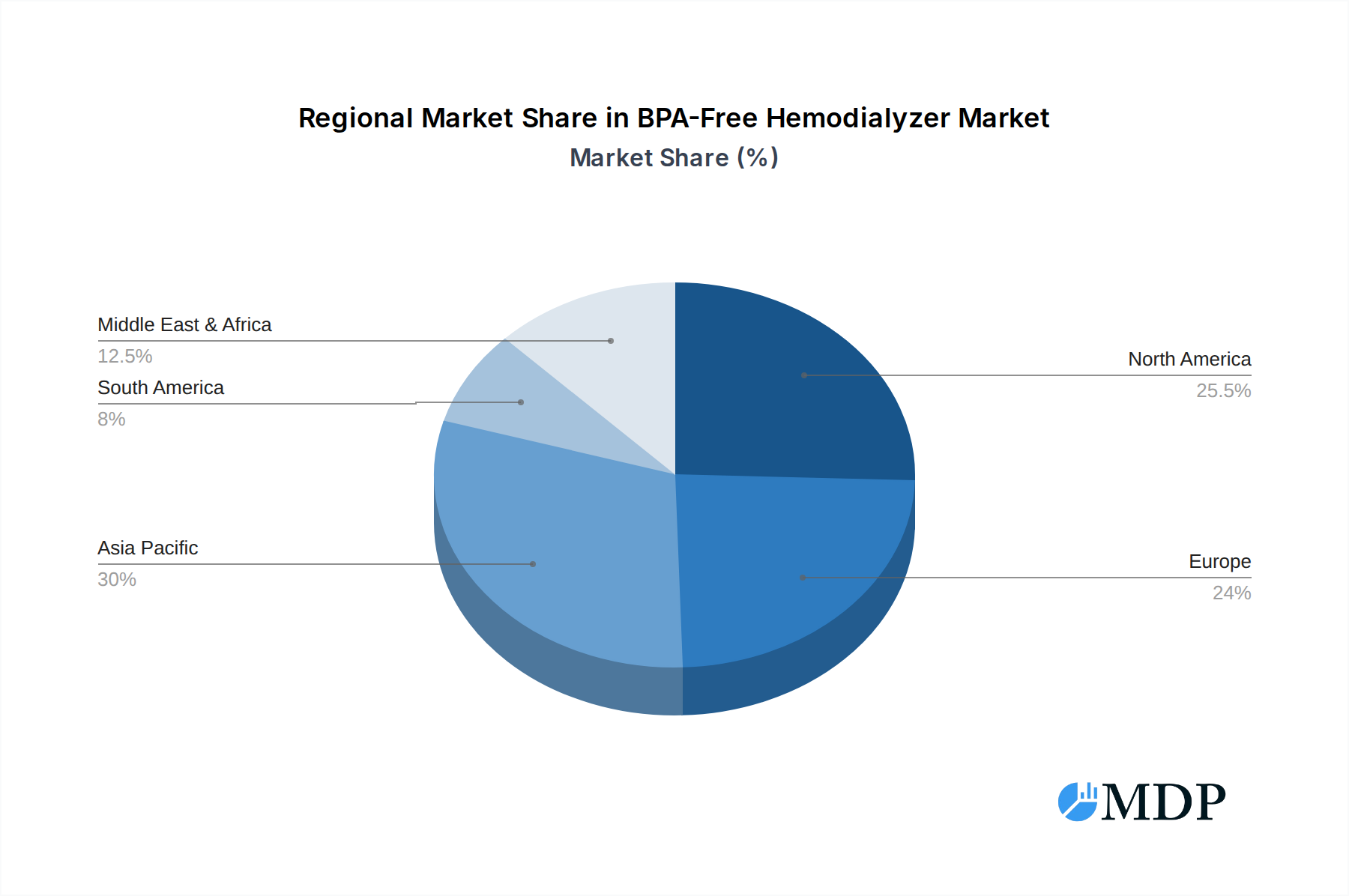
BPA-Free Hemodialyzer Regional Market Share
Geographic Coverage of BPA-Free Hemodialyzer
BPA-Free Hemodialyzer REPORT HIGHLIGHTS
| Aspects | Details |
|---|---|
| Study Period | 2020-2034 |
| Base Year | 2025 |
| Estimated Year | 2026 |
| Forecast Period | 2026-2034 |
| Historical Period | 2020-2025 |
| Growth Rate | CAGR of 2.2% from 2020-2034 |
| Segmentation |
|
Table of Contents
- 1. Introduction
- 1.1. Research Scope
- 1.2. Market Segmentation
- 1.3. Research Methodology
- 1.4. Definitions and Assumptions
- 2. Executive Summary
- 2.1. Introduction
- 3. Market Dynamics
- 3.1. Introduction
- 3.2. Market Drivers
- 3.3. Market Restrains
- 3.4. Market Trends
- 4. Market Factor Analysis
- 4.1. Porters Five Forces
- 4.2. Supply/Value Chain
- 4.3. PESTEL analysis
- 4.4. Market Entropy
- 4.5. Patent/Trademark Analysis
- 5. Global BPA-Free Hemodialyzer Analysis, Insights and Forecast, 2020-2032
- 5.1. Market Analysis, Insights and Forecast - by Application
- 5.1.1. Hospital
- 5.1.2. Clinic
- 5.2. Market Analysis, Insights and Forecast - by Types
- 5.2.1. High Flux Membrane
- 5.2.2. Low Flux Membrane
- 5.3. Market Analysis, Insights and Forecast - by Region
- 5.3.1. North America
- 5.3.2. South America
- 5.3.3. Europe
- 5.3.4. Middle East & Africa
- 5.3.5. Asia Pacific
- 5.1. Market Analysis, Insights and Forecast - by Application
- 6. North America BPA-Free Hemodialyzer Analysis, Insights and Forecast, 2020-2032
- 6.1. Market Analysis, Insights and Forecast - by Application
- 6.1.1. Hospital
- 6.1.2. Clinic
- 6.2. Market Analysis, Insights and Forecast - by Types
- 6.2.1. High Flux Membrane
- 6.2.2. Low Flux Membrane
- 6.1. Market Analysis, Insights and Forecast - by Application
- 7. South America BPA-Free Hemodialyzer Analysis, Insights and Forecast, 2020-2032
- 7.1. Market Analysis, Insights and Forecast - by Application
- 7.1.1. Hospital
- 7.1.2. Clinic
- 7.2. Market Analysis, Insights and Forecast - by Types
- 7.2.1. High Flux Membrane
- 7.2.2. Low Flux Membrane
- 7.1. Market Analysis, Insights and Forecast - by Application
- 8. Europe BPA-Free Hemodialyzer Analysis, Insights and Forecast, 2020-2032
- 8.1. Market Analysis, Insights and Forecast - by Application
- 8.1.1. Hospital
- 8.1.2. Clinic
- 8.2. Market Analysis, Insights and Forecast - by Types
- 8.2.1. High Flux Membrane
- 8.2.2. Low Flux Membrane
- 8.1. Market Analysis, Insights and Forecast - by Application
- 9. Middle East & Africa BPA-Free Hemodialyzer Analysis, Insights and Forecast, 2020-2032
- 9.1. Market Analysis, Insights and Forecast - by Application
- 9.1.1. Hospital
- 9.1.2. Clinic
- 9.2. Market Analysis, Insights and Forecast - by Types
- 9.2.1. High Flux Membrane
- 9.2.2. Low Flux Membrane
- 9.1. Market Analysis, Insights and Forecast - by Application
- 10. Asia Pacific BPA-Free Hemodialyzer Analysis, Insights and Forecast, 2020-2032
- 10.1. Market Analysis, Insights and Forecast - by Application
- 10.1.1. Hospital
- 10.1.2. Clinic
- 10.2. Market Analysis, Insights and Forecast - by Types
- 10.2.1. High Flux Membrane
- 10.2.2. Low Flux Membrane
- 10.1. Market Analysis, Insights and Forecast - by Application
- 11. Competitive Analysis
- 11.1. Global Market Share Analysis 2025
- 11.2. Company Profiles
- 11.2.1 Fresenius
- 11.2.1.1. Overview
- 11.2.1.2. Products
- 11.2.1.3. SWOT Analysis
- 11.2.1.4. Recent Developments
- 11.2.1.5. Financials (Based on Availability)
- 11.2.2 B.Braun
- 11.2.2.1. Overview
- 11.2.2.2. Products
- 11.2.2.3. SWOT Analysis
- 11.2.2.4. Recent Developments
- 11.2.2.5. Financials (Based on Availability)
- 11.2.3 Nipro
- 11.2.3.1. Overview
- 11.2.3.2. Products
- 11.2.3.3. SWOT Analysis
- 11.2.3.4. Recent Developments
- 11.2.3.5. Financials (Based on Availability)
- 11.2.4 Asahi Kasei
- 11.2.4.1. Overview
- 11.2.4.2. Products
- 11.2.4.3. SWOT Analysis
- 11.2.4.4. Recent Developments
- 11.2.4.5. Financials (Based on Availability)
- 11.2.5 Weigao Group
- 11.2.5.1. Overview
- 11.2.5.2. Products
- 11.2.5.3. SWOT Analysis
- 11.2.5.4. Recent Developments
- 11.2.5.5. Financials (Based on Availability)
- 11.2.6 Lepu Medical
- 11.2.6.1. Overview
- 11.2.6.2. Products
- 11.2.6.3. SWOT Analysis
- 11.2.6.4. Recent Developments
- 11.2.6.5. Financials (Based on Availability)
- 11.2.7 Henan Tuoren Medical
- 11.2.7.1. Overview
- 11.2.7.2. Products
- 11.2.7.3. SWOT Analysis
- 11.2.7.4. Recent Developments
- 11.2.7.5. Financials (Based on Availability)
- 11.2.8 Jiangxi Hongda Medical Equipment
- 11.2.8.1. Overview
- 11.2.8.2. Products
- 11.2.8.3. SWOT Analysis
- 11.2.8.4. Recent Developments
- 11.2.8.5. Financials (Based on Availability)
- 11.2.9 Guangdong ZhongAi Medical Technology
- 11.2.9.1. Overview
- 11.2.9.2. Products
- 11.2.9.3. SWOT Analysis
- 11.2.9.4. Recent Developments
- 11.2.9.5. Financials (Based on Availability)
- 11.2.10 Renacon Pharma
- 11.2.10.1. Overview
- 11.2.10.2. Products
- 11.2.10.3. SWOT Analysis
- 11.2.10.4. Recent Developments
- 11.2.10.5. Financials (Based on Availability)
- 11.2.1 Fresenius
List of Figures
- Figure 1: Global BPA-Free Hemodialyzer Revenue Breakdown (undefined, %) by Region 2025 & 2033
- Figure 2: North America BPA-Free Hemodialyzer Revenue (undefined), by Application 2025 & 2033
- Figure 3: North America BPA-Free Hemodialyzer Revenue Share (%), by Application 2025 & 2033
- Figure 4: North America BPA-Free Hemodialyzer Revenue (undefined), by Types 2025 & 2033
- Figure 5: North America BPA-Free Hemodialyzer Revenue Share (%), by Types 2025 & 2033
- Figure 6: North America BPA-Free Hemodialyzer Revenue (undefined), by Country 2025 & 2033
- Figure 7: North America BPA-Free Hemodialyzer Revenue Share (%), by Country 2025 & 2033
- Figure 8: South America BPA-Free Hemodialyzer Revenue (undefined), by Application 2025 & 2033
- Figure 9: South America BPA-Free Hemodialyzer Revenue Share (%), by Application 2025 & 2033
- Figure 10: South America BPA-Free Hemodialyzer Revenue (undefined), by Types 2025 & 2033
- Figure 11: South America BPA-Free Hemodialyzer Revenue Share (%), by Types 2025 & 2033
- Figure 12: South America BPA-Free Hemodialyzer Revenue (undefined), by Country 2025 & 2033
- Figure 13: South America BPA-Free Hemodialyzer Revenue Share (%), by Country 2025 & 2033
- Figure 14: Europe BPA-Free Hemodialyzer Revenue (undefined), by Application 2025 & 2033
- Figure 15: Europe BPA-Free Hemodialyzer Revenue Share (%), by Application 2025 & 2033
- Figure 16: Europe BPA-Free Hemodialyzer Revenue (undefined), by Types 2025 & 2033
- Figure 17: Europe BPA-Free Hemodialyzer Revenue Share (%), by Types 2025 & 2033
- Figure 18: Europe BPA-Free Hemodialyzer Revenue (undefined), by Country 2025 & 2033
- Figure 19: Europe BPA-Free Hemodialyzer Revenue Share (%), by Country 2025 & 2033
- Figure 20: Middle East & Africa BPA-Free Hemodialyzer Revenue (undefined), by Application 2025 & 2033
- Figure 21: Middle East & Africa BPA-Free Hemodialyzer Revenue Share (%), by Application 2025 & 2033
- Figure 22: Middle East & Africa BPA-Free Hemodialyzer Revenue (undefined), by Types 2025 & 2033
- Figure 23: Middle East & Africa BPA-Free Hemodialyzer Revenue Share (%), by Types 2025 & 2033
- Figure 24: Middle East & Africa BPA-Free Hemodialyzer Revenue (undefined), by Country 2025 & 2033
- Figure 25: Middle East & Africa BPA-Free Hemodialyzer Revenue Share (%), by Country 2025 & 2033
- Figure 26: Asia Pacific BPA-Free Hemodialyzer Revenue (undefined), by Application 2025 & 2033
- Figure 27: Asia Pacific BPA-Free Hemodialyzer Revenue Share (%), by Application 2025 & 2033
- Figure 28: Asia Pacific BPA-Free Hemodialyzer Revenue (undefined), by Types 2025 & 2033
- Figure 29: Asia Pacific BPA-Free Hemodialyzer Revenue Share (%), by Types 2025 & 2033
- Figure 30: Asia Pacific BPA-Free Hemodialyzer Revenue (undefined), by Country 2025 & 2033
- Figure 31: Asia Pacific BPA-Free Hemodialyzer Revenue Share (%), by Country 2025 & 2033
List of Tables
- Table 1: Global BPA-Free Hemodialyzer Revenue undefined Forecast, by Application 2020 & 2033
- Table 2: Global BPA-Free Hemodialyzer Revenue undefined Forecast, by Types 2020 & 2033
- Table 3: Global BPA-Free Hemodialyzer Revenue undefined Forecast, by Region 2020 & 2033
- Table 4: Global BPA-Free Hemodialyzer Revenue undefined Forecast, by Application 2020 & 2033
- Table 5: Global BPA-Free Hemodialyzer Revenue undefined Forecast, by Types 2020 & 2033
- Table 6: Global BPA-Free Hemodialyzer Revenue undefined Forecast, by Country 2020 & 2033
- Table 7: United States BPA-Free Hemodialyzer Revenue (undefined) Forecast, by Application 2020 & 2033
- Table 8: Canada BPA-Free Hemodialyzer Revenue (undefined) Forecast, by Application 2020 & 2033
- Table 9: Mexico BPA-Free Hemodialyzer Revenue (undefined) Forecast, by Application 2020 & 2033
- Table 10: Global BPA-Free Hemodialyzer Revenue undefined Forecast, by Application 2020 & 2033
- Table 11: Global BPA-Free Hemodialyzer Revenue undefined Forecast, by Types 2020 & 2033
- Table 12: Global BPA-Free Hemodialyzer Revenue undefined Forecast, by Country 2020 & 2033
- Table 13: Brazil BPA-Free Hemodialyzer Revenue (undefined) Forecast, by Application 2020 & 2033
- Table 14: Argentina BPA-Free Hemodialyzer Revenue (undefined) Forecast, by Application 2020 & 2033
- Table 15: Rest of South America BPA-Free Hemodialyzer Revenue (undefined) Forecast, by Application 2020 & 2033
- Table 16: Global BPA-Free Hemodialyzer Revenue undefined Forecast, by Application 2020 & 2033
- Table 17: Global BPA-Free Hemodialyzer Revenue undefined Forecast, by Types 2020 & 2033
- Table 18: Global BPA-Free Hemodialyzer Revenue undefined Forecast, by Country 2020 & 2033
- Table 19: United Kingdom BPA-Free Hemodialyzer Revenue (undefined) Forecast, by Application 2020 & 2033
- Table 20: Germany BPA-Free Hemodialyzer Revenue (undefined) Forecast, by Application 2020 & 2033
- Table 21: France BPA-Free Hemodialyzer Revenue (undefined) Forecast, by Application 2020 & 2033
- Table 22: Italy BPA-Free Hemodialyzer Revenue (undefined) Forecast, by Application 2020 & 2033
- Table 23: Spain BPA-Free Hemodialyzer Revenue (undefined) Forecast, by Application 2020 & 2033
- Table 24: Russia BPA-Free Hemodialyzer Revenue (undefined) Forecast, by Application 2020 & 2033
- Table 25: Benelux BPA-Free Hemodialyzer Revenue (undefined) Forecast, by Application 2020 & 2033
- Table 26: Nordics BPA-Free Hemodialyzer Revenue (undefined) Forecast, by Application 2020 & 2033
- Table 27: Rest of Europe BPA-Free Hemodialyzer Revenue (undefined) Forecast, by Application 2020 & 2033
- Table 28: Global BPA-Free Hemodialyzer Revenue undefined Forecast, by Application 2020 & 2033
- Table 29: Global BPA-Free Hemodialyzer Revenue undefined Forecast, by Types 2020 & 2033
- Table 30: Global BPA-Free Hemodialyzer Revenue undefined Forecast, by Country 2020 & 2033
- Table 31: Turkey BPA-Free Hemodialyzer Revenue (undefined) Forecast, by Application 2020 & 2033
- Table 32: Israel BPA-Free Hemodialyzer Revenue (undefined) Forecast, by Application 2020 & 2033
- Table 33: GCC BPA-Free Hemodialyzer Revenue (undefined) Forecast, by Application 2020 & 2033
- Table 34: North Africa BPA-Free Hemodialyzer Revenue (undefined) Forecast, by Application 2020 & 2033
- Table 35: South Africa BPA-Free Hemodialyzer Revenue (undefined) Forecast, by Application 2020 & 2033
- Table 36: Rest of Middle East & Africa BPA-Free Hemodialyzer Revenue (undefined) Forecast, by Application 2020 & 2033
- Table 37: Global BPA-Free Hemodialyzer Revenue undefined Forecast, by Application 2020 & 2033
- Table 38: Global BPA-Free Hemodialyzer Revenue undefined Forecast, by Types 2020 & 2033
- Table 39: Global BPA-Free Hemodialyzer Revenue undefined Forecast, by Country 2020 & 2033
- Table 40: China BPA-Free Hemodialyzer Revenue (undefined) Forecast, by Application 2020 & 2033
- Table 41: India BPA-Free Hemodialyzer Revenue (undefined) Forecast, by Application 2020 & 2033
- Table 42: Japan BPA-Free Hemodialyzer Revenue (undefined) Forecast, by Application 2020 & 2033
- Table 43: South Korea BPA-Free Hemodialyzer Revenue (undefined) Forecast, by Application 2020 & 2033
- Table 44: ASEAN BPA-Free Hemodialyzer Revenue (undefined) Forecast, by Application 2020 & 2033
- Table 45: Oceania BPA-Free Hemodialyzer Revenue (undefined) Forecast, by Application 2020 & 2033
- Table 46: Rest of Asia Pacific BPA-Free Hemodialyzer Revenue (undefined) Forecast, by Application 2020 & 2033
Frequently Asked Questions
1. What is the projected Compound Annual Growth Rate (CAGR) of the BPA-Free Hemodialyzer?
The projected CAGR is approximately 2.2%.
2. Which companies are prominent players in the BPA-Free Hemodialyzer?
Key companies in the market include Fresenius, B.Braun, Nipro, Asahi Kasei, Weigao Group, Lepu Medical, Henan Tuoren Medical, Jiangxi Hongda Medical Equipment, Guangdong ZhongAi Medical Technology, Renacon Pharma.
3. What are the main segments of the BPA-Free Hemodialyzer?
The market segments include Application, Types.
4. Can you provide details about the market size?
The market size is estimated to be USD XXX N/A as of 2022.
5. What are some drivers contributing to market growth?
N/A
6. What are the notable trends driving market growth?
N/A
7. Are there any restraints impacting market growth?
N/A
8. Can you provide examples of recent developments in the market?
N/A
9. What pricing options are available for accessing the report?
Pricing options include single-user, multi-user, and enterprise licenses priced at USD 2900.00, USD 4350.00, and USD 5800.00 respectively.
10. Is the market size provided in terms of value or volume?
The market size is provided in terms of value, measured in N/A.
11. Are there any specific market keywords associated with the report?
Yes, the market keyword associated with the report is "BPA-Free Hemodialyzer," which aids in identifying and referencing the specific market segment covered.
12. How do I determine which pricing option suits my needs best?
The pricing options vary based on user requirements and access needs. Individual users may opt for single-user licenses, while businesses requiring broader access may choose multi-user or enterprise licenses for cost-effective access to the report.
13. Are there any additional resources or data provided in the BPA-Free Hemodialyzer report?
While the report offers comprehensive insights, it's advisable to review the specific contents or supplementary materials provided to ascertain if additional resources or data are available.
14. How can I stay updated on further developments or reports in the BPA-Free Hemodialyzer?
To stay informed about further developments, trends, and reports in the BPA-Free Hemodialyzer, consider subscribing to industry newsletters, following relevant companies and organizations, or regularly checking reputable industry news sources and publications.
Methodology
Step 1 - Identification of Relevant Samples Size from Population Database



Step 2 - Approaches for Defining Global Market Size (Value, Volume* & Price*)

Note*: In applicable scenarios
Step 3 - Data Sources
Primary Research
- Web Analytics
- Survey Reports
- Research Institute
- Latest Research Reports
- Opinion Leaders
Secondary Research
- Annual Reports
- White Paper
- Latest Press Release
- Industry Association
- Paid Database
- Investor Presentations

Step 4 - Data Triangulation
Involves using different sources of information in order to increase the validity of a study
These sources are likely to be stakeholders in a program - participants, other researchers, program staff, other community members, and so on.
Then we put all data in single framework & apply various statistical tools to find out the dynamic on the market.
During the analysis stage, feedback from the stakeholder groups would be compared to determine areas of agreement as well as areas of divergence