


Key Insights
The Middle East commercial aircraft cabin seating market is projected to reach approximately $14 billion by 2024, exhibiting a robust Compound Annual Growth Rate (CAGR) of 7.5% from 2024 to 2033. This expansion is primarily driven by a significant increase in regional air travel and substantial investments in fleet modernization by airlines. Key growth catalysts include the proliferation of low-cost carriers (LCCs), boosting demand for efficient seating solutions, and a growing emphasis on passenger comfort, leading to increased adoption of premium seating options. Infrastructure developments, such as airport expansions and new hub constructions in the UAE and Saudi Arabia, further support market growth, alongside the rising popularity of regional travel and tourism.
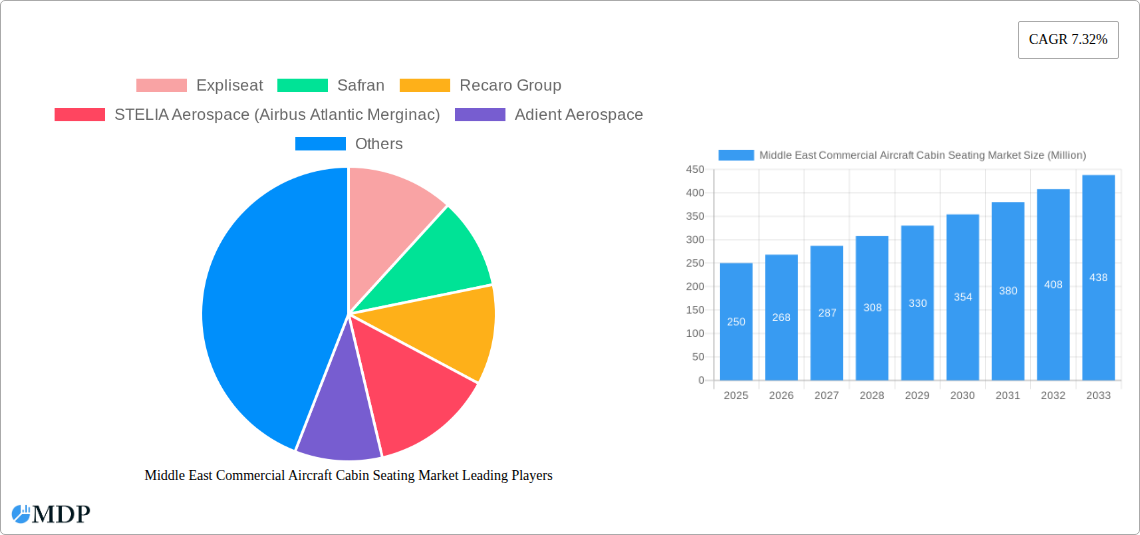
Middle East Commercial Aircraft Cabin Seating Market Market Size (In Billion)

Challenges to market growth include the impact of volatile oil prices and geopolitical instability on airline investment and passenger traffic. Intense competition among seating manufacturers necessitates ongoing innovation and cost optimization. The narrow-body aircraft segment is anticipated to lead market share, reflecting the dominance of LCCs, while the UAE and Saudi Arabia are expected to be the largest contributors due to their established aviation sectors and significant infrastructure investments. Leading players such as Expliseat, Safran, Recaro Group, STELIA Aerospace, Adient Aerospace, Collins Aerospace, and ZIM Aircraft Seating are actively pursuing product innovation and strategic alliances to enhance their competitive positions. The long-term outlook for the Middle East aviation sector positively influences the future trajectory of the commercial aircraft cabin seating market.
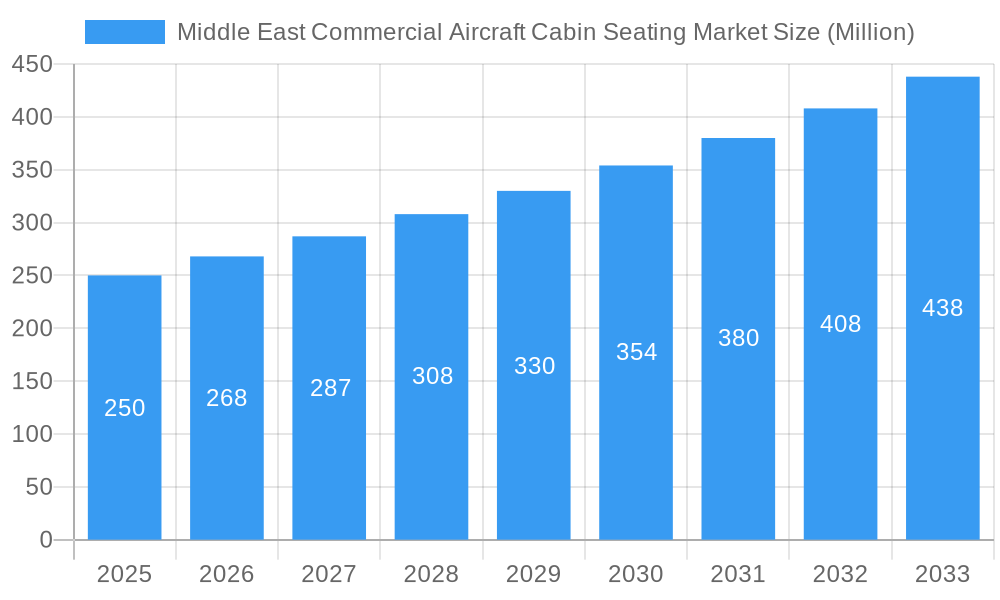
Middle East Commercial Aircraft Cabin Seating Market Company Market Share
Middle East Commercial Aircraft Cabin Seating Market: A Comprehensive Report (2019-2033)
This in-depth report provides a comprehensive analysis of the Middle East Commercial Aircraft Cabin Seating Market, offering valuable insights for industry stakeholders, investors, and strategic decision-makers. Covering the period 2019-2033, with a focus on 2025, this report meticulously examines market dynamics, trends, leading players, and future growth prospects. The report utilizes rigorous data analysis and incorporates key industry developments to provide a holistic view of this dynamic market. The market size is predicted to reach xx Million by 2033.
Middle East Commercial Aircraft Cabin Seating Market Dynamics & Concentration
The Middle East Commercial Aircraft Cabin Seating Market is characterized by a moderate level of concentration, with key players holding significant market share. The market share distribution is constantly evolving due to ongoing mergers and acquisitions (M&A) activities and intense competition. Over the historical period (2019-2024), approximately xx M&A deals were recorded, primarily driven by the need for expansion into new markets and technological advancements. Innovation is a key driver, with companies constantly striving to develop lighter, more comfortable, and technologically advanced seating solutions. Regulatory frameworks, including safety and certification standards, play a vital role in shaping market dynamics. Product substitutes, such as alternative cabin configurations, are limited, further consolidating the market. End-user trends, particularly focusing on passenger comfort, sustainability, and technological integration, significantly influence demand.
- Market Concentration: Moderately concentrated, with top 5 players holding approximately xx% market share in 2024.
- Innovation Drivers: Lightweight materials, improved ergonomics, in-seat entertainment integration, and sustainable materials.
- Regulatory Framework: Stringent safety and certification standards from relevant aviation authorities.
- Product Substitutes: Limited, mainly alternative cabin configurations.
- End-User Trends: Growing demand for enhanced passenger comfort, personalization, and technological integration.
- M&A Activity: Approximately xx M&A deals between 2019 and 2024.
Middle East Commercial Aircraft Cabin Seating Market Industry Trends & Analysis
The Middle East Commercial Aircraft Cabin Seating Market is experiencing robust growth, driven by a surge in air passenger traffic, expansion of airline fleets, and rising investments in airport infrastructure across the region. The Compound Annual Growth Rate (CAGR) during the forecast period (2025-2033) is estimated to be xx%. Technological disruptions, including the integration of advanced materials, in-seat power, and improved entertainment systems, are significantly influencing market dynamics. Consumer preferences are increasingly shifting towards enhanced comfort, personalization, and sustainability. Competitive dynamics are intense, with manufacturers vying for market share through product innovation, strategic partnerships, and technological advancements. Market penetration of advanced seating technologies is projected to reach xx% by 2033.
Leading Markets & Segments in Middle East Commercial Aircraft Cabin Seating Market
The United Arab Emirates (UAE) and Saudi Arabia constitute the largest segments of the Middle East Commercial Aircraft Cabin Seating Market, driven by their substantial airline industries and expanding airport infrastructure. The “Rest of Middle East” segment also exhibits considerable growth potential.
Key Drivers:
- UAE: Strong aviation sector, major airline hubs (Dubai, Abu Dhabi), significant investments in airport infrastructure.
- Saudi Arabia: Rapid economic diversification, investments in aviation infrastructure, expansion of national airlines.
- Rest of Middle East: Growth in air travel demand, investments in regional airlines and airports.
Dominance Analysis: The UAE and Saudi Arabia’s dominance stems from their established aviation sectors, robust economic growth, and investments in airport modernization. However, the "Rest of Middle East" is witnessing increased activity, fueled by tourism and regional connectivity.
Aircraft Type:
- Narrowbody: This segment holds a larger market share due to the high number of narrowbody aircraft in operation across the region.
- Widebody: While smaller than narrowbody, this segment experiences significant growth due to increased long-haul flights and premium cabin demand.
Middle East Commercial Aircraft Cabin Seating Market Product Developments
Recent product innovations focus on lightweight materials, improved ergonomics, enhanced passenger comfort features (such as adjustable headrests and lumbar support), and integration of in-seat power and entertainment systems. Manufacturers are emphasizing sustainable materials and design elements to address environmental concerns. Competitive advantages are primarily driven by technological advancements, cost-effectiveness, and superior passenger experience.
Key Drivers of Middle East Commercial Aircraft Cabin Seating Market Growth
Several factors fuel the growth of the Middle East Commercial Aircraft Cabin Seating Market:
- Increased Air Passenger Traffic: The region's booming tourism and business travel are major contributors.
- Airline Fleet Expansion: Major airlines in the region continuously expand their fleets to accommodate growing demand.
- Technological Advancements: Innovations in seating design and materials offer enhanced comfort and efficiency.
- Government Initiatives: Investment in airport infrastructure and aviation support further boosts the sector.
Challenges in the Middle East Commercial Aircraft Cabin Seating Market
The market faces certain challenges:
- Supply Chain Disruptions: Global supply chain volatility can impact production and delivery timelines.
- Economic Fluctuations: Economic downturns can reduce airline investments in new aircraft and cabin upgrades.
- Intense Competition: The market is competitive, requiring manufacturers to constantly innovate to maintain market share.
Emerging Opportunities in Middle East Commercial Aircraft Cabin Seating Market
Several opportunities exist for growth:
- Technological Advancements: Integration of advanced technologies like personalized in-seat entertainment and improved connectivity.
- Strategic Partnerships: Collaborations between manufacturers and airlines can lead to customized solutions.
- Market Expansion: Expansion into new markets within the Middle East and beyond can drive growth.
Leading Players in the Middle East Commercial Aircraft Cabin Seating Market Sector
- Expliseat
- Safran
- Recaro Group
- STELIA Aerospace (Airbus Atlantic Merginac)
- Adient Aerospace
- Collins Aerospace
- ZIM Aircraft Seating Gmb
Key Milestones in Middle East Commercial Aircraft Cabin Seating Market Industry
- June 2022: STELIA Aerospace and AERQ collaborate on Cabin Digital Signage integration for OPERA seats in the A320neo family – signifying a move towards enhanced passenger experience through technological integration.
- June 2021: Qatar Airways launches its 311-seat Boeing 787-9 Dreamliner with Adient Aerospace Ascent business class seats – showcasing a significant adoption of premium seating solutions.
- March 2021: Safran's Z110i and Z600 seats selected by Airbus for the A220 family – highlighting a key contract win and reinforcing Safran's position in the market.
Strategic Outlook for Middle East Commercial Aircraft Cabin Seating Market Market
The Middle East Commercial Aircraft Cabin Seating Market is poised for continued growth, driven by rising air passenger traffic, airline fleet expansion, and ongoing investments in airport infrastructure. Strategic opportunities lie in developing innovative seating solutions that cater to evolving passenger preferences, focusing on sustainability, technological integration, and enhanced comfort. Manufacturers who successfully adapt to these trends and build strong relationships with airlines are expected to capture significant market share in the years to come.
Middle East Commercial Aircraft Cabin Seating Market Segmentation
-
1. Aircraft Type
- 1.1. Narrowbody
- 1.2. Widebody
Middle East Commercial Aircraft Cabin Seating Market Segmentation By Geography
-
1. Middle East
- 1.1. Saudi Arabia
- 1.2. United Arab Emirates
- 1.3. Israel
- 1.4. Qatar
- 1.5. Kuwait
- 1.6. Oman
- 1.7. Bahrain
- 1.8. Jordan
- 1.9. Lebanon
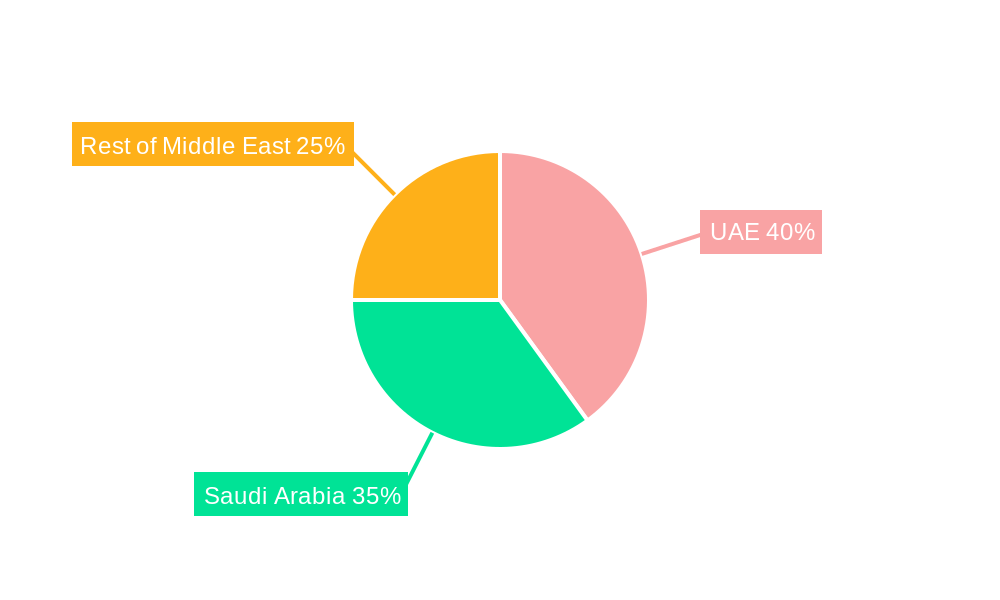
Middle East Commercial Aircraft Cabin Seating Market Regional Market Share
Geographic Coverage of Middle East Commercial Aircraft Cabin Seating Market
Middle East Commercial Aircraft Cabin Seating Market REPORT HIGHLIGHTS
| Aspects | Details |
|---|---|
| Study Period | 2020-2034 |
| Base Year | 2025 |
| Estimated Year | 2026 |
| Forecast Period | 2026-2034 |
| Historical Period | 2020-2025 |
| Growth Rate | CAGR of 7.5% from 2020-2034 |
| Segmentation |
|
Table of Contents
- 1. Introduction
- 1.1. Research Scope
- 1.2. Market Segmentation
- 1.3. Research Methodology
- 1.4. Definitions and Assumptions
- 2. Executive Summary
- 2.1. Introduction
- 3. Market Dynamics
- 3.1. Introduction
- 3.2. Market Drivers
- 3.3. Market Restrains
- 3.4. Market Trends
- 3.4.1. OTHER KEY INDUSTRY TRENDS COVERED IN THE REPORT
- 4. Market Factor Analysis
- 4.1. Porters Five Forces
- 4.2. Supply/Value Chain
- 4.3. PESTEL analysis
- 4.4. Market Entropy
- 4.5. Patent/Trademark Analysis
- 5. Middle East Commercial Aircraft Cabin Seating Market Analysis, Insights and Forecast, 2020-2032
- 5.1. Market Analysis, Insights and Forecast - by Aircraft Type
- 5.1.1. Narrowbody
- 5.1.2. Widebody
- 5.2. Market Analysis, Insights and Forecast - by Region
- 5.2.1. Middle East
- 5.1. Market Analysis, Insights and Forecast - by Aircraft Type
- 6. Competitive Analysis
- 6.1. Market Share Analysis 2025
- 6.2. Company Profiles
- 6.2.1 Expliseat
- 6.2.1.1. Overview
- 6.2.1.2. Products
- 6.2.1.3. SWOT Analysis
- 6.2.1.4. Recent Developments
- 6.2.1.5. Financials (Based on Availability)
- 6.2.2 Safran
- 6.2.2.1. Overview
- 6.2.2.2. Products
- 6.2.2.3. SWOT Analysis
- 6.2.2.4. Recent Developments
- 6.2.2.5. Financials (Based on Availability)
- 6.2.3 Recaro Group
- 6.2.3.1. Overview
- 6.2.3.2. Products
- 6.2.3.3. SWOT Analysis
- 6.2.3.4. Recent Developments
- 6.2.3.5. Financials (Based on Availability)
- 6.2.4 STELIA Aerospace (Airbus Atlantic Merginac)
- 6.2.4.1. Overview
- 6.2.4.2. Products
- 6.2.4.3. SWOT Analysis
- 6.2.4.4. Recent Developments
- 6.2.4.5. Financials (Based on Availability)
- 6.2.5 Adient Aerospace
- 6.2.5.1. Overview
- 6.2.5.2. Products
- 6.2.5.3. SWOT Analysis
- 6.2.5.4. Recent Developments
- 6.2.5.5. Financials (Based on Availability)
- 6.2.6 Collins Aerospace
- 6.2.6.1. Overview
- 6.2.6.2. Products
- 6.2.6.3. SWOT Analysis
- 6.2.6.4. Recent Developments
- 6.2.6.5. Financials (Based on Availability)
- 6.2.7 ZIM Aircraft Seating Gmb
- 6.2.7.1. Overview
- 6.2.7.2. Products
- 6.2.7.3. SWOT Analysis
- 6.2.7.4. Recent Developments
- 6.2.7.5. Financials (Based on Availability)
- 6.2.1 Expliseat
List of Figures
- Figure 1: Middle East Commercial Aircraft Cabin Seating Market Revenue Breakdown (billion, %) by Product 2025 & 2033
- Figure 2: Middle East Commercial Aircraft Cabin Seating Market Share (%) by Company 2025
List of Tables
- Table 1: Middle East Commercial Aircraft Cabin Seating Market Revenue billion Forecast, by Aircraft Type 2020 & 2033
- Table 2: Middle East Commercial Aircraft Cabin Seating Market Revenue billion Forecast, by Region 2020 & 2033
- Table 3: Middle East Commercial Aircraft Cabin Seating Market Revenue billion Forecast, by Aircraft Type 2020 & 2033
- Table 4: Middle East Commercial Aircraft Cabin Seating Market Revenue billion Forecast, by Country 2020 & 2033
- Table 5: Saudi Arabia Middle East Commercial Aircraft Cabin Seating Market Revenue (billion) Forecast, by Application 2020 & 2033
- Table 6: United Arab Emirates Middle East Commercial Aircraft Cabin Seating Market Revenue (billion) Forecast, by Application 2020 & 2033
- Table 7: Israel Middle East Commercial Aircraft Cabin Seating Market Revenue (billion) Forecast, by Application 2020 & 2033
- Table 8: Qatar Middle East Commercial Aircraft Cabin Seating Market Revenue (billion) Forecast, by Application 2020 & 2033
- Table 9: Kuwait Middle East Commercial Aircraft Cabin Seating Market Revenue (billion) Forecast, by Application 2020 & 2033
- Table 10: Oman Middle East Commercial Aircraft Cabin Seating Market Revenue (billion) Forecast, by Application 2020 & 2033
- Table 11: Bahrain Middle East Commercial Aircraft Cabin Seating Market Revenue (billion) Forecast, by Application 2020 & 2033
- Table 12: Jordan Middle East Commercial Aircraft Cabin Seating Market Revenue (billion) Forecast, by Application 2020 & 2033
- Table 13: Lebanon Middle East Commercial Aircraft Cabin Seating Market Revenue (billion) Forecast, by Application 2020 & 2033
Frequently Asked Questions
1. What is the projected Compound Annual Growth Rate (CAGR) of the Middle East Commercial Aircraft Cabin Seating Market?
The projected CAGR is approximately 7.5%.
2. Which companies are prominent players in the Middle East Commercial Aircraft Cabin Seating Market?
Key companies in the market include Expliseat, Safran, Recaro Group, STELIA Aerospace (Airbus Atlantic Merginac), Adient Aerospace, Collins Aerospace, ZIM Aircraft Seating Gmb.
3. What are the main segments of the Middle East Commercial Aircraft Cabin Seating Market?
The market segments include Aircraft Type.
4. Can you provide details about the market size?
The market size is estimated to be USD 14 billion as of 2022.
5. What are some drivers contributing to market growth?
N/A
6. What are the notable trends driving market growth?
OTHER KEY INDUSTRY TRENDS COVERED IN THE REPORT.
7. Are there any restraints impacting market growth?
N/A
8. Can you provide examples of recent developments in the market?
June 2022: STELIA Aerospace and AERQ to collaborate on Cabin Digital Signage integration of OPERA seats for the A320neo family.June 2021: Qatar Airways launch its 311-seat Boeing 787-9 Dreamliner with Adient Aerospace Ascent business class seat.March 2021: Safran announced that its Z110i and Z600 seats had been selected by Airbus to provide its latest generation of short and medium-range economy and business class solutions as SFE seats (Supplier Furnished Equipment) for the A220 Family.
9. What pricing options are available for accessing the report?
Pricing options include single-user, multi-user, and enterprise licenses priced at USD 3800, USD 4500, and USD 5800 respectively.
10. Is the market size provided in terms of value or volume?
The market size is provided in terms of value, measured in billion.
11. Are there any specific market keywords associated with the report?
Yes, the market keyword associated with the report is "Middle East Commercial Aircraft Cabin Seating Market," which aids in identifying and referencing the specific market segment covered.
12. How do I determine which pricing option suits my needs best?
The pricing options vary based on user requirements and access needs. Individual users may opt for single-user licenses, while businesses requiring broader access may choose multi-user or enterprise licenses for cost-effective access to the report.
13. Are there any additional resources or data provided in the Middle East Commercial Aircraft Cabin Seating Market report?
While the report offers comprehensive insights, it's advisable to review the specific contents or supplementary materials provided to ascertain if additional resources or data are available.
14. How can I stay updated on further developments or reports in the Middle East Commercial Aircraft Cabin Seating Market?
To stay informed about further developments, trends, and reports in the Middle East Commercial Aircraft Cabin Seating Market, consider subscribing to industry newsletters, following relevant companies and organizations, or regularly checking reputable industry news sources and publications.
Methodology
Step 1 - Identification of Relevant Samples Size from Population Database



Step 2 - Approaches for Defining Global Market Size (Value, Volume* & Price*)

Note*: In applicable scenarios
Step 3 - Data Sources
Primary Research
- Web Analytics
- Survey Reports
- Research Institute
- Latest Research Reports
- Opinion Leaders
Secondary Research
- Annual Reports
- White Paper
- Latest Press Release
- Industry Association
- Paid Database
- Investor Presentations

Step 4 - Data Triangulation
Involves using different sources of information in order to increase the validity of a study
These sources are likely to be stakeholders in a program - participants, other researchers, program staff, other community members, and so on.
Then we put all data in single framework & apply various statistical tools to find out the dynamic on the market.
During the analysis stage, feedback from the stakeholder groups would be compared to determine areas of agreement as well as areas of divergence