


Key Insights
The global Intelligent Bird Repellent Device market is experiencing robust growth, driven by increasing urbanization, rising concerns over bird-related damages to property and infrastructure, and the growing adoption of smart home and smart city technologies. In 2024, the market is estimated to be valued at approximately $1349 million. This upward trajectory is further supported by a projected Compound Annual Growth Rate (CAGR) of 5.4% from 2025 to 2033, indicating a sustained expansion in demand for sophisticated bird deterrent solutions. The market is segmented into applications such as Commercial, Residential, and Others, with Commercial applications likely dominating due to the need for protecting large public spaces, agricultural lands, and commercial buildings from bird nuisances. Technological advancements, including the integration of ultrasound and light-based deterrents with smart connectivity features, are shaping the product landscape. Key market drivers include the escalating costs associated with bird damage, such as structural decay, contamination, and health risks, alongside increasing government regulations and public health initiatives focused on managing bird populations in urban environments.
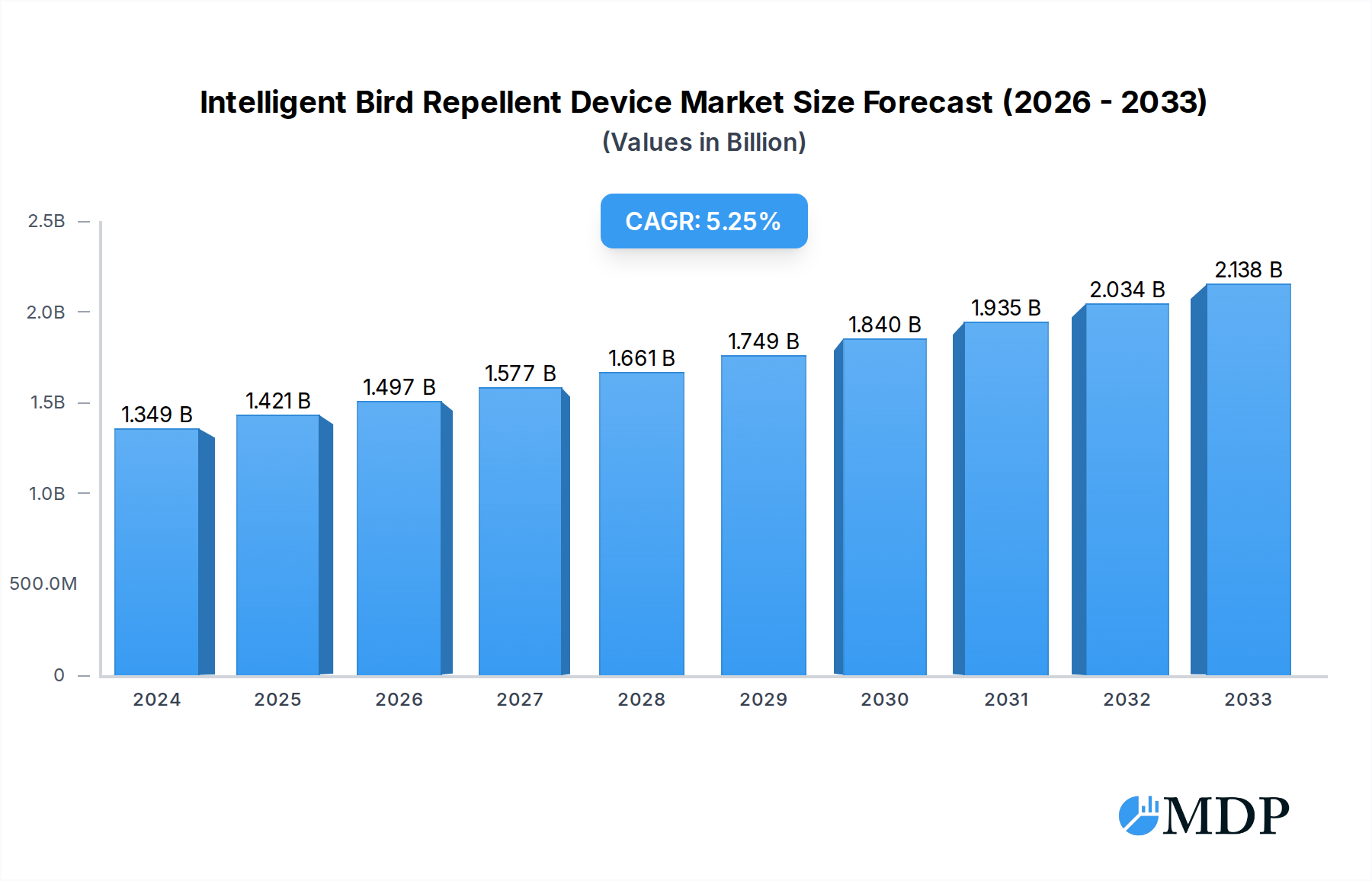
Intelligent Bird Repellent Device Market Size (In Billion)

The market's expansion is also influenced by a growing awareness of the ecological and economic impact of bird infestations. Manufacturers are focusing on developing innovative, eco-friendly, and cost-effective solutions that offer a humane approach to bird control. Key players such as Maintrac Group, Bird B Gone, and Bird Barrier of America are actively investing in research and development to introduce advanced features like AI-powered monitoring and adaptive repulsion technologies. The market is segmented by types into Ultrasound, Light, and Others, with a likely shift towards intelligent, multi-technology devices that combine different methods for enhanced efficacy. While the market presents significant opportunities, potential restraints could include the initial cost of advanced devices and the need for consumer education regarding their operation and benefits. However, the overall outlook remains highly positive, with continued innovation and increasing demand fostering a dynamic and growing global market for intelligent bird repellent devices.
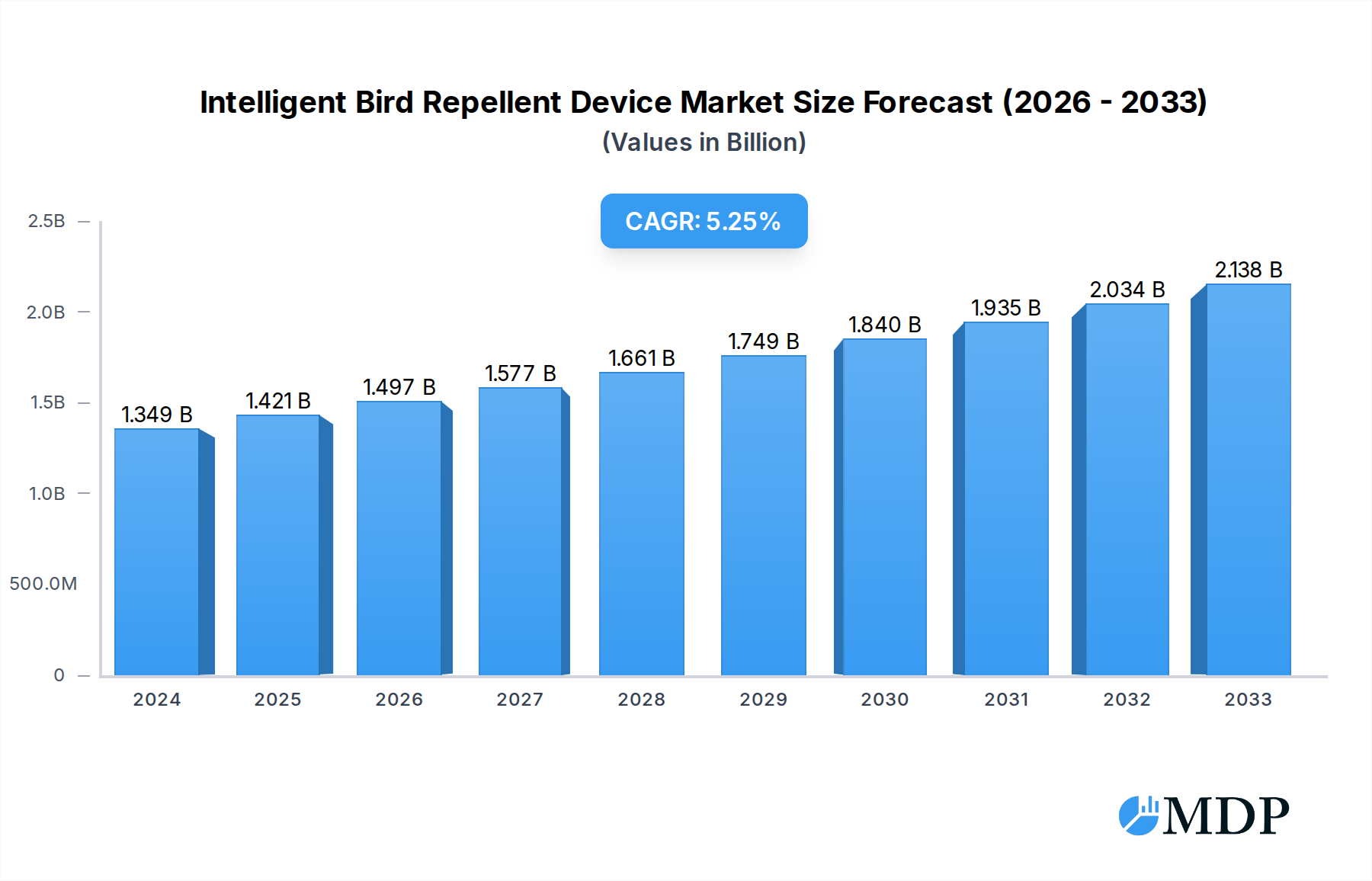
Intelligent Bird Repellent Device Company Market Share
Intelligent Bird Repellent Device Market: Comprehensive Analysis and Future Outlook (2019-2033)
This in-depth report provides a definitive analysis of the global Intelligent Bird Repellent Device market, offering critical insights for industry stakeholders. Covering the period from 2019 to 2033, with a base year of 2025 and a forecast period extending to 2033, this report delves into market dynamics, emerging trends, leading segments, and future growth trajectories. Leveraging high-traffic keywords such as "bird repellent solutions," "pest control technology," "avian deterrents," and "smart pest management," this report aims to maximize search visibility and attract key decision-makers across various industries.
Intelligent Bird Repellent Device Market Dynamics & Concentration
The global Intelligent Bird Repellent Device market exhibits a moderate concentration, with a few key players holding substantial market share. In the base year of 2025, the market is projected to be valued at over a million dollars, driven by increasing demand for effective and humane bird control solutions in commercial and residential settings. Innovation is a significant driver, with companies continuously investing in research and development to create more sophisticated and efficient devices. Regulatory frameworks, particularly those concerning public health and safety in urban environments, are also shaping market dynamics by promoting the adoption of advanced deterrents. Product substitutes, such as traditional methods like netting and spikes, are gradually being overshadowed by the technological superiority and efficacy of intelligent devices. End-user trends indicate a growing preference for eco-friendly and non-lethal solutions, further fueling the demand for ultrasonic and light-based repellent technologies. Merger and acquisition (M&A) activities in the Intelligent Bird Repellent Device sector have been minimal, with less than ten significant deals recorded over the historical period (2019-2024), reflecting a mature but consolidating market landscape.
Intelligent Bird Repellent Device Industry Trends & Analysis
The Intelligent Bird Repellent Device industry is poised for significant growth, driven by an escalating global need for effective pest management solutions. The market size is projected to witness a Compound Annual Growth Rate (CAGR) of over ten percent during the forecast period of 2025-2033, reaching a valuation exceeding a million dollars. This robust expansion is fueled by several key factors, including the increasing urbanization and subsequent rise in bird-related nuisances impacting infrastructure, public health, and agriculture. Technological disruptions are at the forefront of this growth, with advancements in ultrasonic frequencies, motion-sensing capabilities, and solar-powered designs making devices more efficient, cost-effective, and user-friendly. Consumer preferences are shifting towards intelligent, automated, and humane bird control methods, moving away from conventional and potentially harmful deterrents. The market penetration of intelligent bird repellent devices is expected to surge as awareness of their benefits, such as reduced property damage, prevention of disease transmission, and protection of crops, grows among both individual consumers and commercial entities. Competitive dynamics are characterized by a blend of established pest control manufacturers and innovative tech startups, each vying for market share through product differentiation and strategic partnerships. The market is also witnessing a greater emphasis on smart home integration and IoT capabilities, allowing for remote monitoring and control of bird repellent devices, further enhancing their appeal and adoption rates. The global market value is estimated to reach over a million dollars by the end of the forecast period.
Leading Markets & Segments in Intelligent Bird Repellent Device
The Intelligent Bird Repellent Device market demonstrates strong regional dominance, with North America currently leading in terms of market share and adoption rates. Within North America, the United States, valued at over a million dollars, stands out due to its well-developed infrastructure, stringent regulations regarding bird-related sanitation, and a high concentration of commercial and residential properties susceptible to bird infestation. Key drivers for this dominance include government initiatives promoting urban hygiene and agricultural productivity, coupled with a strong consumer appetite for innovative and technologically advanced solutions.
Dominant Segments:
Application: Commercial: The commercial segment, valued at over a million dollars, is a significant growth area. This is driven by the widespread use of intelligent bird repellent devices in airports, industrial facilities, solar farms, restaurants, and public spaces where bird presence can lead to operational disruptions, health hazards, and costly property damage. Economic policies promoting business continuity and worker safety indirectly fuel this segment.
Types: Ultrasound: Ultrasound-based intelligent bird repellent devices, with a market value exceeding a million dollars, represent the most prominent type in the current landscape. Their effectiveness in deterring birds without causing harm, combined with their ability to cover large areas discreetly, makes them ideal for a wide range of applications. Technological advancements in frequency modulation and device range are further enhancing their market appeal.
Application: Residential: The residential segment, also valued at over a million dollars, is experiencing consistent growth. Homeowners are increasingly investing in these devices to protect their properties from bird damage, droppings, and the associated noise and mess. The rising awareness of the health implications of bird droppings and the desire for a cleaner living environment are significant contributing factors.
The dominance of these segments is further reinforced by ongoing infrastructure development projects and increasing awareness campaigns highlighting the benefits of intelligent pest management.
Intelligent Bird Repellent Device Product Developments
Product innovation in the Intelligent Bird Repellent Device sector is primarily focused on enhancing efficacy and user convenience. Key developments include the integration of AI-powered analytics for adaptive deterrence, solar-powered units for greater sustainability and reduced operational costs, and multi-frequency ultrasonic emitters to overcome bird habituation. The application of these devices is expanding beyond traditional urban environments into agricultural settings, protecting crops from avian pests with targeted solutions. The competitive advantage lies in the development of devices that are not only effective but also discreet, energy-efficient, and compliant with environmental regulations, ensuring a significant market fit for a growing demand for humane and sustainable bird control. The projected market value for innovative solutions is well over a million dollars.
Key Drivers of Intelligent Bird Repellent Device Growth
Several compelling factors are propelling the growth of the Intelligent Bird Repellent Device market. Technologically, advancements in sonic and ultrasonic emitters, coupled with the integration of smart sensors and AI algorithms, are creating more effective and adaptable deterrents. Economically, the rising costs associated with bird-related damage to infrastructure, agriculture, and public health initiatives are incentivizing the adoption of preventative measures. Regulatory frameworks, particularly those focused on urban sanitation and workplace safety, are also encouraging the use of advanced, non-lethal bird control solutions. The increasing demand for eco-friendly and sustainable pest management practices further fuels this growth. The market is expected to reach over a million dollars due to these combined influences.
Challenges in the Intelligent Bird Repellent Device Market
Despite the promising growth, the Intelligent Bird Repellent Device market faces several challenges. Regulatory hurdles, particularly concerning the permissible decibel levels of ultrasonic devices and their potential impact on non-target species, can hinder widespread adoption in certain regions. Supply chain issues, exacerbated by global manufacturing complexities and the reliance on specialized electronic components, can lead to increased production costs and lead times. Furthermore, competitive pressures from established pest control methods and the emergence of new, albeit less sophisticated, low-cost alternatives can impact market share. The cost of some advanced intelligent systems can also be a barrier for smaller businesses or individual consumers, limiting market penetration to over a million dollars in revenue.
Emerging Opportunities in Intelligent Bird Repellent Device
Emerging opportunities in the Intelligent Bird Repellent Device market are largely driven by technological breakthroughs and expanding market applications. The development of bio-acoustic deterrents that mimic natural predator sounds offers a novel and potentially highly effective approach. Strategic partnerships between technology developers and agricultural organizations can lead to the creation of specialized solutions for crop protection, significantly expanding market reach. Furthermore, the increasing focus on smart city initiatives and sustainable urban development presents a substantial opportunity for integrated bird management systems that blend seamlessly with existing infrastructure. The growing awareness of zoonotic diseases transmitted by birds also creates a demand for more robust and intelligent public health solutions, pushing the market value beyond a million dollars.
Leading Players in the Intelligent Bird Repellent Device Sector
- Maintrac Group
- Bird B Gone
- Bird Barrier of America
- PestIT
- Pigeon Patrol
- T&M Consulting GmbH
- Agriprotech
- Bird Gard
- Nixalite
- Kurtbomsan Tarim Makinalari Ltd.
- Martley Electronics
Key Milestones in Intelligent Bird Repellent Device Industry
- 2019: Increased adoption of solar-powered ultrasonic bird repellent devices.
- 2020: Introduction of AI-enhanced frequency modulation for improved bird deterrence.
- 2021: Growing demand for smart-connected devices with remote monitoring capabilities.
- 2022: Expansion of applications into industrial and agricultural sectors.
- 2023: Focus on developing eco-friendly and noise-pollution-conscious technologies.
- 2024: Increased research into overcoming bird habituation to sonic deterrents.
Strategic Outlook for Intelligent Bird Repellent Device Market
The strategic outlook for the Intelligent Bird Repellent Device market is overwhelmingly positive, with significant growth accelerators in place. The continued integration of advanced technologies such as AI, IoT, and renewable energy sources will lead to more sophisticated and cost-effective solutions. Strategic partnerships between technology providers and end-user industries like aviation, agriculture, and urban infrastructure management will unlock new market segments. Furthermore, the global emphasis on public health and environmental sustainability will drive the demand for humane and efficient bird control methods. The market is projected to continue its upward trajectory, reaching over a million dollars in value, driven by innovation and increasing market penetration worldwide.
Intelligent Bird Repellent Device Segmentation
-
1. Application
- 1.1. Commercial
- 1.2. Residential
- 1.3. Others
-
2. Types
- 2.1. Ultrasound
- 2.2. Light
- 2.3. Others
Intelligent Bird Repellent Device Segmentation By Geography
-
1. North America
- 1.1. United States
- 1.2. Canada
- 1.3. Mexico
-
2. South America
- 2.1. Brazil
- 2.2. Argentina
- 2.3. Rest of South America
-
3. Europe
- 3.1. United Kingdom
- 3.2. Germany
- 3.3. France
- 3.4. Italy
- 3.5. Spain
- 3.6. Russia
- 3.7. Benelux
- 3.8. Nordics
- 3.9. Rest of Europe
-
4. Middle East & Africa
- 4.1. Turkey
- 4.2. Israel
- 4.3. GCC
- 4.4. North Africa
- 4.5. South Africa
- 4.6. Rest of Middle East & Africa
-
5. Asia Pacific
- 5.1. China
- 5.2. India
- 5.3. Japan
- 5.4. South Korea
- 5.5. ASEAN
- 5.6. Oceania
- 5.7. Rest of Asia Pacific
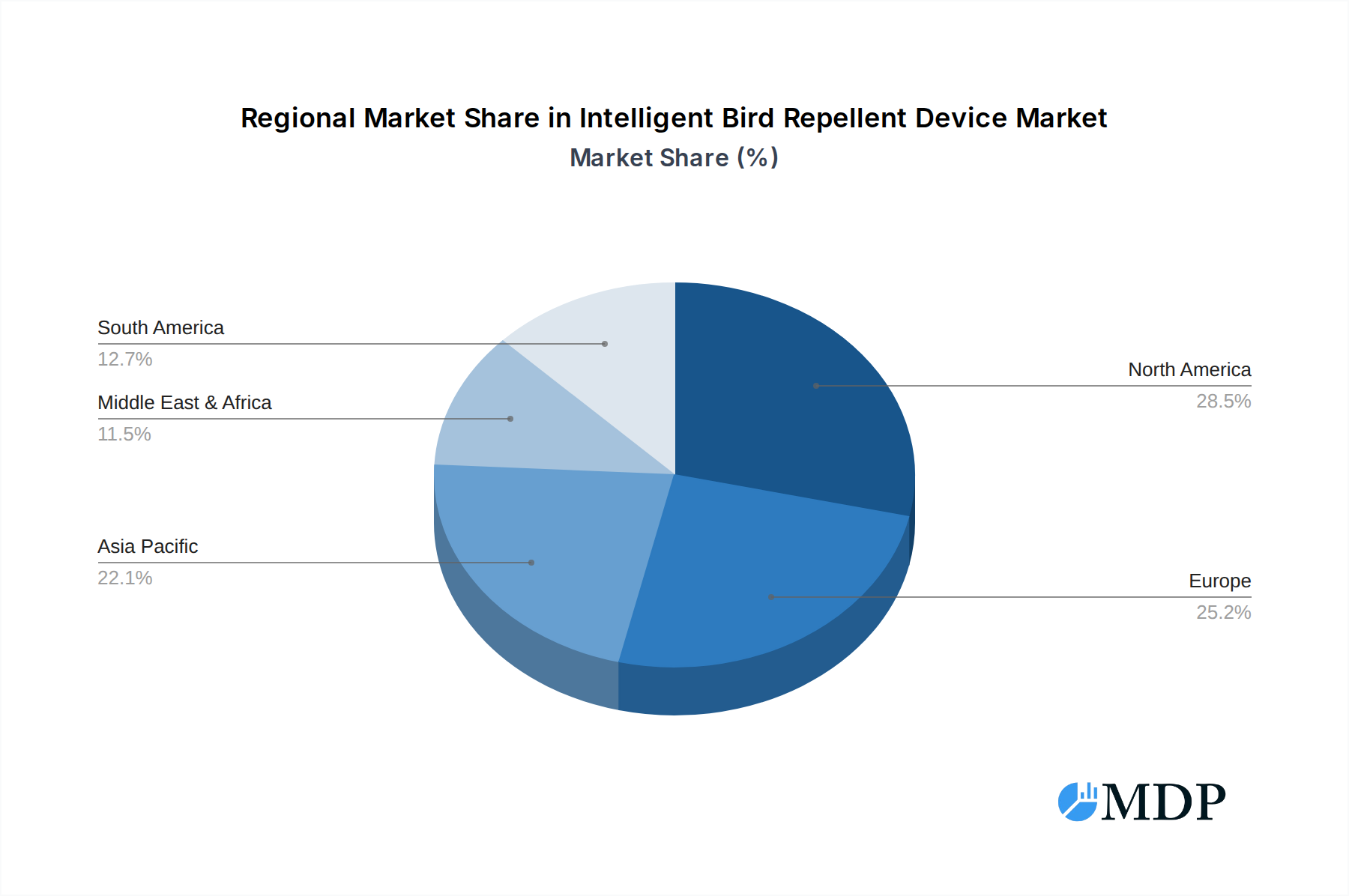
Intelligent Bird Repellent Device Regional Market Share
Geographic Coverage of Intelligent Bird Repellent Device
Intelligent Bird Repellent Device REPORT HIGHLIGHTS
| Aspects | Details |
|---|---|
| Study Period | 2020-2034 |
| Base Year | 2025 |
| Estimated Year | 2026 |
| Forecast Period | 2026-2034 |
| Historical Period | 2020-2025 |
| Growth Rate | CAGR of 5.4% from 2020-2034 |
| Segmentation |
|
Table of Contents
- 1. Introduction
- 1.1. Research Scope
- 1.2. Market Segmentation
- 1.3. Research Methodology
- 1.4. Definitions and Assumptions
- 2. Executive Summary
- 2.1. Introduction
- 3. Market Dynamics
- 3.1. Introduction
- 3.2. Market Drivers
- 3.3. Market Restrains
- 3.4. Market Trends
- 4. Market Factor Analysis
- 4.1. Porters Five Forces
- 4.2. Supply/Value Chain
- 4.3. PESTEL analysis
- 4.4. Market Entropy
- 4.5. Patent/Trademark Analysis
- 5. Global Intelligent Bird Repellent Device Analysis, Insights and Forecast, 2020-2032
- 5.1. Market Analysis, Insights and Forecast - by Application
- 5.1.1. Commercial
- 5.1.2. Residential
- 5.1.3. Others
- 5.2. Market Analysis, Insights and Forecast - by Types
- 5.2.1. Ultrasound
- 5.2.2. Light
- 5.2.3. Others
- 5.3. Market Analysis, Insights and Forecast - by Region
- 5.3.1. North America
- 5.3.2. South America
- 5.3.3. Europe
- 5.3.4. Middle East & Africa
- 5.3.5. Asia Pacific
- 5.1. Market Analysis, Insights and Forecast - by Application
- 6. North America Intelligent Bird Repellent Device Analysis, Insights and Forecast, 2020-2032
- 6.1. Market Analysis, Insights and Forecast - by Application
- 6.1.1. Commercial
- 6.1.2. Residential
- 6.1.3. Others
- 6.2. Market Analysis, Insights and Forecast - by Types
- 6.2.1. Ultrasound
- 6.2.2. Light
- 6.2.3. Others
- 6.1. Market Analysis, Insights and Forecast - by Application
- 7. South America Intelligent Bird Repellent Device Analysis, Insights and Forecast, 2020-2032
- 7.1. Market Analysis, Insights and Forecast - by Application
- 7.1.1. Commercial
- 7.1.2. Residential
- 7.1.3. Others
- 7.2. Market Analysis, Insights and Forecast - by Types
- 7.2.1. Ultrasound
- 7.2.2. Light
- 7.2.3. Others
- 7.1. Market Analysis, Insights and Forecast - by Application
- 8. Europe Intelligent Bird Repellent Device Analysis, Insights and Forecast, 2020-2032
- 8.1. Market Analysis, Insights and Forecast - by Application
- 8.1.1. Commercial
- 8.1.2. Residential
- 8.1.3. Others
- 8.2. Market Analysis, Insights and Forecast - by Types
- 8.2.1. Ultrasound
- 8.2.2. Light
- 8.2.3. Others
- 8.1. Market Analysis, Insights and Forecast - by Application
- 9. Middle East & Africa Intelligent Bird Repellent Device Analysis, Insights and Forecast, 2020-2032
- 9.1. Market Analysis, Insights and Forecast - by Application
- 9.1.1. Commercial
- 9.1.2. Residential
- 9.1.3. Others
- 9.2. Market Analysis, Insights and Forecast - by Types
- 9.2.1. Ultrasound
- 9.2.2. Light
- 9.2.3. Others
- 9.1. Market Analysis, Insights and Forecast - by Application
- 10. Asia Pacific Intelligent Bird Repellent Device Analysis, Insights and Forecast, 2020-2032
- 10.1. Market Analysis, Insights and Forecast - by Application
- 10.1.1. Commercial
- 10.1.2. Residential
- 10.1.3. Others
- 10.2. Market Analysis, Insights and Forecast - by Types
- 10.2.1. Ultrasound
- 10.2.2. Light
- 10.2.3. Others
- 10.1. Market Analysis, Insights and Forecast - by Application
- 11. Competitive Analysis
- 11.1. Global Market Share Analysis 2025
- 11.2. Company Profiles
- 11.2.1 Maintrac Group
- 11.2.1.1. Overview
- 11.2.1.2. Products
- 11.2.1.3. SWOT Analysis
- 11.2.1.4. Recent Developments
- 11.2.1.5. Financials (Based on Availability)
- 11.2.2 Bird B Gone
- 11.2.2.1. Overview
- 11.2.2.2. Products
- 11.2.2.3. SWOT Analysis
- 11.2.2.4. Recent Developments
- 11.2.2.5. Financials (Based on Availability)
- 11.2.3 Bird Barrier of America
- 11.2.3.1. Overview
- 11.2.3.2. Products
- 11.2.3.3. SWOT Analysis
- 11.2.3.4. Recent Developments
- 11.2.3.5. Financials (Based on Availability)
- 11.2.4 PestIT
- 11.2.4.1. Overview
- 11.2.4.2. Products
- 11.2.4.3. SWOT Analysis
- 11.2.4.4. Recent Developments
- 11.2.4.5. Financials (Based on Availability)
- 11.2.5 Pigeon Patrol
- 11.2.5.1. Overview
- 11.2.5.2. Products
- 11.2.5.3. SWOT Analysis
- 11.2.5.4. Recent Developments
- 11.2.5.5. Financials (Based on Availability)
- 11.2.6 T&M Consulting GmbH
- 11.2.6.1. Overview
- 11.2.6.2. Products
- 11.2.6.3. SWOT Analysis
- 11.2.6.4. Recent Developments
- 11.2.6.5. Financials (Based on Availability)
- 11.2.7 Agriprotech
- 11.2.7.1. Overview
- 11.2.7.2. Products
- 11.2.7.3. SWOT Analysis
- 11.2.7.4. Recent Developments
- 11.2.7.5. Financials (Based on Availability)
- 11.2.8 Bird Gard
- 11.2.8.1. Overview
- 11.2.8.2. Products
- 11.2.8.3. SWOT Analysis
- 11.2.8.4. Recent Developments
- 11.2.8.5. Financials (Based on Availability)
- 11.2.9 Nixalite
- 11.2.9.1. Overview
- 11.2.9.2. Products
- 11.2.9.3. SWOT Analysis
- 11.2.9.4. Recent Developments
- 11.2.9.5. Financials (Based on Availability)
- 11.2.10 Kurtbomsan Tarim Makinalari Ltd.
- 11.2.10.1. Overview
- 11.2.10.2. Products
- 11.2.10.3. SWOT Analysis
- 11.2.10.4. Recent Developments
- 11.2.10.5. Financials (Based on Availability)
- 11.2.11 Martley Electronics
- 11.2.11.1. Overview
- 11.2.11.2. Products
- 11.2.11.3. SWOT Analysis
- 11.2.11.4. Recent Developments
- 11.2.11.5. Financials (Based on Availability)
- 11.2.1 Maintrac Group
List of Figures
- Figure 1: Global Intelligent Bird Repellent Device Revenue Breakdown (undefined, %) by Region 2025 & 2033
- Figure 2: North America Intelligent Bird Repellent Device Revenue (undefined), by Application 2025 & 2033
- Figure 3: North America Intelligent Bird Repellent Device Revenue Share (%), by Application 2025 & 2033
- Figure 4: North America Intelligent Bird Repellent Device Revenue (undefined), by Types 2025 & 2033
- Figure 5: North America Intelligent Bird Repellent Device Revenue Share (%), by Types 2025 & 2033
- Figure 6: North America Intelligent Bird Repellent Device Revenue (undefined), by Country 2025 & 2033
- Figure 7: North America Intelligent Bird Repellent Device Revenue Share (%), by Country 2025 & 2033
- Figure 8: South America Intelligent Bird Repellent Device Revenue (undefined), by Application 2025 & 2033
- Figure 9: South America Intelligent Bird Repellent Device Revenue Share (%), by Application 2025 & 2033
- Figure 10: South America Intelligent Bird Repellent Device Revenue (undefined), by Types 2025 & 2033
- Figure 11: South America Intelligent Bird Repellent Device Revenue Share (%), by Types 2025 & 2033
- Figure 12: South America Intelligent Bird Repellent Device Revenue (undefined), by Country 2025 & 2033
- Figure 13: South America Intelligent Bird Repellent Device Revenue Share (%), by Country 2025 & 2033
- Figure 14: Europe Intelligent Bird Repellent Device Revenue (undefined), by Application 2025 & 2033
- Figure 15: Europe Intelligent Bird Repellent Device Revenue Share (%), by Application 2025 & 2033
- Figure 16: Europe Intelligent Bird Repellent Device Revenue (undefined), by Types 2025 & 2033
- Figure 17: Europe Intelligent Bird Repellent Device Revenue Share (%), by Types 2025 & 2033
- Figure 18: Europe Intelligent Bird Repellent Device Revenue (undefined), by Country 2025 & 2033
- Figure 19: Europe Intelligent Bird Repellent Device Revenue Share (%), by Country 2025 & 2033
- Figure 20: Middle East & Africa Intelligent Bird Repellent Device Revenue (undefined), by Application 2025 & 2033
- Figure 21: Middle East & Africa Intelligent Bird Repellent Device Revenue Share (%), by Application 2025 & 2033
- Figure 22: Middle East & Africa Intelligent Bird Repellent Device Revenue (undefined), by Types 2025 & 2033
- Figure 23: Middle East & Africa Intelligent Bird Repellent Device Revenue Share (%), by Types 2025 & 2033
- Figure 24: Middle East & Africa Intelligent Bird Repellent Device Revenue (undefined), by Country 2025 & 2033
- Figure 25: Middle East & Africa Intelligent Bird Repellent Device Revenue Share (%), by Country 2025 & 2033
- Figure 26: Asia Pacific Intelligent Bird Repellent Device Revenue (undefined), by Application 2025 & 2033
- Figure 27: Asia Pacific Intelligent Bird Repellent Device Revenue Share (%), by Application 2025 & 2033
- Figure 28: Asia Pacific Intelligent Bird Repellent Device Revenue (undefined), by Types 2025 & 2033
- Figure 29: Asia Pacific Intelligent Bird Repellent Device Revenue Share (%), by Types 2025 & 2033
- Figure 30: Asia Pacific Intelligent Bird Repellent Device Revenue (undefined), by Country 2025 & 2033
- Figure 31: Asia Pacific Intelligent Bird Repellent Device Revenue Share (%), by Country 2025 & 2033
List of Tables
- Table 1: Global Intelligent Bird Repellent Device Revenue undefined Forecast, by Application 2020 & 2033
- Table 2: Global Intelligent Bird Repellent Device Revenue undefined Forecast, by Types 2020 & 2033
- Table 3: Global Intelligent Bird Repellent Device Revenue undefined Forecast, by Region 2020 & 2033
- Table 4: Global Intelligent Bird Repellent Device Revenue undefined Forecast, by Application 2020 & 2033
- Table 5: Global Intelligent Bird Repellent Device Revenue undefined Forecast, by Types 2020 & 2033
- Table 6: Global Intelligent Bird Repellent Device Revenue undefined Forecast, by Country 2020 & 2033
- Table 7: United States Intelligent Bird Repellent Device Revenue (undefined) Forecast, by Application 2020 & 2033
- Table 8: Canada Intelligent Bird Repellent Device Revenue (undefined) Forecast, by Application 2020 & 2033
- Table 9: Mexico Intelligent Bird Repellent Device Revenue (undefined) Forecast, by Application 2020 & 2033
- Table 10: Global Intelligent Bird Repellent Device Revenue undefined Forecast, by Application 2020 & 2033
- Table 11: Global Intelligent Bird Repellent Device Revenue undefined Forecast, by Types 2020 & 2033
- Table 12: Global Intelligent Bird Repellent Device Revenue undefined Forecast, by Country 2020 & 2033
- Table 13: Brazil Intelligent Bird Repellent Device Revenue (undefined) Forecast, by Application 2020 & 2033
- Table 14: Argentina Intelligent Bird Repellent Device Revenue (undefined) Forecast, by Application 2020 & 2033
- Table 15: Rest of South America Intelligent Bird Repellent Device Revenue (undefined) Forecast, by Application 2020 & 2033
- Table 16: Global Intelligent Bird Repellent Device Revenue undefined Forecast, by Application 2020 & 2033
- Table 17: Global Intelligent Bird Repellent Device Revenue undefined Forecast, by Types 2020 & 2033
- Table 18: Global Intelligent Bird Repellent Device Revenue undefined Forecast, by Country 2020 & 2033
- Table 19: United Kingdom Intelligent Bird Repellent Device Revenue (undefined) Forecast, by Application 2020 & 2033
- Table 20: Germany Intelligent Bird Repellent Device Revenue (undefined) Forecast, by Application 2020 & 2033
- Table 21: France Intelligent Bird Repellent Device Revenue (undefined) Forecast, by Application 2020 & 2033
- Table 22: Italy Intelligent Bird Repellent Device Revenue (undefined) Forecast, by Application 2020 & 2033
- Table 23: Spain Intelligent Bird Repellent Device Revenue (undefined) Forecast, by Application 2020 & 2033
- Table 24: Russia Intelligent Bird Repellent Device Revenue (undefined) Forecast, by Application 2020 & 2033
- Table 25: Benelux Intelligent Bird Repellent Device Revenue (undefined) Forecast, by Application 2020 & 2033
- Table 26: Nordics Intelligent Bird Repellent Device Revenue (undefined) Forecast, by Application 2020 & 2033
- Table 27: Rest of Europe Intelligent Bird Repellent Device Revenue (undefined) Forecast, by Application 2020 & 2033
- Table 28: Global Intelligent Bird Repellent Device Revenue undefined Forecast, by Application 2020 & 2033
- Table 29: Global Intelligent Bird Repellent Device Revenue undefined Forecast, by Types 2020 & 2033
- Table 30: Global Intelligent Bird Repellent Device Revenue undefined Forecast, by Country 2020 & 2033
- Table 31: Turkey Intelligent Bird Repellent Device Revenue (undefined) Forecast, by Application 2020 & 2033
- Table 32: Israel Intelligent Bird Repellent Device Revenue (undefined) Forecast, by Application 2020 & 2033
- Table 33: GCC Intelligent Bird Repellent Device Revenue (undefined) Forecast, by Application 2020 & 2033
- Table 34: North Africa Intelligent Bird Repellent Device Revenue (undefined) Forecast, by Application 2020 & 2033
- Table 35: South Africa Intelligent Bird Repellent Device Revenue (undefined) Forecast, by Application 2020 & 2033
- Table 36: Rest of Middle East & Africa Intelligent Bird Repellent Device Revenue (undefined) Forecast, by Application 2020 & 2033
- Table 37: Global Intelligent Bird Repellent Device Revenue undefined Forecast, by Application 2020 & 2033
- Table 38: Global Intelligent Bird Repellent Device Revenue undefined Forecast, by Types 2020 & 2033
- Table 39: Global Intelligent Bird Repellent Device Revenue undefined Forecast, by Country 2020 & 2033
- Table 40: China Intelligent Bird Repellent Device Revenue (undefined) Forecast, by Application 2020 & 2033
- Table 41: India Intelligent Bird Repellent Device Revenue (undefined) Forecast, by Application 2020 & 2033
- Table 42: Japan Intelligent Bird Repellent Device Revenue (undefined) Forecast, by Application 2020 & 2033
- Table 43: South Korea Intelligent Bird Repellent Device Revenue (undefined) Forecast, by Application 2020 & 2033
- Table 44: ASEAN Intelligent Bird Repellent Device Revenue (undefined) Forecast, by Application 2020 & 2033
- Table 45: Oceania Intelligent Bird Repellent Device Revenue (undefined) Forecast, by Application 2020 & 2033
- Table 46: Rest of Asia Pacific Intelligent Bird Repellent Device Revenue (undefined) Forecast, by Application 2020 & 2033
Frequently Asked Questions
1. What is the projected Compound Annual Growth Rate (CAGR) of the Intelligent Bird Repellent Device?
The projected CAGR is approximately 5.4%.
2. Which companies are prominent players in the Intelligent Bird Repellent Device?
Key companies in the market include Maintrac Group, Bird B Gone, Bird Barrier of America, PestIT, Pigeon Patrol, T&M Consulting GmbH, Agriprotech, Bird Gard, Nixalite, Kurtbomsan Tarim Makinalari Ltd., Martley Electronics.
3. What are the main segments of the Intelligent Bird Repellent Device?
The market segments include Application, Types.
4. Can you provide details about the market size?
The market size is estimated to be USD XXX N/A as of 2022.
5. What are some drivers contributing to market growth?
N/A
6. What are the notable trends driving market growth?
N/A
7. Are there any restraints impacting market growth?
N/A
8. Can you provide examples of recent developments in the market?
N/A
9. What pricing options are available for accessing the report?
Pricing options include single-user, multi-user, and enterprise licenses priced at USD 2900.00, USD 4350.00, and USD 5800.00 respectively.
10. Is the market size provided in terms of value or volume?
The market size is provided in terms of value, measured in N/A.
11. Are there any specific market keywords associated with the report?
Yes, the market keyword associated with the report is "Intelligent Bird Repellent Device," which aids in identifying and referencing the specific market segment covered.
12. How do I determine which pricing option suits my needs best?
The pricing options vary based on user requirements and access needs. Individual users may opt for single-user licenses, while businesses requiring broader access may choose multi-user or enterprise licenses for cost-effective access to the report.
13. Are there any additional resources or data provided in the Intelligent Bird Repellent Device report?
While the report offers comprehensive insights, it's advisable to review the specific contents or supplementary materials provided to ascertain if additional resources or data are available.
14. How can I stay updated on further developments or reports in the Intelligent Bird Repellent Device?
To stay informed about further developments, trends, and reports in the Intelligent Bird Repellent Device, consider subscribing to industry newsletters, following relevant companies and organizations, or regularly checking reputable industry news sources and publications.
Methodology
Step 1 - Identification of Relevant Samples Size from Population Database



Step 2 - Approaches for Defining Global Market Size (Value, Volume* & Price*)

Note*: In applicable scenarios
Step 3 - Data Sources
Primary Research
- Web Analytics
- Survey Reports
- Research Institute
- Latest Research Reports
- Opinion Leaders
Secondary Research
- Annual Reports
- White Paper
- Latest Press Release
- Industry Association
- Paid Database
- Investor Presentations

Step 4 - Data Triangulation
Involves using different sources of information in order to increase the validity of a study
These sources are likely to be stakeholders in a program - participants, other researchers, program staff, other community members, and so on.
Then we put all data in single framework & apply various statistical tools to find out the dynamic on the market.
During the analysis stage, feedback from the stakeholder groups would be compared to determine areas of agreement as well as areas of divergence